The second Donald Trump administration’s National Security Strategy highlights “enlist and expand” as the US’s primary strategy to engage with Latin American countries. This seeks to end external influence in the Western hemisphere and expand the US’s footprint through political influence, security, and trade. Its early progress suggests a deliberate sequence.
The US is Latin America’s largest trading partner. However, China is following suit, having surpassed the US in several South American countries in trade value over the last few years. Its expansion focused on critical minerals, infrastructure, and clean energy, grew from roughly $296 billion in 2020 to over $500 billion by 2024. Beijing reaffirmed this commitment to the region at the 12th China-Community of Latin American and Caribbean States (CELAC) Infrastructure Cooperation Forum in June 2026, underlining the depth of its economic influence in this part of the globe.
Faced with such engagement from Beijing and the prospects that come with it, the Trump administration appears to have accepted that the US cannot quickly outpace China on trade and investment. Instead, it aims to expand security cooperation and political alignment, while building narrower economic security leverages in critical minerals, ports, and maritime routes. These may not counter Chinese influence immediately, but they position the US to secure its interests over the long-term.
The US-led critical minerals framework highlights this approach, with 11 partner States, including four from Latin America. The framework aims at loosening Beijing’s influence over critical minerals globally. It includes a guaranteed price floor for Argentine lithium and separate reciprocal trade agreements with El Salvador, Ecuador, and Argentina aimed at restricting Chinese State firms. The contested sale of Panama’s canal-side ports to a consortium led by an American asset manager extends the same logic to strategic infrastructure.
The US’s moves have had considerable impact on some Chinese interests in the region. In Panama, authorities annulled two Chinese port concessions and seized the terminals in early 2026. In Chile, the transport ministry rescinded the approval for a $500-million China Mobile submarine cable under pressure from Washington.
Security cooperation has expanded alongside these economic measures. In April 2025, the US and Panama concluded a security pact that permits a rotational American military presence around the canal. Washington followed this up in late 2025, with arrangements with Guyana, Paraguay, Trinidad and Tobago, the Dominican Republic, and Ecuador for access to their air and naval facilities. Peru was granted a non-NATO ally status as the Trump administration approved large arms packages, including the sale of F-16s to both Peru and Argentina.
Also Read | Tariff threat: Lula says Rubio 'mortal enemy' of Latin America
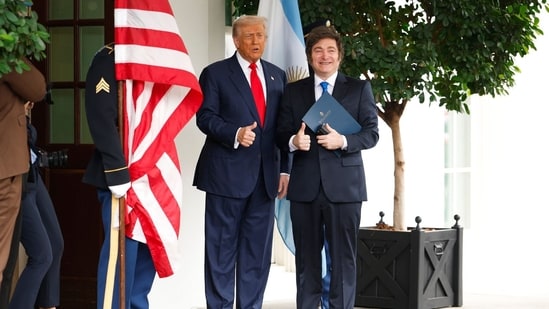
Colombia’s Abelardo de la Espriella is the 7th Trump-endorsed presidential winner in the region since 2024. Leaders such as Argentina’s Javier Milei, El Salvador’s Nayib Bukele, and Ecuador’s Daniel Noboa share Donald Trump’s priorities on cracking down on cartels and checking migration. In March 2026, the Trump administration attempted to formalise this affinity through the Shield of the Americas summit, where 12 Right-wing Latin American leaders were invited with an aim to consolidate existing security ties into a single hemispheric framework against organised crime.
However, there are limits to this strategy. Despite these attempts, Chinese imports from the region reached $146.9 billion in the first half of 2026, recording a 29.7% increase. China’s exports to Mexico also grew despite the United States-Mexico-Canada Agreement (USMCA) review, and the Asian nation’s trade with Venezuela remained consistent even after the US intervention. Peru’s China-owned Chancay port continues to grow, while Argentina approved incentives for Zijin Mining’s $709-million lithium project. China also retaliated against Panama by detaining Panamanian-flagged vessels.
The political gains for the US from its moves in the region must be similarly qualified. That support is driven mainly by domestic concerns over crime and migration rather than by any real opposition to Beijing, and most US-aligned leaders continue to court Chinese trade and investment even as they embrace Trump.
Also Read | South America is eradicating hunger
However, this alignment has not reached the public. Polling data suggests that trust in the US and President Trump in the region has worsened, while perceptions of China have remained stable. The US military actions in the region have drawn further criticism following the capture of Venezuelan President Nicolas Maduro in January 2026.
All that said, Washington’s immediate opportunity in Latin America cannot be ignored. A region led by likeminded leaders is more likely to grant favourable security and trade access, and growing US influence over strategic resources gives it long-term leverage. Whether this presence can eventually erode China’s economic gravity is a question that is yet to be answered.