
 E-Paper



South America is eradicating hunger
The share of people who are hungry has been decreasing faster in South America than anywhere else in the world


 Prefer HTon Google


The smell of grilled meat wafts through the shanty town of Guamá. Its riverside favelas are among Brazil’s poorest, but on a recent weekday residents cooked steak and shrimp on their porches. “Life isn’t easy,” says Alex Lima, a shopkeeper who sells coxinha pasties from his wooden house on stilts in the coffee-coloured water. Yet it is improving, fast.
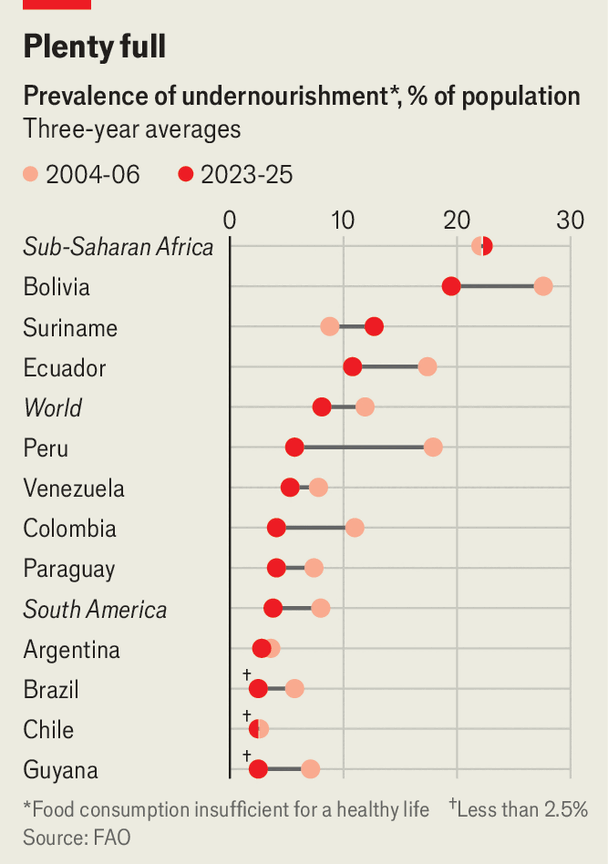
The share of people who are hungry has been decreasing faster in South America than anywhere else in the world. It is down by one-third since 2020, according to a report published on July 21st by the UN’s Food and Agriculture Organisation (FAO). Just 3.5% of people in the region consume insufficient calories, the lowest level recorded. Eliminating hunger by 2030 is one of the UN’s “sustainable-development” goals. “If there is a region in the world that can potentially achieve that, it’s South America,” says Máximo Torero, the FAO’s chief economist.
The continent has been here before. Hunger plummeted in the 2000s as a commodity boom lifted economic growth, allowing left-wing leaders to splurge on social programmes. In Venezuela Hugo Chávez created state-subsidised supermarkets. Argentina’s Néstor and Cristina Kirchner funded comedores populares (soup kitchens). Brazil’s Luiz Inácio Lula da Silva expanded credit for small-scale family farmers. The splurging worked, but when commodity prices fell in 2014, triggering recessions across the region, food insecurity shot up and stayed there. The pandemic made things worse. As unemployment surged it dragged swathes of the middle class into poverty and hunger.
Yet most countries have recovered. Brazil led the way. Lula, as the president is commonly known, made food security a priority when he returned to office in 2023. By 2025 Brazil had made it off the UN’s Hunger Map, which tracks countries where more than 2.5% of the population suffers from chronic hunger. Chile and oil-rich Guyana were also removed. Argentina is almost there at under 3%. Colombia and Paraguay are approaching at 4%, while Peru and crisis-battered Venezuela are making inroads near 5%. Even Ecuador and Bolivia have improved a tad, to 11% and 20% respectively. Only Suriname is moving in the wrong direction.
This decline rests on sturdier foundations. The first is macroeconomic stability. South America’s central banks are far more independent and adept at managing inflation than they were two decades ago. Its monetary officials were quick to lift interest rates aggressively during the pandemic, getting inflation under control faster than elsewhere. While covid-19 stimulus packages did swell public debt, subsequent governments have trimmed spending, too much of which can pump up inflation. Javier Milei’s shock therapy has yielded Argentina’s first primary surplus since 2008. Conservatives in Bolivia, Chile and Ecuador are also cutting spending. Newly elected right-wingers in Peru and Colombia pledge to do the same.
This eases pressure on grocery bills. Monthly food-price inflation in Argentina has slowed from a peak of almost 30% in 2023—among the world’s worst rates—to under 2% in June, lower than wage growth. Bolivia’s annual rate was 33% in November, when right-wing president Rodrigo Paz took office. It’s now running at around 13%. In Ecuador food inflation has turned negative while wages are stable. Alongside big oil reserves, fiscal discipline has buffered South America from the economic shock of the Iran war.
Yet groceries that become more affordable over time do little to help those too poor to buy enough food today. Social programmes are the other pillar of South America’s success in reducing hunger. Most famous is Brazil’s Bolsa Família, a cash-transfer programme which pays families a stipend if they vaccinate their children and send them to school. Lula has also raised Brazil’s minimum wage. “These are the core policies,” says José Graziano da Silva, a former boss of the FAO.
Such measures were standard in the 2000s, too. However, they have become more sophisticated, says Elisabetta Recine of Consea, the Brazilian government’s advisory council on food security. Bolsa Família has digitalised payments and linked them to broader social registries, reducing fraud and allowing quick payment (so that, for instance, it can now cover seasonal workers who dip in and out of poverty). Colombia has been experimenting with scrapping conditions on cash transfers for the poorest, whose children may not have a school to attend. Chile’s version includes job training.
Untouchable transfers
Cash-transfer schemes are wildly popular. Right-wing politicians have embraced them. Former Brazilian president Jair Bolsonaro tripled the average stipend from Bolsa Família while in office. Javier Milei doubled funding for food stamps after receiving criticism from the Catholic Church. Abelardo de la Espriella, Colombia’s populist right-wing president-elect, has vowed to shrink the state by 40%, yet claims, optimistically, that he will not touch social handouts.. Chilean arch-conservative José Antonio Kast has needed to invoke the spectre of drug crime in an effort to slash benefits, proposing a “vandals registry” that blocks those with a criminal record from receiving benefits and other state services.
Serious challenges remain. The biggest is climate change. With rising temperatures, plant pests and crop failures have become more common. The coming year looks especially fraught. The National Oceanic and Atmospheric Administration, a US government agency, says the coming cycle of the El Niño weather pattern will be “very strong”. That is the highest of the five categories used to rank the phenomenon, used for only the third time since 1950. “It’s going to aggravate every food problem,” says Carolina Trivelli, a former government minister in Peru.
That makes it a bad moment to fine-tune social schemes. Yet change is needed. Many countries struggle to wean recipients off cash-transfer programmes. A study found one-fifth of children who in 2005 were covered by Bolsa Família, were still covered as adults in 2024. What began as a relatively cheap and focused project in 2003 has ballooned. It now costs 1.5% of GDP and covers nearly a fifth of households. The current design is discouraging workers from joining the formal sector, according to a paper by Daniel Duque of the Getulio Vargas Foundation, a university in São Paulo. “There are more efficient ways to fight hunger,” he says.
Then there is diet. The shares of children who are overweight and adults who are obese have surged to record levels of close to 10% and 30% respectively, among the worst in the world. Adjusted for purchasing power, South America is the fourth most expensive place in the world to procure a healthy diet, after the Caribbean, North Africa and South-East Asia. Fruits and vegetables are surprisingly expensive for an area known for agriculture. That is because farmland is largely dedicated to commodities. When greens are produced, shabby roads and dodgy cold chains yank up costs. Cash-strapped consumers are more likely to reach for processed, calorie-dense products.
These are manageable problems. New technologies are helping farmers adapt to a changing climate. Policymakers in Bolivia, Brazil and Peru have quietly acknowledged that certain programmes need better targeting. Improved labelling of healthier food is gaining ground, as are sin taxes, says Juliana Tângari of Comida do Amanhã, a Brazilian think-tank. No food system will be perfect. Yet outright hunger may soon have rumbled its last in South America.
Sign up to El Boletín, our subscriber-only newsletter on Latin America, to understand the forces shaping a fascinating and complex region.


