Of the 16 women killed every day in India for dowry why has the death of Twisha Sharma on May 12 gripped us?
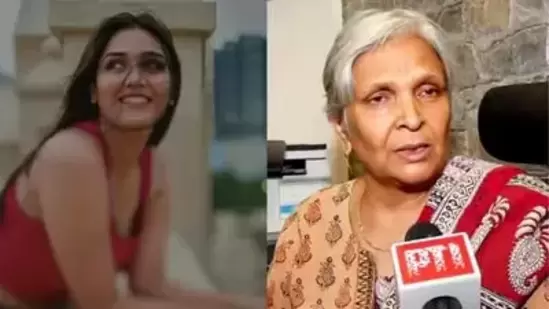
We don’t yet know whether she was murdered ( as her family claims) or died by suicide (as her husband and mother-in-law claim). So, what is it about this death?
I can think of several reasons, not the least of which are her mother-in-law Giribala Singh’s regressive comments in media interviews. Speaking dispassionately, the head of Bhopal’s consumer forum and retired district judge, has no shortage of complaints against the wife of her son, advocate Samarth Singh. These include, drug use and mental health issues; past sexual history and an abortion; failure to pray and forgetting to water the plants. Wait, what? Twisha’s body is in the morgue and the mother-in-law is whining about her plants not being watered?
If the purpose of the media interactions was to gain public sympathy, then the move has backfired. Far from showing anything remotely resembling grief at the death of her daughter-in-law, here is an elder woman dredging up various instances of “bad behaviour”, including her past relationships, forgetting conveniently to question whether her son had any.
There is something depressingly familiar about the character assassination of a just-dead daughter-in-law. Giribala Singh is making it clear that in life Twisha was never enough. And in death she is somehow still to be blamed.
{{/usCountry}}There is something depressingly familiar about the character assassination of a just-dead daughter-in-law. Giribala Singh is making it clear that in life Twisha was never enough. And in death she is somehow still to be blamed.
{{/usCountry}}That this backward attitude comes from an educated, articulate woman, a judge no less, makes the stereotype of the wily mother-in-law only more real. But Giribala is not a caricature from a TV serial. She comes across as a calculating, flesh and blood version, using the media to paint Twisha as a mentally unstable woman and an unsuitable daughter-in-law as though that somehow mitigates the possible role of the marital family in her death.
The interviews also make clear that the powerful and the connected have a different expectation of justice delivery. Singh was granted anticipatory bail on May 15, hours after an FIR was finally lodged, under sustained pressure from Twisha’s family three days after her death.
Her father has now released a list of 46 people, including judges and a CCTV technician who he says Giribala spoke to in the aftermath of Twisha’s death. He claims that Giribala was present during the post-mortem examination and “attempts were made to tamper with the facts.” Under court orders, a second post-mortem, as demanded by her family, will now be conducted by a team of doctors from AIIMS Delhi.
Solicitor general Tushar Mehta is opposing Giribala Singh’s bail and the Supreme Court will later today look at possible institutional bias and procedural lapses in the aftermath of Twisha’s death.
Finally, after dodging police for 10 days after the death of Twisha, her husband Samarth Singh, showed up in a court in Jabalpur on Friday and was handed over to Bhopal police for interrogation. The Bar Council has suspended his license to practice and Giribala Singh has reportedly been removed from her post as head of the consumer forum.
Portrait of a marriage
A 33-year-old model, actor and marketing executive Twisha Sharma met Samarth Singh in December 2024 on a dating app. A year later they were married. And five months later she was dead.
The Singhs claim she died by suicide; her family insists she was tortured by Samarth and his mother over dowry and then murdered. The distinction matters because the two charges carry significantly different sentences. Dowry death places a presumption of guilt on the husband and his family and carries a minimum sentence of seven years. Abetment to suicide allows far greater leeway for judicial discretion.
Going by Giribala’s interviews, there can be little doubt that the environment in the marital home was toxic. There is a secretly recorded audio tape of a conversation between Twisha’s brother, Major Harshit Sharma and Giribala Singh where she calls her daughter-in-law’s past relationships transactional and says “promiscuity can be a habit.”
A marriage in which the husband discusses his wife’s past sexual relationships with his mother, uses an ugly slur in Hindi to describe her and, then, instead of reprimanding her raja beta, the mother-in-law compares her to a prostitute is, under the definition of the Domestic Violence Act, a violent marriage. India’s Domestic Violence Act defines violence in not just physical terms but also in terms of mental and verbal cruelty.
Sixteen women die every day over dowry—5,737 reported deaths in 2024, according to the National Crime Records Bureau. In the same week that Twisha Sharma died, other reported dowry deaths included one from West Delhi’s Inderpuri where 28-year-old Veena Kumari fell off the roof of a three-storey building, minutes after she had called her sister begging to be saved.
In Patna a man allegedly set his former wife, her new in-laws and even his own three-year-old own child on fire, a fortnight after she remarried.
In Pune, a man who suspected his wife of having an affair beat her, poured acid on her genitals and stopped her from seeking medical help for days.
Dismantling dowry
As Twisha Sharma’s death shows, violence is not just physical. It is also emotional and verbal. It is the constant scrutiny of failing to meet some arbitrary standards of the marital house. It is the expectation that a daughter-in-law will not only move in with her husband’s family but unquestioningly adjust to their ways and demands. Like so many others before her, “A daughter’s desperate cry for help is responded to with ‘adjust’, ‘compromise’, or ‘save the marriage’,” says Audrey D’Mello, director of Majlis, a Mumbai-based legal centre for women and children facing sexual and domestic violence. “Girls are repeatedly sent back into abusive homes till one fine day, they are dead.”
Not enough is spoken about either dowry or the transactional nature of arranged marriages. Parents invest in a son’s education, the cost of which can be recovered at the time of his marriage. In states like Bihar, so-called rate cards determine a bridegroom’s price on the basis of his job and qualifications. “The custom survives because society sustains it,” says D’Mello.
Sixty-five years after dowry was made illegal in 1961, it not only persists but thrives. In a post-liberalised global world, trends—professional make-up artists, destination wedding, choreographed dances for social media—push up the price of getting married every year. Very often it is the bride’s family that is expected to pay.
Unlike the Big Fat Indian Wedding and its insatiable demand for dowry, domestic violence is a crime that we have chosen to invisibilise. Twenty years after the Domestic Violence Act, lack of training means that police and judges still fail to recognise it and still dismiss it as a private, family matter. It’s the same attitude that informs the government’s refusal to criminalise marital rape on the grounds that doing so would destroy the institution of marriage.
Perhaps the question to ask now that we have yet another dead body, is this institution in its current form worth saving?
The dowry battle will not be won piecemeal. It will be won when more and more of us begin to question what marriage in a modern society must look like.