
 E-Paper



Why short-termism is a recipe for disaster
News cycles are short. Public attention extends to the duration that a topic trends on social media. Even faced with the climate “comet”, many will look to sow confusion and discontent, saying the science is not clear

 Prefer HTon Google


The first global blockbuster of the season is Don’t Look Up, a movie on Netflix about the discovery of a comet on collision course with Earth and the attempts of the astronomers who made the discovery to get those in power to prevent a mass extinction event. The movie is satirical but has resonance with scientists whose warnings on the pandemic and the climate crisis have gone unheeded.
Could a comet wipe out life on Earth? In any given year, an extinction-causing comet colliding with Earth is a low probability, but a high-impact event. But the zone of habitability in which Earth exists now is not a permanent state. There have been two “Snowball Earth” events when the planet’s surface was almost completely frozen. Nascent life came precariously close to getting snuffed out. Over the course of Earth’s history, cataclysmic events of this nature will happen. And suffice it to say, we are not ready for them.
How can we be so sure that an uncertain future awaits the planet? We only need to look around in the solar system. Our nearest neighbours Venus and Mars had more Earth-like conditions in their early history too. What we have on Earth is special and won’t last forever. Life has had a good run of around four billion years on this planet. As the sun gets brighter, the Earth will heat up due to a runaway greenhouse effect. And then, 1 billion years from now, all life on this planet will become toast.
That may seem a long time away as humans face the climate crisis, mass extinction, and catastrophic ecosystem losses. And it is indeed distant because we are adept at finding large-scale ways of ravaging the planet. Just a few years ago, we were tearing a massive hole in the ozone layer and minutes away from nuclear annihilation.
We don’t have to look up in the sky to see ignored threats either. We can look down. There’s already another pandemic that we’re brushing off. I’m referring to the hidden pandemic of antibiotic-resistant superbugs.
For the past few decades, we have been using antibiotics indiscriminately. Unfortunately, bacteria are acquiring resistance faster than we can make antibiotics now. We are at the point that the last lines of defence don’t work against bacteria that swap resistance genes with one another. Just as we need vaccines for future pandemic threats that have not yet been identified, we need future antibiotics for the next generation of killer microbes.
A defence system against comets and asteroids would cost money, but might not be used. Similarly, we would need to create a medicine cabinet of antibiotics as insurance against future superbugs. It would require resources and planning, but in an ideal scenario might never be required. The problem is that short-termism is antithetical to hedging against low-probability events. So who will fund these projects?
News cycles are short. Public attention extends to the duration that a topic trends on social media. Politicians look to what they need to do to get elected or to stay in office. Companies look to their next earnings report and to bumping their stock price.
There’s a remarkably prescient passage by Carl Sagan in The Demon-Haunted World that I recall occasionally. “We’ve arranged a global civilization in which most crucial elements – transportation, communications, and all industries; agriculture, medicine, education, entertainment, protecting the environment; and even the key democratic institution of voting — profoundly depend on science and technology. We have also arranged things so that almost no one understands science and technology. This is a prescription for disaster.”
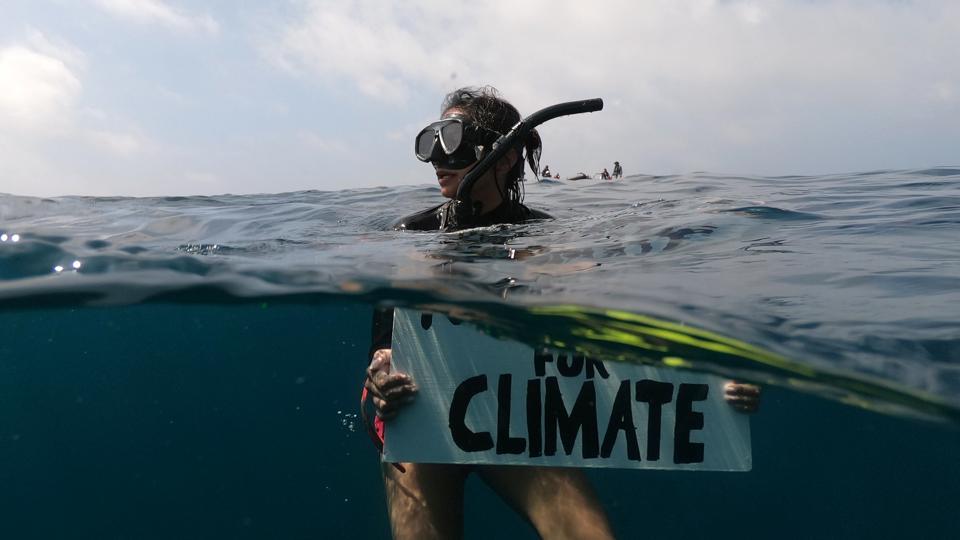
Here’s the deal with the climate crisis. Scientific and technological solutions already exist that can mitigate it. It is a political and social problem. It is a problem of economic inequality. It is a problem of willpower and short-term thinking.
Even faced with the climate “comet”, many will look to sow confusion and discontent, saying the science is not clear. This is the same playbook that tobacco companies used to convince the public that smoking was unrelated to cancer and that energy companies used to argue burning fossil fuels didn’t contribute to the climate crisis (even though in both cases, internal documents showed they knew otherwise).
Humans are tribal, which makes us require other human enemies. Yet, the climate crisis impacts the world and requires us to see beyond the narrow prism of naked self-interest. If storms and rising sea levels had been sent by another country, then we’d be up in arms protecting coastlines. If there was an Olympic game for conservation, we would be writing volumes about building infrastructure to compete with other nations in saving species.
Anirban Mahapatra, a scientist by training, is the author of Covid-19: Separating Fact From Fiction
The views expressed are personal


