
 E-Paper



Photos: Yayoi Kusama ‘Japan’s polka dot queen’ gets first museum in Tokyo
Japanese avant-garde artist Yayoi Kusuma, also hailed as the 'polka dot queen' is opening an eponymous museum in Tokyo's Shinjuku district that could only be hers. The exhibition opens to the public on October 1.
Updated on: Sep 28, 2017 1:22 PM IST

Share via


Copy link

1/9
 View Photos in a new improved layout
Updated on Sep 28, 2017 1:22 PM
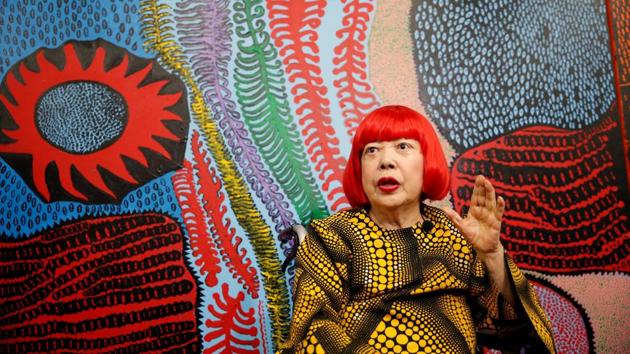
Japanese avant-garde artist Yayoi Kusama, known for her obsessive, dot-covered art and pumpkin motifs, as well as the use of mirrors to create mystical ‘Infinity Rooms’ is opening a museum in Tokyo that could only be hers. The 88-year-old, named the world’s most popular artist in 2014 by the Art Newspaper, said she had accomplished her ‘profound lifelong hope of having everyone be able to see my artwork’. (Toru Hanai / REUTERS)
2/9
 View Photos in a new improved layout
Updated on Sep 28, 2017 1:22 PM
A man views a Kusama exhibit ‘Infinity Mirrored Room - The Souls of a Million Light Years Away’ at the Hirshhorn Museum in Washington, US. Born in 1929 in central Japan’s Matsumoto, Kusama suffered from psychological trauma due to feuding parents and was already drawing dots and nets as a child, based on her hallucinatory experiences. She moved to the US aged 28 and spent 16 years in New York at the height of the sexual liberation movement. (Joshua Roberts / REUTERS)
3/9
 View Photos in a new improved layout
Updated on Sep 28, 2017 1:22 PM
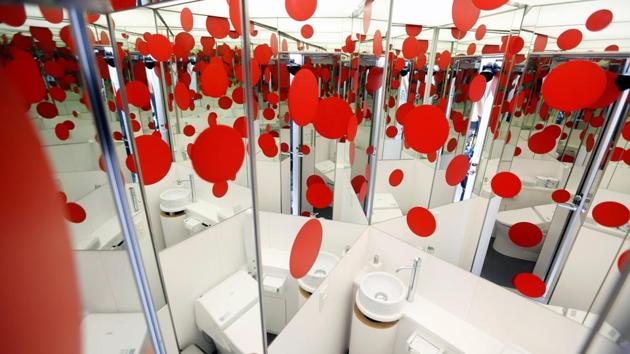
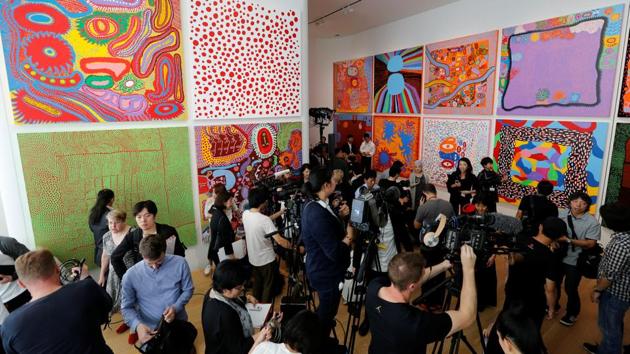
The first exhibition at the museum in Tokyo’s Shinjuku district features 45 works created between 2004 and 2017, including a series entitled ‘My Eternal Soul’. It includes a sparkly pumpkin statue, large paintings with meticulously replicated drawings of dots and eyes, and red polka dots on mirrors inside a toilet. Kusuma said in a statement she wanted visitors to ‘see and feel my philosophy towards life... all my love devoted to all beloved humans through a sincere, lifelong endeavour towards art.’ (Toru Hanai / REUTERS)
4/9
 View Photos in a new improved layout
Updated on Sep 28, 2017 1:22 PM
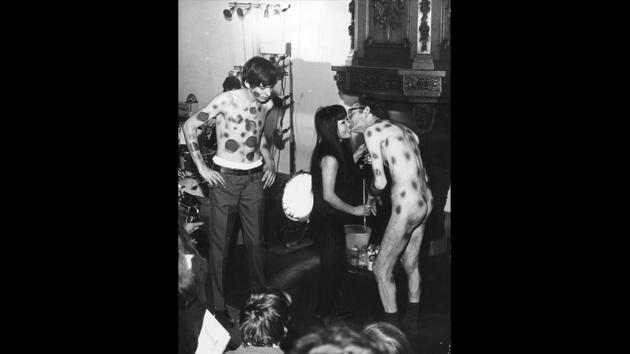
Kusama with two of her ‘works of art’. She painted naked bodies in an attempt to make them more beautiful. At this exhibition in Utrecht in June 1968, a man is painted all over, while another refused to remove his trousers. While in the US, Kusuma was a friend and contemporary to artists Andy Warhol, Frank Stella, Donald Judd and Joseph Cornell. She had undergone six years of Freudian analysis in New York but that the treatment stymied her creativity. (KeyStone Features / Getty Images)
5/9
 View Photos in a new improved layout
Updated on Sep 28, 2017 1:22 PM
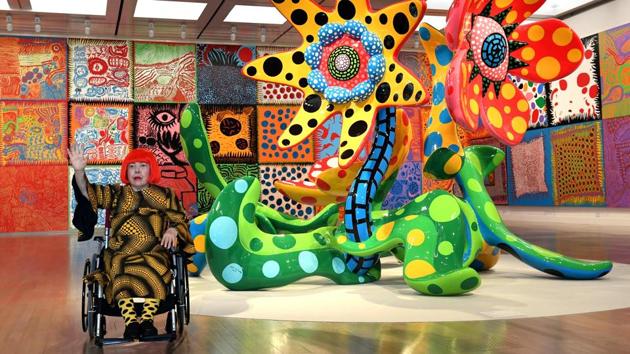
‘Ideas stopped coming out no matter what I painted or drew,’ she said, ‘because everything was coming out of my mouth’. she has said in an earlier interview.By the time Kusama returned to Japan in 1973, she was burned out and voluntarily checked into a psychiatric ward where she has lived ever since. (Toshifumi Kitamura / AFP)
6/9
 View Photos in a new improved layout
Updated on Sep 28, 2017 1:22 PM
It was not until the 1990s that Kusama was rediscovered. Her polka dots and pumpkins were a perfect fit for a highly commercialised art market, with collectors drawn to her instantly recognisable style. One of her signature mirror-lined rooms, with rows of yellow and black pumpkins reflected into infinity, is installed on the fourth floor. (Toru Hanai / REUTERS)
7/9
 View Photos in a new improved layout
Updated on Sep 28, 2017 1:22 PM
But the diminutive Kusama, one of whose paintings sold for $7.1 million in 2014 –close to the record for a living woman artist-- refuses to take it easy. ‘Even now, there isn’t a single day when I’m not painting,’ she told a small group of journalists, as completed canvases stood piled against the walls and spots of paint dot the gray wall-to-wall carpeting. Laid over two tables, a barely begun azure canvas bore lines of linked eyes in black paint. (Toru Hanai / REUTERS)
8/9
 View Photos in a new improved layout
Updated on Sep 28, 2017 1:22 PM
‘I still see hallucinations even now,’ said Kusama, wearing her trademark scarlet wig and an orange and black dress derived from her artwork. ‘Dots come flying everywhere - on my dress, the floor, things I’m carrying, throughout the house, the ceiling. And I paint them.’ The dots that have helped make her name are present throughout the museum, which opens on Oct 1 - including in the toilet, where mirrors amplify their impact. (Toru Hanai / REUTERS)
9/9
 View Photos in a new improved layout
Updated on Sep 28, 2017 1:22 PM


