
 E-Paper



77 unauthorised constructions identified as one of the reasons for Pune flash floods 2019 still stand
In a detailed post-mortem of the scenario in the aftermath of the devastating flash floods that killed 26 and destroyed property along the banks of the stream, it was found that illegal encroachments and unauthorised structures on, and along the stream, were a key factor in causing the flash floods.


One hundred mm of rain in two hours in September 2019 set the Ambil Odha up to burst its banks and overflow.
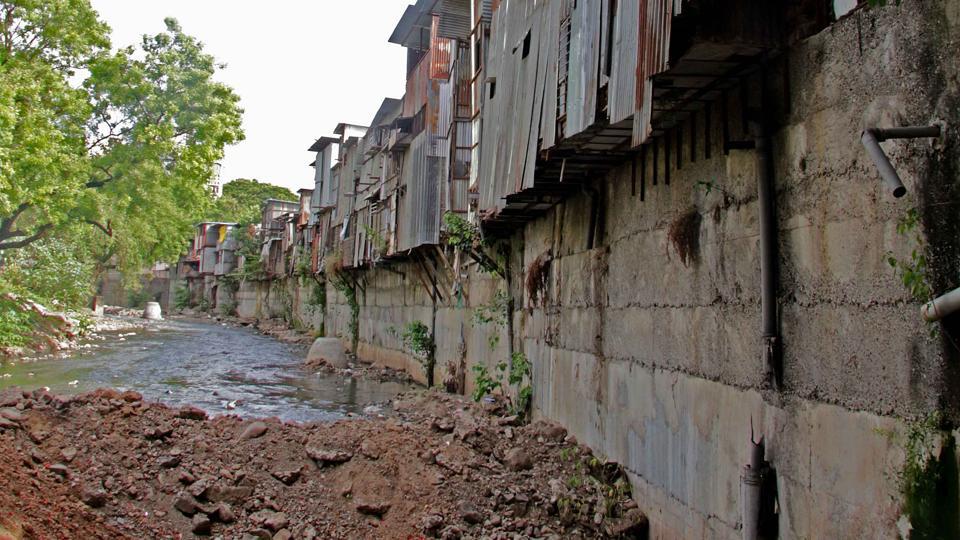
In a detailed post-mortem of the scenario in the aftermath of the devastating flash floods that killed 26 and destroyed property along the banks of the stream, it was found that illegal encroachments and unauthorised structures on, and along the stream, were a key factor in causing the flash floods.
Nine months later, the monsoon has arrived in the city, on schedule, and most unauthorised structures are still standing.
The situation, according to activists and local residents, is a perfect mix for inviting “havoc” again.
After the floods, which caused a loss of Rs 400 crore, Pune Municipal Corporation (PMC) appointed a private firm, Pri-Move, to survey the stream.
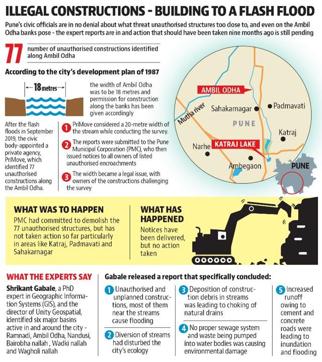
The firm identified 77 structures alongside the Ambil Odha which aggravated the floods.
A separate committee of environmental activists and residents then prepared a report pointing to specific unauthorised constructions that contributed to the floods.
Based on the Pri-Move report, the PMC served notices to all 77 unauthorised structures and razed 12 of them.
“We had served notices to the 77 unauthorised structures which surfaced in the report and 12 such structures have been demolished so far. Action has been taken based on the recommendations made in the report,” said PMC’s engineering superintendent Rajendra Raut.
Civic activists, however, questioned the PMC figure of 77 unauthorised structures along the Ambil Odha.
“This is definitely not an honest assessment as 77 is too low a number. The illegal tenements are linked to a deeper nexus, which makes effective action difficult,” said RTI activist Vijay Kumbhar.
Besides the PMC’s survey, a group of environmental activists independently surveyed a four-kilometre stretch, starting from Katraj lake till Sahakarnagar.
The group, known as ‘Bhavtal’, found that illegal encroachments along with garbage had choked drains that created a hindrance to the flow of water during the floods.
“Most illegal structures have been there for years and some of them were found to be the main obstacles to free flowing water,” said Abhijit Ghorpade, founder of Bhavtal, “Things cannot improve unless effective steps are taken for encroachment removal from the nallah beds by the PMC.”
Stream width the hurdle
The Pune development plan (DP) of 1987 states that the width of Ambil Odha is 18 metres and permission for construction was granted accordingly.
During its survey, Pri-Move considered the width of the stream as 20 metres, and used it as a baseline to calculate which structures were unauthorised.
“In 2020, the width used in the survey became a legal issue with the PMC finding it difficult to take action against illegal structures due to political pressure,” said a PMC official, requesting anonymity.
Civic chief Shekhar Gaikwad disagreed. “It’s not that PMC is not acting against unauthorised structures and illegal encroachments. We have already initiated the action before the monsoon; though because of the Covid pandemic now the focus has shifted. We plan to resume action once the Covid tide subsides,” said Gaikwad.
Ground reality
Local corporators are squarely blaming the civic body for the inaction, citing “corruption”.
The NCP’s Ashwini Kadam, corporator of Dhankawdi- Sahakarnagar, said, “It is the rampant corruption in PMC which has caused rolling back of tenders and inaction for the past one year against such structures. The monsoon has already set in and there is every possibility of flooding in the area.”
Residents of areas affected by the 2019 flash floods agree.
Shantanu Khilare, a resident of Gururaj Society in Sahakarnagar said, “These structures blocked the flow of water which led to the flooding of our residential societies. The PMC sat idle for an entire year and now the officials are saying that they are facing the Covid crisis.”
Dhananjay Gaikwad, a resident of the Dandekar bridge area claimed that the PMC cannot evict residents from the tenements as they had voter IDs and paid taxes. “Any action by the PMC against the slums will destroy their homes and livelihoods and lead to a humanitarian crisis,” Gaikwad said.


