
 E-Paper



Capital infusion is an important thrust area for defence,says Suresh Bhamre
He was speaking at a seminar on ‘Defence Industry Indigenisation’, jointly organised by defence-related website bharatshakti.in and MCCIA


Minister of State (MoS) for Defence Suresh Bhamre on Tuesday called for capital infusion in the defence industry as an important thrust area in the wake of the government committing huge resources on defence modernisation in the coming days.
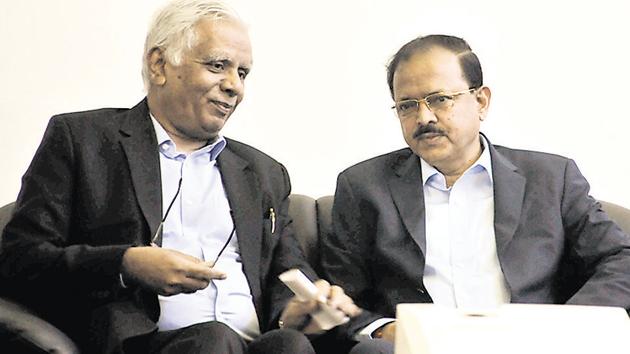
He was speaking at a seminar on ‘Defence Industry Indigenisation’, jointly organised by defence-related website bharatshakti.in and city-based Mahratta Chamber of Commerce, Industries & Agriculture (MCCIA), where industry leaders and officials from various defence organisations were present.Among those present were, Pradeep Bhargava, president, MCCIA; Nitin Gokhale, founder, bharatshakti.in; Prashant Girbane, director general, MCCIA and Baba Kalyani, chairman, Kalyani Group.
Sharing his views on defence industry indigenisation, Bhamre said, “ Those of you who are ready to invest in the sector have perhaps the best opportunity to get favourable returns on investments.”
Referring to production and marketing of defence equipment, he said, “The market is limited. Hence, a huge thrust is required to boost exports of your products. To be able to make a dent in the export market, we require quality equipment that is cost competitive. In fact, an equipment being inducted by the Indian Armed Forces acts as a substantial certification of your product’s quality.”
He noted that the defence sector has a few basic requirements such as sophistication in design and technology upgradation. He said, “The latest technology more often than not is not easily available. Hence he government, industry, research and development (R&D) establishments and the academia have to come together to evolve Indian technologies for the country’s requirements.” The minister further added, “ In terms of production and marketing of defence equipment, the market is limited. Hence a huge thrust is required to boost exports.”
While delivering the welcome address, Pradeep Bhargava, President, MCCIA said, “India always had an agenda of no private sector manufacturing for defence even as we imported a lot of equipment from private companies in other countries. This has slowly changed and today there are initiatives like Make in India and Start-up India which will help in defence industry indigenisation. It has to be understood that Indian industries have showed their remarkable potential in developing state of art technologies for various industries including India’s space industry. Hence, there is no reason why the industry should not contribute in the defence sector.”:
Sharing his views, Nitin Gokhale, founder, Bharatshakti.in said, “In the past few years, the government has brought in place several policies which aim at defence industry indigenisation. The Defence Procurement Procedure (DPP) has also been path-breaking in this regard. Yet what needs to be changed is the mindset of some of the decision makers, bureaucrats to make these policies operational.”
Gokhale said that presently there are ten countries who dominate defence manufacturing. “There are several countries who want to import basic defence equipment. India can look at this and increase its exports in this area.”
Indigenisation must become a national endeavour: Baba Kalyani
Baba Kalyani, chairman, Kalyani Group said, “During the end of 2014, Indian manufacturing had reduced to 15.5 per cent from 17 per cent which created a lot of turbulence in the ability to create jobs and technology. Hence, indigenisation needs to be a national endeavour.”
Speaking of how Pune can help in defence industry indigenisation, Kalyani said, “Pune is endowed with a huge amount of talent and has an ecosystem designed for defence R&D. Pune has nine of Defence Research and Development Organisation (DRDO) doing fabulous work in developing technology. Pune also has around 11 universities. Pune has an industry built by technocrats who understand the know-how and more importantly the know-why. Hence, Pune is a pot boiling with knowledge and technology and it can be used for producing anything.”
Speaking about Defence Production and Procurement (DPP), Kalyani said that DPP is path breaking and it gives a timeline of defence products to be made in India. He added that it is very important that the government follows DPP in its true spirit. Kalyani also emphasised that there is a need to have a national goal of creating a top-notch defence industry in India.


