
 E-Paper



Caretaker overcomes lockdown hurdles to look after destitute infants in Pune
Taking care of 46 infants at Shreevatsa Child Care Institute became an issue as the lockdown hampered the movement of its 70 caretakers


When the Covid-19 lockdown was clamped in Pune on March 25 along with the rest of the country, one of the establishments that was hit hard was Shreevatsa Child Care Institute which takes care of infant destitutes and abandoned babies.
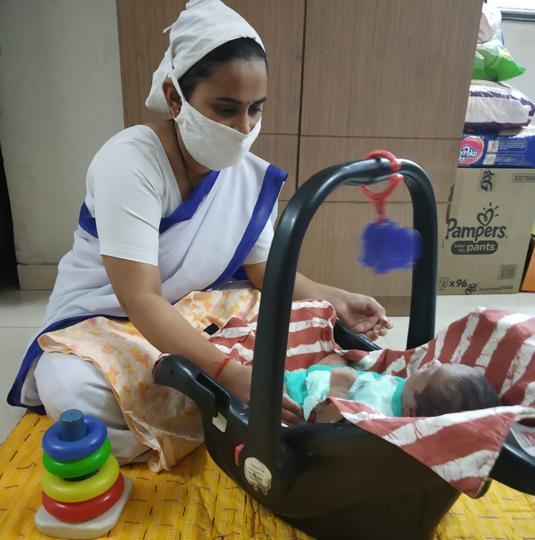
Located inside the premises of the government-run Sassoon General Hospital, Shreevatsa, run by the Society of Friends of Sassoon Hospital (Sofosh), had 46 infants in its custody at the time of the lockdown. Taking care of them became an issue as the lockdown hampered the movement of its 70 caretakers.
That is when Shalini Suresh Wadkar a 29-year-old caretaker with Shreevatsa, decided to stay at the itself rather than go home and be away from work. She was among the 25 caretakers who stayed at the child care centre for 15 days at a stretch.
Working at Shreevatsa for the last 10 years, Shalini, a mother of three children, began staying at the centre for 15 days and then going home for a week. She received full support from her family while adapting to this new, demanding schedule.
However, this was not just a job for Shalini who went out of her way to care for these children.
Recently when one of the new born babies had some health issues and needed to be hospitalised, this caretaker voluntarily came forward to stay with the baby in the hospital for 24 hours. “For the next one week she was with that baby in the hospital, just as a mother would have done, till it was cured and discharged. She would give me a daily report about the baby’s recovery,” said Sharmila Sayed, administration in-charge at Sofosh.
About this incident Shalini said it was on May 7 that this baby was admitted to a nearby private hospital and she immediately volunteered to stay with it. “I felt it was unsafe to leave the baby alone at the hospital,” she said. On one occasion when she was not allowed to go inside the neonatal intensive care unit (NICU) because she was not the mother, Shalini insisted that “she was as good as the baby’s mother and she wanted to go in like the other mothers who were being allowed inside.” Finally, the nurses relented and she was allowed.
“I just wanted my baby to recover fast and bring it back home to our centre,” she said.
Upon their return, both she and the baby had to stay in isolation for a week as they had returned from a hospital.
“During this period I would video-call my children and speak to them,” she said.
Sayed recalled that a year ago Shalini had given birth to her own baby. When she re-joined duty, she breast-fed not just her own chid but, with permission, also a premature baby at the centre.”
Hailing from a lower-middle-class family, Shalini is married to an autorickshaw driver who has lost his earnings due to the lockdown. The family is now solely dependent on her income with her husband and parents taking care of her three children when she is away at the child care centre.
“I have two daughters and a son at home and my family is very supportive of my work. Because of them I am able to stay at the centre and work round the clock for my other children who are at the child care centre. These children need us and we have a different bonding with them. When I am at the centre staying with them, I am completely immersed in my work as this also is my family,” she said.


