
 E-Paper



Maharashtra takes measures against spread of Kyasanur forest disease
Sawantwadi and Dodamarg in Sindhudurg district have come in contact with this disease


With six deaths in Karnataka during January due to the tick-borne infection Kyasanur Forest Disease (KFD), the neighbouring states of Maharashtra and Goa have taken precautionary steps to prevent the spread of the disease in their states.
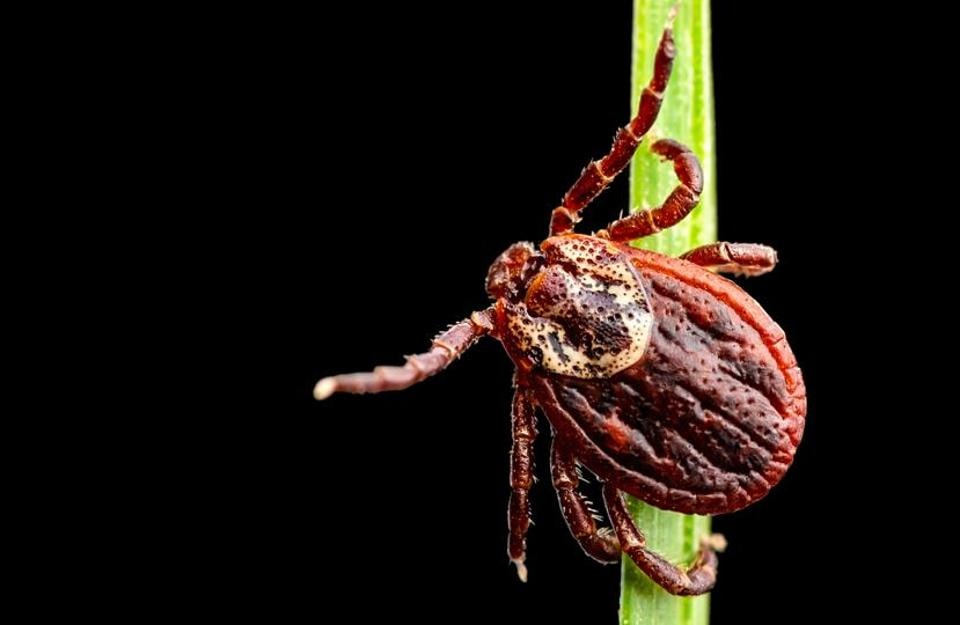
Maharashtra has ordered 77,800 vials of the KFD vaccine from Karnataka-based Virus Diagnostic Laboratories (VDL) as a precautionary measure, Dr Pradeep Vyas, principal secretary, Maharashtra Health Department, said.
In Maharashtra, Sindhudurg-Sawantwadi and Dodamarg have come in contact with this disease and according to Dr Pradeep Awate, director, epidemiology, Maharashtra health department, four positive cases have been recorded with 17 suspected cases of KFD in the state. In Karnataka, KFD has claimed at least six lives in January with around 20 cases reported so far, he said.
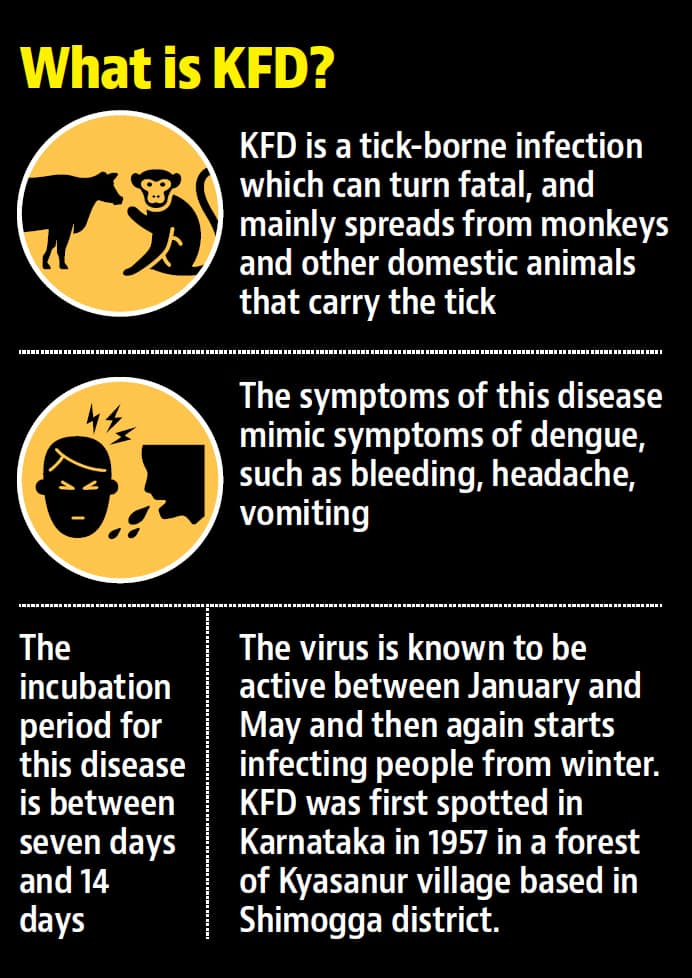
Goa has established a treatment facility at Goa Medical College, Bambolim. Dr A Khalipe, the district health officer (DHO) of Sindhudurg said, “The critical cases, if any, will be immediately shifted to the Goa-based Medical college as Sindhudurg is on the border with Goa.”
Dr Mahendra Jagtap, who heads the state entomology department said KFD was first seen in Maharashtra in 2016. Last year, around 13 deaths and 112 positive cases of KFD were reported in the state.
The Maharashtra health department has also ensured close coordination with the animal husbandry and forest departments.
“The animal husbandry department has been instructed to educate people about regular spraying of insecticide to keep the cattle and other domestic animals safe from the tick-borne infection and also to stock ivermectin injection to vaccinate domestic animals against the deadly haemorrhagic fever. We have also informed the Forest department to keep malithion spray handy and immediately destroy the carcass of any dead monkey if found in the affected areas. The Forest department has been asked to even declare the spot where the carcass is found as ‘hotspot’ and immediately spray malithion in around 50 metres to curb the spread of the infection among humans,” Dr Pradeep Awate, director, epidemiology, Maharashtra health department said.
The officials have also instructed the Forest department to announce monkey deaths so that these deaths can be recorded and reported. “This helps in knowing the exact status of the disease. The dead monkey’s carcass has ticks which are known to spread the infection and enters the village or taluka through grazing cattle. These ticks then bite humans giving way to the spread of the infection in humans. Hence it is important to not only report the number of monkey deaths but also dispose off the carcass very carefully. Till last year there were around 60 monkey deaths that were reported from Sindhudurg area,” Dr Awate said.
“The vaccination of the human population is important because we do not want the non-infected parts of the state to get exposure to this infection,” Dr Jagtap said, adding that if an infected person travels to other places there are chances that he could spread the disease.


