
 E-Paper



Campus connect: Pune’s Lalit Kala Kendra strives to keep ‘gurukuls’ alive
Ancient teacher-disciple tradition is being reinterpreted to ensure the post-modern ethos is relevant


Shivani Karmarkar, a first year Master’s student of Kathak at Lalit Kala Kendra, (centre of performing arts) of Savitribai Phule Pune University (SPPU) is getting ready for the next sequence of musical notes. She is at Nad-Roop, the dance institute of Shama Bhate on Tilak road.
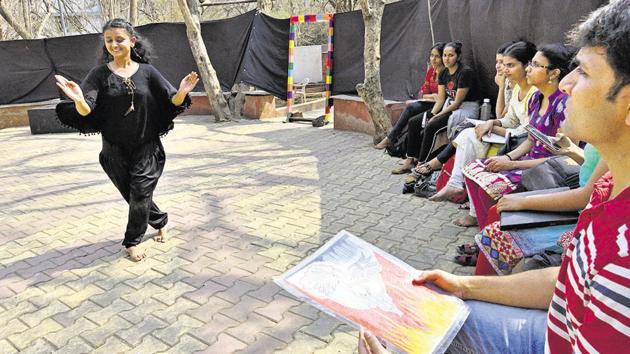
The course curriculum demands that she spend time with her dance teacher at her place (residence or workplace) and this is one of the reasons that Lalit Kala Kendra attracted her.
She has a bachelor’s degree in Psychology from SP College.
“I have been learning Kathak from childhood and I was always inclined to do my master’s in Kathak from Lalit Kala Kendra as the institution allows me to select a teacher of my choice,” says Karmarkar, who hails from Indore.
She is one of the many who have opted to be a part of the Gurukul system (traditional way of teaching), which has been combined with the modern education system at Lalit Kala Kendra.
“Gurukul is the indigenous education system of India where students spend a considerable number of years under the tutelage of a teacher. Gurukul has been in existence for the last 2,000 years,” says Praveen Bhole, head of department, Lalit Kala Kendra.
The kendra was started in 1988 by stalwarts like Pandit Bhimsen Joshi, Pandit Jitendra Abhisheki and Pandita Rohini Bhate. The trio proposed the idea of a dedicated performing arts department within the university running the Gurukul system, to the then vice-chancellor of SPPU, V G Bhide. Thus, Lalit Kala Kendra was born.
A special lecture called the ‘Setu Tasika’ is held for students who are new to performing arts.
The lecture is open to students of all branches of performing arts.
Under the ‘Setu Tasika’, students have an interactive session with teachers where they study the connection between other forms of arts and performing arts.
Poetry, painting, music compositions and dance choreography are part of the sessions.
“We are trying to bridge tradition and modern teaching methods. This college offers the student the choice of selecting their guru while most colleges have permanent faculty members,” says Parimal Phadke, dance teacher.
TESTIMONY
Dancer Shama Bhate has 12 students learning Kathak from her. “It has been 33 years since I started being associated with the institute. The system is well in place, thanks to visionaries, including Rohini Bhate. Performing arts should create students who are role models for others. The gurukul system increases the interest of students. The gurukul style has has succeeded as an ideal model,” says Bhate.
Bhate also shares her experience as to how she feels proud being part of Lalit Kala Kendra.
“I visit many universities across the globe and share details about how Lalit Kala Kendra is creating global students using the traditional gurukul system,” she says.
Students of Lalit Kala Kendra get to understand tradition and modern techniques, she adds.
Anuskha Banerjee is pursuing her MA. She holds a bachelor’s in Kathak from Bharti Vidyapeeth, but has falledn in love with the way the subject is taught to her at Lalit Kala Kendra. “The method of teaching is different. Our teacher through dance is teaching us the form, and more. Their teaching help us widen our horizons. I am very happy to be a part of the course,” Banerjee said.
Rutuja Pophale, an alumna of Bharti Vidyapeeth, is at Lalit Kala Kendra for her master’s in Bharatnatyam with Sucheta Chapekar as her guide.
“Learning from a teacher at her residence is a very different experience. It gives a different perspective to the whole learning process. It changes the way we look at the dance form, ” says Pophale.


