
 E-Paper



Startup Saturday: Ayurvedic pulse diagnosis procedure gets an artificial intelligence reading
Aniruddha Joshi , a computer scientist, digitises the way Ayurvedic doctors read your ‘nadi’, or pulse, and believes a big business beckons

 Prefer HTon Google


If you have ever been to an Ayurvedic doctor you will be familiar with what is known as ‘nadi’ reading. Ayurvedic doctors make their diagnosis based on the reading of the pulse at your wrist. “But strangely, though this is very important for diagnosis, out of the five lakh vaidyas in our country only about 500 doctors know how the ‘nadi’ is read,” says Joshi, founder of Atreya Innovations who developed a gadget called ‘nadi tarangini’, that uses artificial intelligence to read a pulse.
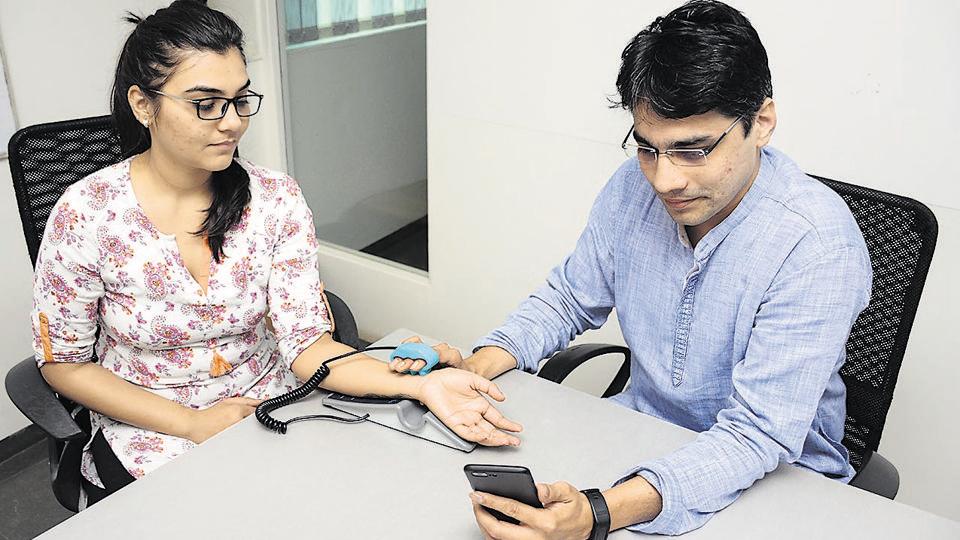
It would seem strange that a computer scientist is working with Ayurveda, but Joshi who did his PhD from IIT Mumbai has big plans. “Rishi Atreya was the man responsible for propagating Ayurveda and I want to be like him, except that I want to use technology to do so.” The idea to get into Ayurveda came from his father Dr Jeshtaraj B Joshi, a Padmavibhushan and former head of University department of chemical technology (UDCT).
In 2003, Joshi’s father had a neurological problem that was being treated by an allopath. “Someone recommended an Ayurvedic doctor from Pune and we believe it was his treatment that helped cure him. This set my father thinking. His field was fluid dynamics and he felt that the ‘nadi’ that Ayurvedic doctors feel to make a diagnosis, had some connection with fluid dynamics. He asked me to explore this angle.”
Joshi did his PhD in computer science and his thesis was ‘Acquisition and Analysis of Arterial Pulse’. He presented his thesis to Council of scientific & industrial research (CSIR), who gave him a grant of Rs 1.25 crore to develop a prototype. With this money and data from several Ayurvedic doctors he began his work of developing his idea into a product.
This involved several things, the major one being scouting for varied types of sensors. Joshi says, “There are sensors that use light energy, sound and pressure to get a pulse reading. I tried various permutations and combinations of these sensors to arrive at the Piezo sensor which uses pressure to give a reading. This was the closest to the way ‘nadi’ is read in Ayurveda.”
Getting the right kind of sensor was just one part of the job. The other part was to get a proper air gap between the pulse and the sensor. In 2008 Joshi had a prototype ready. And like all prototypes it needed to be tested. “I went to almost all Ayurvedic hospitals in the western region, from Bengaluru to Gujarat and got their feedback.” At the end of it he had data on about 25,000 ‘nadi’ readings.
Getting the design right
With his prototype, Joshi met Dr Valliathan a renowned cardiac surgeon. “He gave me a very valuable piece of advice. He said, make sure you get a good design for your product, for that is the reason most Indian innovations fail.” Taking this advice seriously, Joshi sought the help of Satish Gokhale of Design Directions. Satish agreed to help him and gave him a design that was perfect. ”I showed my ‘nadi tarangini’ (as it is now called) to Dr Raghunath Mashelkar and Dr Vijay Bhatkar and they were all very pleased with it.” Joshi was till then working with his co-guide for his PhD, Dr BD Kulkarni at NCL.
“I was offered a job at NCL as a scientist and my father was keen I take it up. But the entrepreneurship bug had got to me. I wanted to make a business out of ‘nadi tarangin’,” he says.
Starting out
In 2015, Joshi finally launched his company Atreya Innovations. With the grant he received from CSIR he had developed his prototype. From 2012 to 2014 he did his clinical trials and got a lot of input on how the reports of the naadi should look, what data it should capture and so on. He put his technological skills to use. “I developed an artificial intelligence tool that would be able to generate an automatic report card after a person’s ‘nadi’ was examined by this gadget. This did three things. One it helped visualise how a ‘nadi’ on the wrist would look on paper. Second, it gave an automatic report card that was based on input pattern recognition and machine-based learning. For the first time, your Ayurvedic doctor could talk to you in Syurvedic language using this report card.” Further work meant more money.
Funding
After Joshi had exhausted his grant he got lucky. An alumni from IIT Bombay found great value in his product and agreed to fund it. Though Joshicant reveal the amount, it was substantial for a seed fund. “This was given for scaling the business and marketing.” Along with scaling Joshi digitised other aspects of Ayurveda such as tongue, voice and face reading, all aspects that help Ayurvedic doctors make a diagnosis. Though Joshi had received seed funding he feels he made a few mistakes at the time.
“ Though I formed the company in 2015 I launched my product only in 2017. This was a mistake because I think a product is never perfect. You have to keep improving it. An entrepreneur will make a product based on what s/he feels a customer needs. It is only after s/he launches it and goes into the market will he get better insights into what the customer wants out of your product. I should have launched my product early in 2015 and developed it along the way,” he says.
“The second thing I learnt is that I should have got a partner in earlier. I did try, but could not find one who was on the same wavelength as me. Now of course I have one. The third insight I got was related to pricing. When we launched, we had offered it on a pay-per-use basis. We realised that doctors did not want to do that. They preferred to buy the product outright rather than pay every time they used it. After six months we changed our pricing model,” he explains.
Giving away equity
“I will need more funds by mid 2019 and will again go in for equity funding. Though there are some who view equity funding differently, I think it is a very good thing. I am absolutely happy giving away my equity. The thing about equity funding is that it makes you very efficient. Investors of course want to make 10X or 20X out of your business and want to monetise their exits. But as they do this, they also help you. My investor helped me find the right people for the job, connected me to the right HR consultants and that’s how I built my team of 15 people today. Investors keep the pressure on you which helps you become more efficient. They also make the right connections for you. If that costs some equity, so be it.”
Marketing
“Though I launched my product in 2017 I had begin work much earlier. From 2004 to 2008 I had worked on my sensors and got it ready. When we were ready to go to market I felt that the traditional way would be the best. That’s because ours is a touch and feel product. I could not call and ask people to buy it. My sales team of five people would go to every conference, symposium, colleges, doctors and even the Ayush ministry to market the ‘nadi taranigini’.
“The market is very small. I am charging a premium for it, Rs 45,000 per gadget, but people are happy. So far I have sold 300 pieces in the one year since we began,” he says.
The response so far has been good. Says Joshi, “My customer really is the patient. When they see the ‘nadi’ readings they feel more reassured. One doctor told me how his patient brought her whole family to him after seeing the ‘nadi’ report.”
The future
His plans for the future are big. “I plan to launch various apps in the next five years to reach out to a million people.” These apps will be based on Ayurveda, Homeopathy and traditional medicine”
Joshi has developed an app that can give an analysis of your tongue. “Ayurveda can tell about your digestive health by seeing your tongue. I have an app where you take a selfie of your tongue and post it. It will give you a reading that can tell you how your digestive system is working. This we are doing so that we can get more people into looking at Ayurveda as an alternative. On the app itself you can then connect with our ‘nadi taranigini’ doctors,” he says. He plans to launch this app at the World Ayurveda Congress to be held in Ahmedabad on December 14, 2018. He will later add other apps such as voice and face to give further readings about your health. As his tag line says “to make a healthier you”.


