
 E-Paper



By the way: Dying for Swachh Bharat
Of all of the Messiah’s gimmicks, the one that has caught our everyday attention the most is the Swachh Bharat Abhiyan. Clean our beloved India, says he, Supreme Leader of the Satvik Republic.

 Prefer HTon Google


Of all of the Messiah’s gimmicks, the one that has caught our everyday attention the most is the Swachh Bharat Abhiyan. Clean our beloved India, says he, Supreme Leader of the Satvik Republic. Who will do it, saheb? Everyone must fight this war on garbage, he declares. That’s the patriotic thing to do too, we understand. So, we diligently keep toffee wrappers in our pockets until we find a waste-bin. We tell others not to litter too, of course. We are good soldiers.
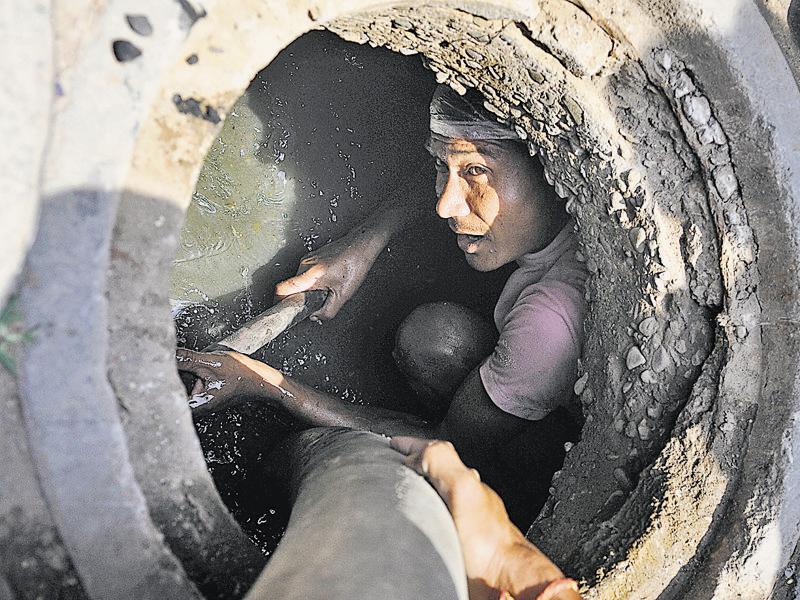
Jitender, in that sense, was one of the frontline combatants. Jitender, who? Shame on you for asking! He was the sewerman who died last month of poisonous gases from a gutter that he was cleaning in that aberration called Hallomajra in the City Already-Beautiful, Chandigarh. He died a valiant death. A true martyr, I say. It’s only a matter of detail that he lacked the equipment to fight the good fight. He did not care for his safety, so the authorities let this brave man go ahead anyway.
He was not the first such son of the soil. Before him, the roll of honour has names of Ashraf, Dhan Singh and Prem Pal, who died of suffocation while cleaning a sewer line in Sector 47 in May last year. And before them there was Satbir, who died of the same reason in the August of 2014, sadly just two months before He Who Will Make India Great Again formally gave us the Clean India Mission, a life goal, on the birth anniversary of He Who (Allegedly) Gave Us Independence.
Read: Sewerman’s death has UT admn, contractor throwing up muck
The Fantastic Fuehrer, however, does not believe in cosmetic change alone. That is why the physical appearance of the sanitation workers remains the way it has been for centuries. It is important in essence, and in reality, that the workers look no different from the usual citizens. A uniform, gas mask, protective jacket, and proper tools will make them stand out; and everyone else will think Swachh Bharat is only those guys’ duty. In a democracy, that is just not done. ‘Sabka Sath, Sabka Vikas’, collective development, is our motto.
Take the case of Chandigarh. How can only 2,700-odd sweepers clean all corners of the city? You cannot always put up bamboo facades to cover up the muck, as was done for Hallomajra when the French President had come to meet the Messiah. Of these sweepers, nearly half are under private contractors, not government employees. There are just 73 technically-trained sanitation employees, including 53 sewer men. Those on contract are supposed to get a minimum of Rs 8,554 a month as per rules, while the government-employed get a starting pay of around Rs 15,000. Some have been on contract for decades, awaiting regular jobs. Bravery, usually, does not come at such a price. The government understands that, after every death; and commendably announces money as compensation for life. That has gone up from Rs 2 lakh per fatality, to Rs 10 lakh now, as in the case of Shaheed Jitender.
Mayor Arun Sood also ordered that until and unless all the safety gear is available, no person will be asked to go down the hole to clean it.
A deadline of June 30 has been set to procure the equipment. By September 30, the MC plans to mechanise the cleaning of the sewers so that it is not done manually. “Also, if a sewer has to be cleaned manually in any emergency, a junior engineer (JE) will be there throughout, for supervision,” the mayor was quoted as saying. When Jitender died, there was reportedly an executive engineer (XEN) of the MC present there; but he fled. I am sure he had some other place to clean. Swachh Bharat is bigger than individuals, we’ve been told.
Some people just don’t get it, man. An anti-national element on Facebook described Jitender as a casualty of the high-decibel, headline-grabbing war that politics has been reduced to. He is so wrong. What do such people want? That Emperor Modi should come and declare Jitender a martyr, formally. He would have done it, you never know. But where’s the time? He is busy cleaning India.


