
 E-Paper



Heavy rainfall brings misery for farmers in Punjab
Apart from paddy, the rain is not good for other kharif crops – cotton, maize and sugarcane — as well.


The ongoing heavy spell of rain across Punjab a week before the start of procurement from October 1 has reportedly done considerable damage to the paddy crop.
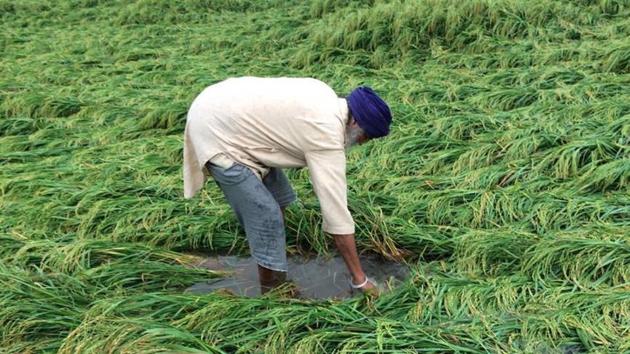
Apart from paddy, the rain is not good for other kharif crops – cotton, maize and sugarcane — as well.
“Cotton sown over 2.84-lakh hectares is worst affected because waterlogging in fields stops aeration, damaging the entire plant beyond repair,” says agriculture director JS Bains.
Paddy is sown over 30.42-lakh hectares in Punjab, of which 5.25-lakh hectares are under basmati cultivation.
Despite a rain alert and advisory to farmers, Bains said the widespread rains have played a spoiler to the kharif crops due to waterlogging.
He said the directorate had projected a bumper paddy crop (190-200 lakh tonne) in Punjab this season.
“55 to 180-mm rain was reported in all 22 districts, and crop is at a maturing stage. Now, the farmers will face problems during procurement as moisture level most likely will exceed the permissible limit of 17%. It will also lead to discolouration,” he said.
He said reports of lodging of paddy have come from some pockets in Ludhiana, Sangrur and Amritsar.
A senior official of Food corporation of India on condition of anonymity said the corporation was monitoring the situation, but, so far, there is no move to relax the procurement norms for discolouration and moisture content.
In two days, highest rainfall of 180mm was recorded in Hoshiarpur district which has 60% of the state’s total area (1.24 lakh hectare) under maize crop. Jalandhar and Ropar districts, where vast chunks are under sugarcane crop, witnessed 135 mm and 123 mm rainfall, respectively.
“We are monitoring the situation, and the staff of agriculture department has been asked to keep a close watch. If there are adverse reports, we may take help of revenue department to assess the damage,” additional chief secretary (development) Vishavjeet Khanna told HT.
1509 basmati variety worst hit
At least 2-lakh tonne of 1509 premium basmati paddy has already been harvested and stacked in purchase centres in Amritsar, Tarn Taran and Gurdaspur districts of Majha and Patiala of Malwa.
Ashok Sethi, director of basmati exporters’ association, said before the rain, the moisture content in the harvested premium variety of basmati was 25% and now the moisture will shoot up to 50% and it will make crop unsaleable.
“It is a crisis situation for basmati growers as crop will take many days to dry up,” he said, adding the 35% of total 1.24-lakh hectares of premium crop is 1509. As per his assessment, 25% crop of 1509 variety will suffer an irreparable damage.
Crop flattened, farmers fear sheath blight attack on paddy
With heavy rain flattening the paddy crop in many areas of the state, threat of sheath blight — a fungal disease — looms large.
The threat of the disease is an addition to the misery of farmers who are already staring at losses due to delay in harvesting of the crop. Agriculture experts say stagnant water in the paddy fields is not good for the crop and sheath blight could attack the crop if the rain persists.
“Apart from the threat of sheath blight attack, constant rain accompanied by strong winds lead to flattening of the near-mature crop,” Resham Singh, agriculture development officer (ADO), Kapurthala, said.
He said farmers usually start harvesting paddy crop at the beginning of the October, but due to rain, the may get delayed by at least 10 to 15 days.
A farmer from Kapurthala, Kuldeep Singh, who has paddy sown on 280 acres, said that 35 per cent of the crop has been flattened. “If the rain doesn’t stop, the farmers will have to suffer huge losses,” he said.
Jaswinder Kumar, agriculture development officer (ADO), Jalandhar, said the rain will also affect the quality of the crop by increasing the moisture content in the paddy and causing discolouration.
“We have already received reports of lodging of standing crop and also sheath blight in some villages. So far, the damage is not much but if the rain won’t stop, losses can be huge,” he said.
Japneet Singh, a farmer from Hoshiarpur, said the current spell of rain was not a good news as dry weather is good ahead of harvesting.


