
 E-Paper



Wildbuzz: Cape of emerald
The dazed turtles took refuge in the emerald ponds but face an uncertain future as the water bodies are heavily polluted with sewerage, household wash and detergents/soap draining into them from Kansal.


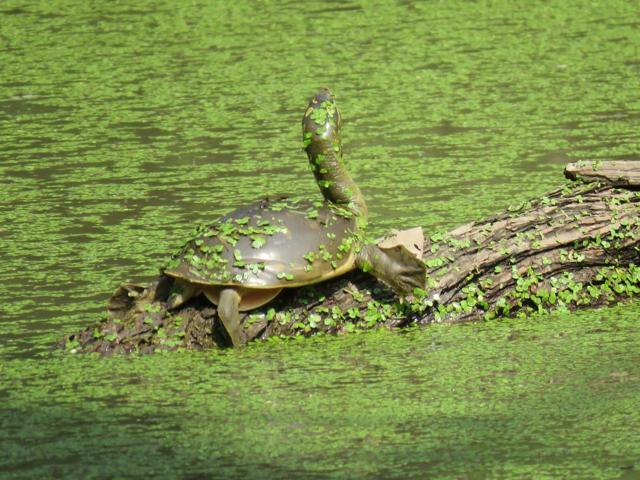
Heavy rains have swept in their gradient run a contingent of Indian Flap-shell turtles to the City Forests/Nagar Van. The dazed turtles took refuge in the emerald ponds but face an uncertain future as the water bodies are heavily polluted with sewerage, household wash and detergents/soap draining into them from Kansal. Pollution carried nutrients that fostered a stifling, emerald algal bloom on water and restricted underwater vegetation.
The UT Forest and Wildlife Department’s solution for pollution – a much-publicised traditional filter using husk, grasses, boulders etc – succeeded partially. The contaminated water stinks hard on occasion and led to the death of an estimated 25,000 Golden carp seed out of two lakh seed of four fish species introduced recently. A worried department proposed aerators for water bodies to boost oxygen levels but these, too, will not fully defuse pollution. A fresh water source for Nagar Van is the preferred option for future biodiversity health and enticing diverse wild species for easy view by the public in the heart of the city.
Concerned over the turtles, I sought counsel of India’s leading, award-winning turtle conservationists, Dr. Shailendra Singh and Rupali Ghosh, of Turtle Survival Alliance. Both reassured me that this turtle species is a highly-adaptive one and can go months without water and food. “This turtle can live in polluted waters with high levels of toxins but can die if expired medicines are immersed in water,” Dr. Singh told this writer.
There is a complication. The turtle is predominantly carnivorous, and eats small fish, crustaceans, earthworms, carrion and decaying fruits. Contaminated water bodies may not support a prey base to ensure the turtle’s long-run sustainability. In that case, the experts advised, the turtles can be left at Nagar Van this winter and after that, caught and translocated to freshwater.
The Sukhna lake, its backwaters and feeder nallahs could be an option for rehabilitation of Nagar Van turtles as these fresh waterbodies harbour a breeding population of this species.
#MeToo, says nature
The subaltern view of humans trampling upon Nature finds originality and sparkle in cartoon wit. A popular cartoon by American artist, Doug Pike, and titled ‘Bear with Me’, depicts two bears who set up a hunter’s camp. After displaying masterly stalking and marksmanship skills (worthy of a Jim Corbett!), the bear shikaris kill a human hunter. The shikaris proceed to relish human meat to the accompaniment of wine and a contemptuous scattering of the hunter’s mangled gun and bones around the camp. One bear reminds the other (with the flourish of a wine connoisseur, well versed with fine dining practises!) that the flesh of fishermen is best downed with white wine while that of hunters with red wine! Cheers!
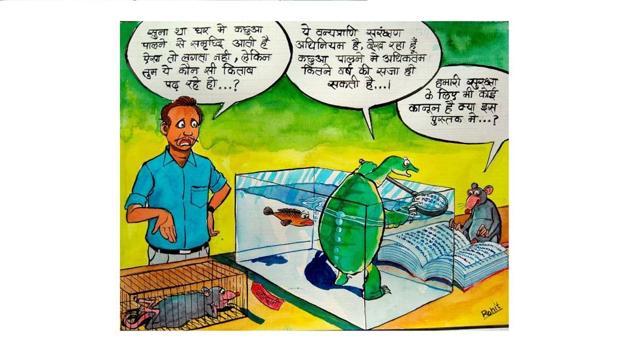
India’s own such cartoonist, Rohit K. Shukla, is a humble forest guard in the Seoni forest division of Madhya Pradesh. A sensitive artist, Shukla’s artwork speaks aloud the proverbial worm’s point of view. In the accompanying cartoon, the human owner of a captive turtle is mystified. The turtle has not brought him wealth and success as promised by quacks but the prisoner seems to have turned a voracious reader (like an imprisoned Bhagat Singh!). “What are you reading”, asks the human?
Shukla shows the turtle poring over the text of the Wildlife (Protection) Act, 1972, and replying to the puzzled jailor that he/she is ascertaining the maximum imprisonment invited by keeping turtles captive!
A humble, illiterate rodent, whose mate is shown caught in a trap by the human, asks the wise, aware turtle if laws have some protection for them, too.
vjswild1@gmail.com


