
 E-Paper



More power to spend
Indians will now be left with more disposable income, but would it be enough for them to buy a house or service their home loans?


Does the maiden Budget presented by finance minister Arun Jaitley motivate you to buy a house? Probably it will if you’re a first-time homebuyer sitting on the fence for a couple of years, undecided on how to bear the burden of high inflation or service a loan in an ever-increasing interest rate regime.

For the record, some of the tax benefits proposed in the budget include raising of tax exemption limit from Rs. 2 lakh to Rs. 2.5 lakh. This will go a long way in enhancing household savings. Additionally, the limit on home loan interest has been increased from Rs. 1.5 lakh to Rs. 2 lakh and third, the exemption limit for investments by individuals in financial instruments has been increased from Rs. 1 lakh to Rs. 1.5 lakh. Therefore, increased savings coupled with an increased tax benefit may go a long way in motivating homebuyers to purchase a house.
According to Neeraj Bansal, partner and head of real estate and construction, KPMG in India, availability of a cheaper loan coupled with increase in income tax deduction on housing loan interest by Rs. 50,000 should boost demand and certainly help revive the sale of housing units in the country. The housing sector could witness a moderate surge in its quarterly absorption rate of about 40,000-50,000 units in the short term. However, certain factors such as high inventory of unsold flats (about 3 lakh units), high property prices and high interest rates would keep a check on the sales. The marginal increase in disposable income in the hands of individuals as basic exemption limits and deduction under Section 80C (raised by Rs. 50,000 each), should further enhance flow of funds into the sector from individual savings.
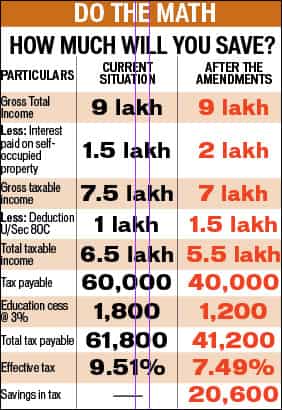
This is what the cumulative effect on your savings will be like (See box). If you earn Rs. 9 lakh a year and are availing of all the three major exemptions, you will end up saving about Rs. 20,600 on an annual basis. You will now not only have more money at your disposal, you will also be eligible for a higher home loan as your total tax payable will now be Rs. 41,200 compared to Rs. 61,800 under the previous tax regime.
Enhancement in the exemption limit coupled with increase in the exemption under Section 80C and home loan interest will increase spending power in the hands of individuals and also make home loans more tax effective. These measures should boost demand in the housing sector and encourage individuals to channelise their savings/increase in personal disposable income towards owning their own house rather than spending in non-productive assets such as gold etc, adds Gaurav Karnik, tax partner-real estate practice, Ernst and Young.
Getamber Anand, president (elect), CREDAI and CMD, ATS Group, says that the sector appreciates the budget, especially the increase in the limit of the income tax rebate on housing from Rs. 1.5 lakh to Rs. 2 lakh...All in all, it’s a good budget and we’ll give it a 7 on 10 and hope to interact more and more with the finance minister in the direction of achieving the goal of housing to all by 2022.”
Income tax deduction limit
Limit on interest on loans
Income tax exemption
What the budget lacks


