
 E-Paper



A new technique can turn a woman’s skin cells into eggs
But improved fertility treatment is still far away


 Prefer HTon Google


MANY COUPLES struggle to conceive. In vitro fertilisation (IVF) can help some, but if the woman has no usable eggs to fertilise, they must either give up or use an egg donor. Researchers have therefore worked for years to create eggs for women who lack them. So far they have succeeded only in mice, but that could be about to change. In a paper just published in Nature Communications, a group of researchers report they have—albeit imperfectly—created fertilisable human eggs from skin cells.
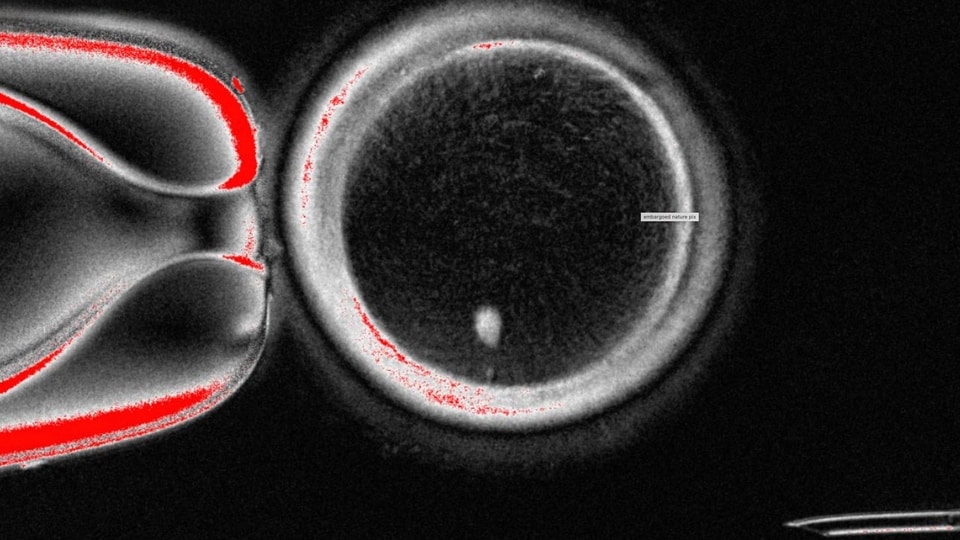
Previous efforts focused on in vitro gametogenesis (IVG). This transforms skin cells into stem cells, which can then turn into other sorts of cells. But transforming stem cells into egg cells is particularly complicated. A team led by Shoukhrat Mitalipov from the Oregon Health & Science University have therefore revived another approach: the somatic-cell nuclear transfer (SCNT) method used to create Dolly the sheep. But they have added a twist.
First, they obtained egg cells from volunteers and removed their nuclei. They then harvested skin cells from other volunteers, cultured them and let individual cells from the culture fuse with the de-nucleated eggs.
Had they sought to clone the skin-cell donors—which they did not, not least because it would be illegal in most countries—they could now have nudged the re-nucleated eggs to become embryos. But infertile couples want to have babies together, not clone themselves. That presents a technical hurdle. Most human cells have 46 chromosomes, but eggs and sperm have only 23, so that when they fuse, the resulting embryo will have the correct number of chromosomes overall. The skin nuclei that went into the eggs delivered 46 chromosomes, leaving no room for any genetic material from a sperm.
Dr Mitalipov’s team therefore needed to jettison half the implanted chromosomes. They did so by hijacking the process of cell division, which takes place in one of two ways, meiosis and mitosis. Meiosis, which happens in cells that give rise to sperm and eggs, produces cells with 23 chromosomes. Mitosis, which occurs in all other cells, imparts 46—achieved by first doubling the number of chromosomes in a cell, and then divvying them up between two identical daughter cells.
By using the skin cells’ nuclei right before the chromosome doubling, and then making them divide early once inside the eggs, Dr Mitalipov’s team managed to initiate what they call mitomeiosis—a kind of cell division that forces nuclei which would normally undergo mitosis to produce the 23 chromosomes required for a fertilisable egg. They created 82 SCNT eggs this way, and fertilised these with sperm. Five went on to the stage of embryonic development known as a blastocyst before the experiment was terminated.
It is “a remarkable achievement”, says Evelyn Telfer, a reproductive biologist at the University of Edinburgh, but there is a long way to go before this kind of process could be used for human reproduction. For one thing, most of the eggs involved did not develop—a problem considering the method relies on egg cells taken from donors, a complex and invasive procedure.
A bigger issue, argues Tony Perry of the University of Bath, is that Dr Mitalipov’s team had no control over how the chromosome number was reduced. Embryos must have the correct pairing between chromosomes, as well as the correct number. There must be one pair of chromosome 1, one pair of chromosome 2 and so forth. But, says Dr Mitalipov, “our system kind of makes errors” in that pairing. On average only about half the pairs match up, he says.
That is top of his list to fix. His team is studying exactly what happens during meiosis, so that they can recapitulate it in mitomeiosis. This is one reason why he says offering the new procedure to childless couples is still a far-off vision. Like all reproductive treatments, it will also require years of public discussion to pin down ethical questions such as who should be eligible and what to do with surplus embryos.
Whether eggs from skin become a reality, and whether stem cells or SCNT will prove the more effective approach, remain to be seen. Despite years of research huge gaps remain in understanding of human reproduction. But there is no lack of enthusiasm. At least one (secretive) startup, called Conception Bio, is pursuing IVG. Hayashi Katsuhiko, a geneticist from the University of Osaka and a pioneer of the stem-cell approach, recently said that researching how to make eggs has started to feel “like being in a race”. With two competing approaches, it does appear that way—even if the finish line is not yet in sight.


