
 E-Paper



Satellites get a new type of armour
Composite tiles, fabrics and foams may bring effective shielding from orbital debris


 Prefer HTon Google


HURTLING AROUND Earth at roughly seven kilometres a second, even tiny pieces of debris pack quite a punch. Such manmade junk poses a far greater threat to satellites circling in low orbits than natural space rocks do—and the risks are rising. According to the European Space Agency, the amount of rubbish in orbit has more than doubled since 2017.
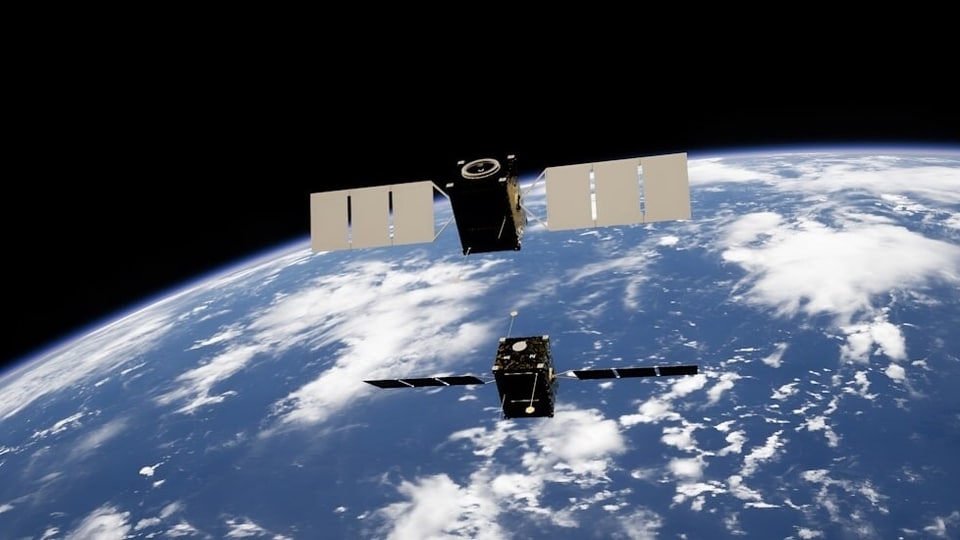
Roughly one small satellite in five stops working within a year of launch, estimates a study published in 2021, and in three-fifths of these cases operators do not know what happened. The smart money is on quite a few such failures being caused by collisions with space debris. To provide more data Odin Space, a firm based in Santa Ana, California, has begun selling a system that uses vibration-sensing adhesive strips to detect and assess impacts. The results should help settle bets on the best shielding for a given orbit.
One longstanding approach to protecting satellites is a Whipple shield—a two-stage affair which places an outlying bumper a few centimetres above a main shield, both of which are typically made of aluminium. The bumper breaks an incoming object into a spray of smaller, less energetic fragments that the main shield can then stop more easily. But this arrangement is bulky and heavy. Most satellites, therefore, simply take their chances behind aluminium panels stiffened with honeycomb, also made of that metal, which offer little protection from debris.
Yet the range of options for protecting satellites is increasing. One of the alternatives on offer is composite tiles. Atomic-6, a firm near Atlanta, is developing these under the brand name Space Armor. It is cagey about the materials involved, but the resulting tiles are hand-sized, 2.5cm thick and weigh about as much as an iPhone. In tests, they successfully stop aluminium projectiles the size of a pea accelerated by a gas gun to 7.2km a second. Moreover, unlike Whipple shields, they throw off no shrapnel that could become someone else’s problem, says Trevor Smith, Atomic-6’s boss. Instead, incoming metal objects (and much space junk is metallic) are vapourised and absorbed by the shielding.
Other types of shielding are also advancing. One combines Kevlar, a fibre used to make bullet-proof jackets (and which also helps protect the International Space Station), with Nextel, a woven ceramic. This promises light shields for smaller, less expensive spacecraft—weight being a crucial consideration for launch costs.
Another approach, from a team at the University of Padua, in Italy, employs 3D printing to up the ante. Lorenzo Olivieri and his colleagues have made experimental shields using a combination of aluminium, Kevlar and carbon-fibre-reinforced resin. Printing such shields layer by layer allows internal cavities to be introduced. These voids, says Dr Olivieri, act as small Whipple shields, subjecting incoming projectiles to successive shocks that break them into ever-tinier fragments.
Shock treatment
A still-further means of delivering Whipple-mimicking repeated shocks is with aluminium foam. This is made by packing a ceramic material into a porous plastic structure, then burning away the plastic to leave a network of cavities into which molten aluminium is poured. Knocking the ceramic out leaves behind a metal foam that has voids up to 5mm across scattered throughout its interior. Testing by NASA, America’s space agency, found that a shield incorporating a layer of this foam a little over 6mm thick could provide the same protection as a conventional Whipple shield of twice the weight.
However promising this repertoire of shielding types is, though, much will hinge on what they encounter. Projectiles range from chunks of metal and pieces of plastic to rocks and flecks of paint, and the mix varies with the orbit, notes Rannveig Marie Faergestad, a shielding designer at Thales Alenia Space, a Franco-Italian spacecraft-maker. Better knowledge of what prevails in a given orbit would therefore help, and Odin Space’s impact sensors should provide it. That will make girding for orbit a bit less of a shot in the dark.


