
 E-Paper



The Sun produced biggest solar flare in 3 yrs. Is our star waking up?
Though the flares were “too weak” to pass the threshold at which space weather forecasts, alerts or warnings are issued, yet what made NASA scientists sit up and take notice was the fact that these appeared after several months of very few sunspots and little solar activity.

 Prefer HTon Google


The Sun recently produced its biggest solar flare since 2017 which, scientists believe, is an indication that it is entering its next life cycle and a period of increased activity.
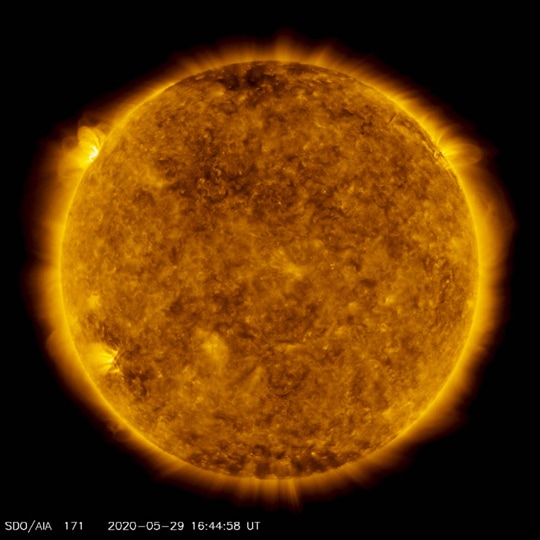
A solar flare is an intense burst of radiation coming from sunspots which are dark spots on the surface of the Sun representing complex magnetic fields.
Harmful radiation from a flare cannot pass through Earth’s atmosphere to physically affect human beings. However, when intense enough, they can disturb the atmospheric layer where GPS and communications signals travel, causing interference in the working of spacecrafts and satellites.
The solar flare in question was spotted on May 29 by a NASA spacecraft. The American space agency described it as a “relatively small M-class solar flare”.
In terms of strength, the M-class flare represents the middle – stronger than C-class flares but not as powerful as X-class flares which can cause radio blackouts.
Though the flares were “too weak” to pass the threshold at which space weather forecasts, alerts or warnings are issued, yet what made NASA scientists sit up and take notice was the fact that these appeared after several months of very few sunspots and little solar activity.
“The sunspots may well be harbingers of the Sun’s solar cycle ramping up and becoming more active,” NASA said in a statement on its website,
“As the Sun moves through its natural 11-year cycle, in which its activity rises and falls, sunspots rise and fall in number.
“This new sunspot activity could be a sign that the Sun is possibly revving up to the new cycle,” according to the American space agency.
The solar flares observed on May 29 may not have been strong enough to affect the geomagnetic space; nonetheless, it was the first M-class flare in almost three years and scientists will be watching to see if the Sun is indeed beginning to wake up, said NASA.


