
 E-Paper



FIFA clears Australian VAR official accused of white supremacist hand gesture during Germany vs Curacao match
FIFA cleared Australian VAR official Shaun Evans of misconduct for a hand gesture during a World Cup match.

 Prefer HTon Google


FIFA has cleared Australian video review official Shaun Evans after he was accused of making a hand gesture resembling a white supremacist symbol during the 2026 World Cup match between Germany and Curacao.
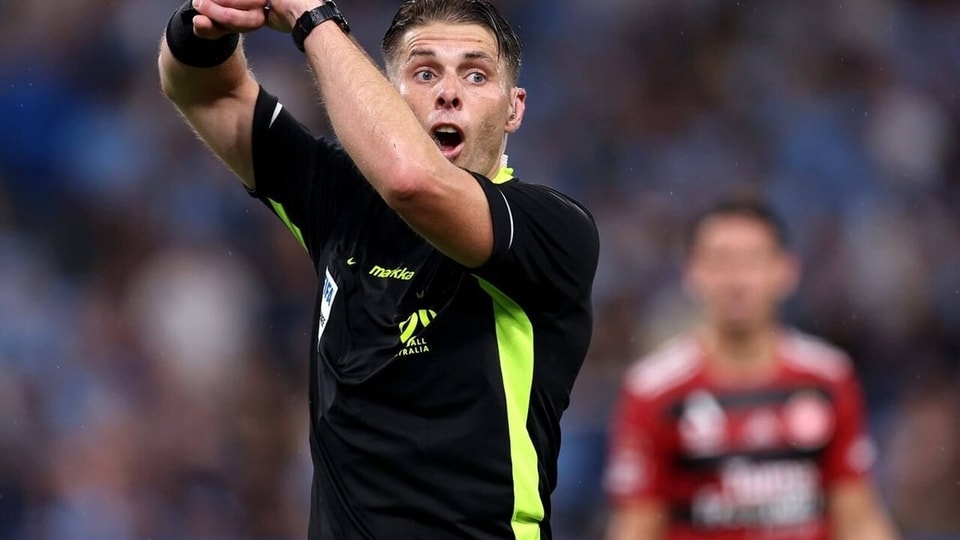
The incident took place before Germany’s 7-1 win over Curacao, when the broadcast showed the video review officials working from the World Cup VAR centre in Dallas. Evans, who was serving as a support video assistant referee, was seen making an upside-down “OK” hand gesture with his right hand.
The gesture triggered criticism online and prompted the Fare etwork, FIFA’s anti-discrimination monitor, to call for Evans to be removed from the tournament. Fare said the gesture resembled a symbol used by far-right and white supremacist groups.
“Advice from our experts is that the gesture used clearly resembles an upside down ‘OK’ hand symbol used as a ‘white power’ symbol in global far-right circles,” Fare said in a statement.
“Clearly this official should have no further role to play in this World Cup,” Fare added, describing the gesture as “neo-Nazi.”
FIFA finds no disciplinary breach
FIFA’s independent disciplinary committee reviewed the matter and concluded that Evans had not breached the governing body’s disciplinary code.
“FIFA’s independent disciplinary committee can confirm that, after looking into the matter involving support video assistant referee Shaun Evans, it has found no evidence of breaches of the FIFA disciplinary code,” the committee said in a statement.
“The disciplinary committee has also taken note of Mr Evans’ statement,” FIFA added.
Evans denied that the gesture was intentional and said he had not meant to communicate any message or affiliation.
“I did not intentionally make a hand gesture or symbol to communicate a message, affiliation, game or belief of any kind,” Evans said in a statement released by FIFA.
“The only explanation I can offer is that the movement was an involuntary, subconscious twitch, and I was unaware I had done it at the time. Images taken later during the match showed that I repeated this movement many times while holding a pen between my fingers,” he added.
Evans also expressed regret over how the gesture had been interpreted, while maintaining that it did not reflect his views or beliefs.
The “OK” hand gesture has multiple meanings depending on context. It has long been used innocently, including as part of a children’s prank or “circle game”. However, the Anti-Defamation League added the gesture to its hate-symbol database in 2019, noting that it had also been adopted by white supremacist and far-right groups.
The incident placed FIFA under scrutiny during the early stages of the expanded 48-team World Cup, with Fare pushing for stronger action and FIFA ultimately deciding there was not enough evidence to establish misconduct.
Evans, a FIFA-listed Australian official, has previously worked as a VAR official at the 2022 World Cup in Qatar. After FIFA’s ruling, he remains cleared of any disciplinary breach in the matter.


