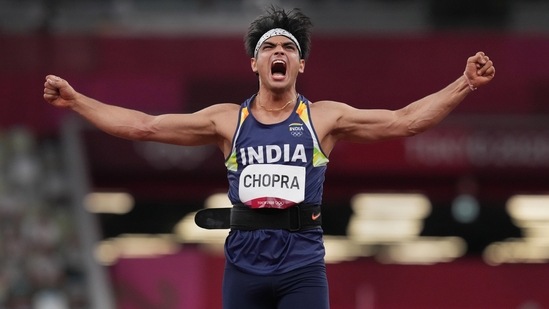
The Olympic champion will be determined to show he is in ideal shape as he tackles the javelin qualifying round first at the athletics World Championships in Eugene, Oregon
Eleven months after sending the spear soaring into the Tokyo night sky and a nation into delirium, Neeraj Chopra will line up at the athletics World championships in Eugene chasing a similar high. A world class field, led by Grenada’s world champion Anderson Peters and Czech Republic’s Olympic silver medallist Jakub Vadlejch, is what he will have to contend with.
Tokyo Olympic javelin Neeraj Chopra (PTI/File Photo)
It's not often that an Indian athlete starts a global competition as a serious contender. Long jumper Anju Bobby George's bronze in 2003 Paris is India’s only medal in the competition. But Chopra has warmed up nicely, breaking his own national record twice last month, the latest of 89.94m at the Stockholm Diamond League meet. Anticipation is also building whether Chopra crosses 90m. The qualifying round is on Thursday evening (Friday morning in India).
His German coach Klaus Bartonietz plays down the 90m talk. “See, 90m is just a number. I mean, he has thrown 89.94m, which means he is just six centimetres away. So, I am not bothered. Also, the throws are measured from the line and not from where the foot was at the point of release, which is some distance behind the line,” he says.
“It will be great if he does it, but we are more focussed on getting a good throw in and finishing at the top. Neeraj knows how it is done.”
A good throw takes multiple physiological factors to align perfectly, creating enough thrust to propel the 800 gram javelin. “It is a complex science. It is one sport that engages each muscle of your body,” says Klaus.
The key, he says, is the run-up.
“You don't throw the javelin from your arm; you throw from your legs. Legs are used to first accelerate and then decelerate. The moment the body decelerates, the javelin should accelerate by what is called the neurophysiological stretch shortening cycle. This means the muscles are pre-stretched and so they can contract faster and stronger," he says. “Your front leg should be really strong for the block. You should have the elasticity to bend backwards before launching the javelin with all the power you have. Think of your body as a bow and javelin as an arrow.”
An ideal javelin run-up is around 30-35 metres. The burst of energy, acceleration and deceleration all must happen smoothly, culminating in the block, throw, and an aggressive follow-through.
Sprint, the key
Months of felicitations after Tokyo meant Chopra could resume training only in December. He then spent considerable time improving his conditioning first. Weight training, middle-distance running and simulating throws with the medicine ball were all part of this build-up.
Satisfied that Chopra had regained his pace and sprint endurance, Klaus focused on 30-50m bursts and his acceleration.
Chopra now averages an impressive 3 to 3.20 secs over 30m. But Klaus says, “it is a measure, but what is important is how fast he is with the javelin and how fast he is on competition day.”
Technical perfection is hard to achieve as strength, elasticity and motion need to be backed by the toughest variable of them all—the angle of release. It is one area Chopra and Klaus are still working on.
“The coach advises me to take care of my angle of release. In competitions so far, considering the power I am putting in my throws, my coach feels if the angle of release is spot on, the javelin will fly longer than it is currently going,” Chopra said before the Worlds.
“At the Paavo Nurmi Games (his first on comeback), the javelin got stuck in the wind a bit. In Stockholm (Diamond League), the throws were going slightly left. So, he tells me that the throws are good but I need to perfect my angle of release to add 2-3 metres.”
Klaus though is happy with where Chopra’s technique now is.
“No one can attain technical perfection in javelin. I’ll give Neeraj 9 out of 10. There is no 10/10 javelin thrower in the world. Neeraj is 90% there, sometimes falls to 80%, which shows the technical precision this sport needs. Jan Zelezny was pretty cool, closest to perfection. It is important to understand how he produced speed in his run-up. I won’t say I am getting Neeraj to copy him, but we pick the best inputs we can,” Klaus explains.
“Johannes Vetter’s consistency is awesome. He has a very strong body and a really strong front leg that helps him throw that far. But he is paying a price for the stress he puts his body in,” he says. The German is currently out due to injury.
Any suggestions of tweaking Chopra's technique though are kept at arm's length.
“His technique was very sound even in 2016 when he won the World Juniors. There's no need to change anything. What we are looking for right now is better control of the javelin,” Klaus says.
“By controlling I mean the javelin should leave the hand like a rocket in a straight line, that's how it should fly… to ensure minimum resistance from the airstream.”
That explains Chopra balancing the javelin in his throwing arm, using both hands to feel the balance before starting the run-up.
“You have to make sure the javelin flies off the hand the correct way and gets the correct lift. You can hit the ground very hard but the throw may not go too far if the aerodynamic lift is not correct.”
Confident of a good show
Despite his good form, Chopra is humble while assessing his chances.
“We are confident because we trust our training. The results in the three post-Olympic events speak for themselves. We are not overconfident because each competition is a new one and you cannot rely on the past,” says Klaus.
After the Stockholm Diamond League—Chopra's latest competition—Klaus took strength training a notch higher as part of the schedule to ensure he peaked at the world championships.
“You want the best performance at the most important competitions. Sometimes, at the start of the season when the body is fresh, you do well and push yourself. By the time the main event of the season comes, you are tired,” the biomechanics expert explains.
As training for Eugene hit the home stretch, Klaus reduced throws, ramping up gym time. Chopra has rarely gone full tilt in training and his 75-80m throws with moderate effort are enough to convince Klaus of his form.
“He knows how it is done. We trust each other. Throwing workouts start to go down 5-6 days before the event. Two days before the competitions, we only do fast lifting. On competition day, we only do the easy warm-ups. There are no throws a day before.”
Come Thursday, Chopra will hope the physical and technical tune-up works in synch.
Stay updated with the latest sports news, including latest headlines and updates from the Olympics 2024, where Indian athletes will compete for glory in Paris. Catch all the action from tennis Grand Slam tournaments, follow your favourite football teams and players with the latest match results, and get the latest on international hockey tournaments and series.

 E-Paper