
 E-Paper



Billie Jean King Cup: India lose to Latvia after Ankita Raina goes down fighting
The 2018 US Open semi-finalist Anastasija Sevastova beat Raina 6-0, 7-6(4) in the first reverse singles to give Latvia an unassailable 3-0 lead and an expected victory against the lower-ranked and inexperienced Indian outfit.


Perhaps the point of the Billie Jean King Cup tie between India and Latvia came in the eighth game of the second set between Anastasija Sevastova and Ankita Raina on Saturday. It had a lengthy rally exchange from the baseline, slices, lobs, drop shots and Raina delivering a backhand down the line pass through the Latvian to cap it off. So exhausted was Raina that she didn’t even care to celebrate, merely placing her hands on the net while the Indian contingent stood up to applaud.
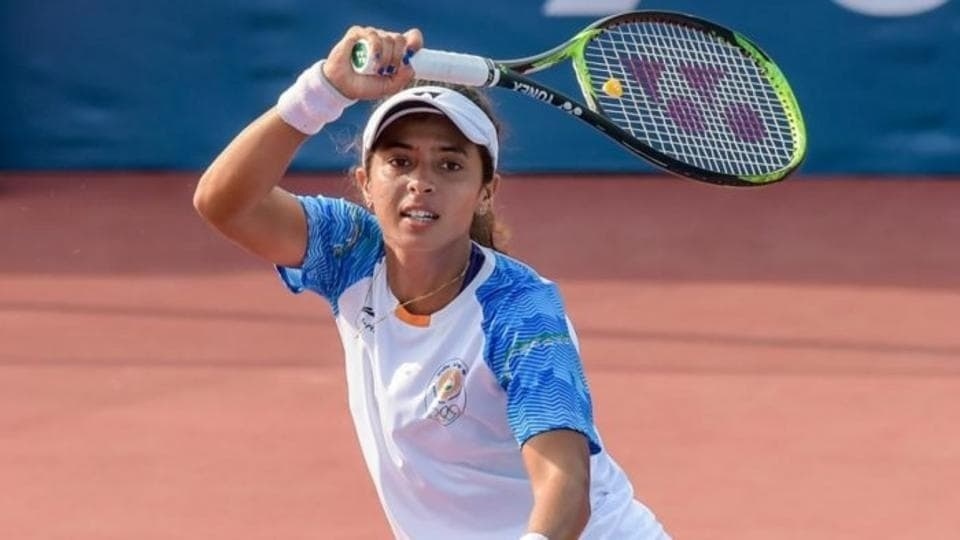
That eighth game also presented the 174th-ranked Indian two second set points against the world No. 47 Latvian after being bageled in the first. But like her 52nd-ranked compatriot Jelena Ostapenko did on Friday, Sevastova raised her stumbling level of play just in time, and when it was most called upon.
Sevastova saved both the set points to make it 5-3, then broke Raina after a backhand cross-court battle and soon restored order. And although Raina saved a match point herself with another backhand pass and broke Sevastova immediately after being broken to love to force a tiebreaker, Sevastova never looked out of control in the tiebreaker.
The 2018 US Open semi-finalist beat Raina 6-0, 7-6(4) in the first reverse singles to give Latvia an unassailable 3-0 lead and an expected victory against the lower-ranked and inexperienced Indian outfit in the Billie Jean King Cup World Group play-offs tie in Lielupe, Jurmala, on Saturday. With the tie lost and the second reverse singles off, India captain Vishal Uppal chose to field first-timers Rutuja Bhosale and Zeel Desai for the inconsequential doubles tie instead of the original pair of Sania Mirza and Raina. The inexperienced Indian combo beat Daniela Vismane and Patricija Spaka 6-4, 5-7, 10-2 to get India on the board and ensure the tie finished 3-1.
After playing for the first time ever at the World Group stage, the Indian team will once again ply at the Asia/Oceania group stage next year. Latvia, meanwhile, have been promoted to the 2022 Qualifiers. “I’m proud of the way the team fought,” Uppal said. “I don’t think a lot of people gave us even a fighting chance against Latvia, but we showed that we came here with purpose and intent.”
In Friday’s opening encounter, the top-ranked Indian Raina ran the 2017 French Open champion Ostapenko close, going down 2-6, 7-5, 5-7. That Sevastova would be a totally different kettle of fish for Raina to ride past on the indoor hard courts was evident quite early on Saturday. Like against Ostapenko, Raina lost her opening service game, but while Ostapenko’s inconsistency and tendency to give away cheap points in being aggressive kept Raina in the hunt, Sevastova’s all-round and all-court game was too solid for Raina to rattle. Add to it, the Indian’s second serves were once again letting her down; while she won 0/7 points on second serve on Friday, she won 1/8 on Saturday.
It meant Raina wasn’t even in the contest in the opening set, which was a 28-minute 6-0 rout by Sevastova who stretched her unbeaten game run over the two days to 14 after beating Karman Kaur Thandi 6-4, 6-0 in Friday’s second encounter.
But if there’s one aspect in Raina that compensates for the limitations in her game, it’s the attitude to stand and fight whatever the situation. She did exactly that, getting on board to begin the second set and immediately breaking the Sevastova serve. Raina was not going to be rolled over, and it began to extract errors off Sevastova’s racquet. The Indian too started to dictate play from the baseline, bossing a majority of the backhand exchanges. She was broken in the fifth game, but earned the one-break advantage right back.
The unforced errors count was mounting from the Latvian—a whopping 35 in the second set compared to eight in the first. That was until the decisive eighth game, which Raina couldn’t close out and from where Sevastova regained her level and hold on the match.
“There were learnings from yesterday’s (Friday’s) match against Ostapenko, but it took me a while in the first set. Anastasija didn’t give any free points. I was able to execute those learnings in the second set. I was much more solid in the second set. But I should’ve been more aggressive while I had those chances to close the set,” Raina said in the post-match press conference organised via official broadcasters Eurosport.
Uppal felt cashing in on those rare chances against the top players like the two Latvian women is something Raina could get better at playing against higher-ranked players going forward.
“Both Ostapenko and Sevastova showed why they’re in the top-50. Because at 4-4 or 5-5, they just happen to find that extra gear. Ankita, for her part, stayed pretty solid through that. But it’s just the quality of the Latvian girls that they were able to raise their level at the crucial points, and that made the difference.
“That’s something Ankita can learn. She can become tactically a little smarter, and understand that you cannot let you level drop even the slightest against these top players, because that can hurt you. And when you get an opportunity, you have to learn to convert it,” he said.


