
 E-Paper



307-million-year-old skull unearthed in Canada reveals Earth’s earliest ‘vegetarian’ animal
The skull of Tyrannoroter heberti was found in Canada's Nova Scotia province.

 Prefer HTon Google


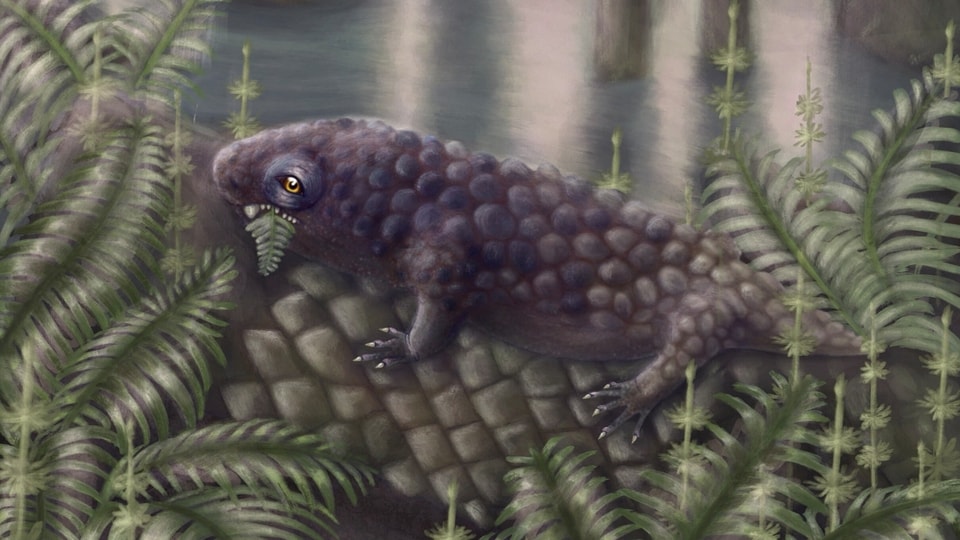
The newly discovered 307-million-year-old skull of a Tyrannoroter heberti has created a buzz in the scientific community, as researchers say it may belong to one of the earliest known herbivorous creatures. Yes, a vegetarian animal.
A study about the discovery was published in the journal Nature Ecology & Evolution. Scientists found the skull inside a fossilised tree stump in Nova Scotia, Canada.
Also Read: Did a million-year-old skull just rewrite our origin story? Researchers say…
Why is it an important find?
For a long time, scientists thought that when animals first moved from the water onto land, they were all meat-eaters. They believed it took a very long time for animals to figure out how to eat plants. This 307-million-year-old fossil proves that animals began eating their "greens" millions of years earlier than previously thought.

"This is highly important because it means that the essential components of the terrestrial ecosystems we recognize today - as herbivore-dominated - have been around and maintained since the Carboniferous Period," said palaeontologist Arjan Mann of the Field Museum in Chicago, co-lead author of the research.
"Tyrannoroter is the earliest and most complete vertebrate land herbivore to show adaptations that could process high-fiber plant material," Mann added.
What did Tyrannoroter heberti look like?
"The skull is very robust," said palaeontologist and study senior author Hillary Maddin of Carleton University in Ottawa.
Also Read: Newly discovered skull uncovers secrets of deadly hunter from 30 million years ago
"The traits that indicate herbivory include its downturned snout, angled optimally for snipping at low-lying plants, large chambers for housing powerful muscles for processing plants, and most importantly, it has a mouth full of opposing dental fields - one on the palate (roof of the mouth) that occludes (fits together) with another on the lower jaw," Maddin said. "These dental batteries are seen in other herbivorous animals."
What does the name mean?
Tyrannoroter means "tyrant digger”. It reflects the animal's relatively larger size for its time. Its species name heberti is in honour of research collaborator Brian Hebert. The researcher found the skull.
"This discovery reveals vertebrate animals radiated into modern-like niches, including herbivory, much more quickly than we thought," Maddin said. The researchers believe that before turning to plants as its main diet, the creature may have been eating insects.
"This paper furthers the idea that insectivory was likely a preadaptation for herbivory, and by eating early herbivorous insects, tetrapods secondarily acquired the gut flora needed to process plant material," Mann said about the football-sized creature.
3D scanning and printing the skull
The researchers used 3D scanning and printing to study the fossil in detail.

“It’s a way of digital preparation that allows us to visualize the skull and make 3D prints for our museum collections, for outreach, and to take around the world without risking the actual fossil,” explained Mann.


