E-Paper



Hindi, Rajasthani and Punjabi greetings carried aboard NASA's Voyager 1 as it nears historic milestone
NASA's Voyager carried greetings in 55 languages, including Hindi, Rajasthani and Punjabi, on its Golden Record.

 Prefer HTon Google


Nearly five decades after leaving Earth, NASA's Voyager 1 spacecraft is approaching a historic milestone, carrying greetings in 55 languages, including Hindi, Rajasthani and Punjabi, as part of a message intended for any extraterrestrial civilisation that might encounter it.
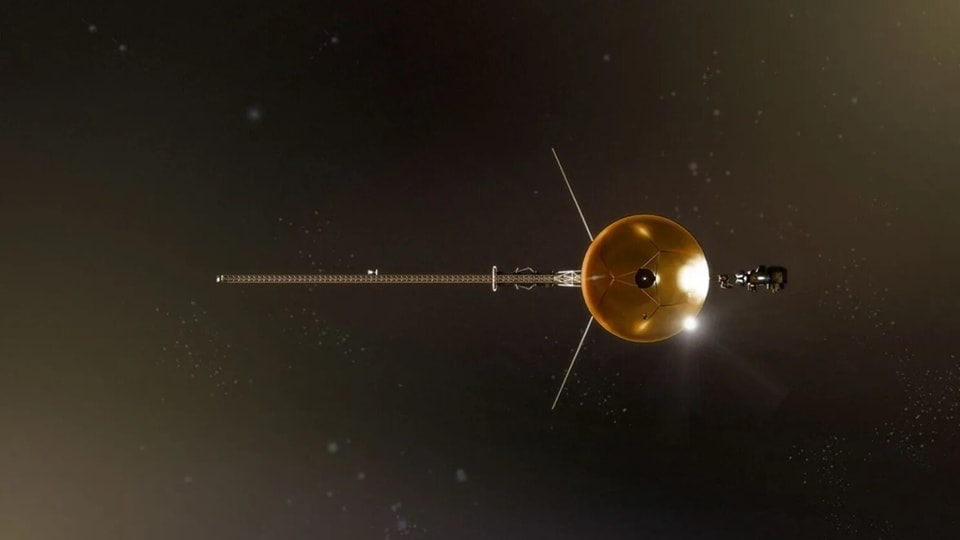
(Also read: NASA's Voyager 1 set to script history: Farthest human-made object to reach one light-day from Earth)
According to NASA, the spacecraft will become the first human-made object to reach a distance of one light-day from Earth on November 18, 2026. It will be approximately 16.09 billion miles (25.9 billion kilometres) away, meaning a radio signal from Earth will take 24 hours to reach it.
What do the Hindi, Rajasthani and Punjabi greetings say?
NASA's Voyager 1 carries a Golden Record, a gold-plated copper disc containing sounds, music, images and spoken greetings representing life on Earth. An identical record was also placed aboard Voyager 2.
According to NASA's official Golden Record archive, the Hindi greeting translates to "Greetings from the inhabitants of this world."
The Rajasthani message includes the words, "We are happy here and you be happy there."
Meanwhile, the Punjabi greeting begins with "Welcome home" and expresses pleasure at receiving a visitor.
The recordings also feature other Indian languages, including Bengali, Gujarati, Kannada, Marathi, Odia, Telugu and Urdu.
The greetings were assembled under the direction of astronomer Carl Sagan, with Linda Salzman Sagan overseeing their collection. NASA says physicist Bishun Khare played a significant role in bringing Indian speakers into the project.
What is NASA's Golden Record?
According to NASA, the Golden Record contains 115 images, natural sounds such as thunder, wind and animal calls, and approximately 90 minutes of music from different cultures.
Each spacecraft carries an identical record, enclosed in a protective aluminium jacket with symbolic instructions explaining how to play it.
The recordings were designed as a time capsule of humanity, potentially allowing another civilisation to learn about Earth's people and cultures.
Voyager 1 approaches historic milestone
Launched on September 5, 1977, Voyager 1 explored Jupiter and Saturn before entering interstellar space in August 2012.
It remains the most distant human-made object and continues transmitting scientific information despite its ageing systems.
To celebrate the upcoming milestone, NASA has invited people worldwide to participate in a symbolic light display on November 17, using phones and other lights to flash the spacecraft's call sign in Morse code.
Voyager 2, which followed a different trajectory, is expected to reach the same distance in November 2035.