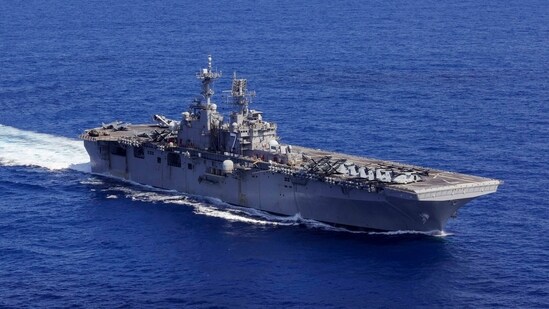
IN THE SOUTHERN Caribbean just two or three American warships and Coast Guard cutters are normally on patrol. Now an amphibious group centred on the USS Iwo Jima — three ships carrying 4,500 sailors and marines — is on its way. A nuclear-powered attack submarine and reconnaissance planes are also being shifted.
With the extra manpower, American crews should be able to seize ships, escort them to port and arrest the crews. (Facebook/USSIwoJimaLHD7)
On the surface of it, one of the biggest American deployments to the region in years is a bid to go after drug traffickers. In February President Donald Trump designated several cartels, mainly Mexican ones, as foreign terrorist organisations.
All this might therefore ring a bell. In April 2020, during Mr Trump’s first term, as the covid pandemic first took hold, the administration announced “enhanced counternarcotics operations” in the Caribbean against drug cartels that were allegedly exploiting the chaos. The Biden administration later scaled back those operations, judging them expensive and largely ineffective.
In principle the deployment could help target traffickers. The current force is too small to intercept many of them; American crews often stop boats but must watch as the cocaine is dumped overboard and traffickers sail on. With the extra manpower, they should be able to seize ships, escort them to port and arrest the crews.
Few, though, think drugs are the sole or even the main focus. The United States’ deadliest drug problem is fentanyl, which kills tens of thousands of its citizens each year. Almost all of it is synthesised in Mexico and trafficked north over land. The Caribbean does carry cocaine bound from South America to Europe and the United States, but the new deployment is not positioned along the busiest routes. And the hardware does not match the task: why send destroyers when much of the trade depends on clandestine flights and unmanned submarines?
Consider the Trump administration’s move on July 25th to designate the Cartel de los Soles as a terrorist outfit. It is supposedly based in Venezuela’s armed forces. While elements of that army are believed to be involved in drug trafficking, there is little evidence the cartel exists as an organised structure. Yet the Trump administration named as its leader President Nicolás Maduro, a serial election-stealer who nabbed last year’s in a daylight robbery. Two weeks later the administration doubled the bounty on his head, raising the reward for information leading to his arrest to $50m—more than it once offered for Osama bin Laden. And on August 8th Mr Trump signed a directive permitting the use of military force against cartels abroad. In short: threatening Mr Maduro now falls within the mission to combat drug gangs.
This, too, might ring a bell: the last major American military operation in the region occurred when President George H.W. Bush sent troops to Panama in 1989 to arrest Manuel Noriega, who had been indicted in the United States on drug-trafficking charges.
There the parallel stops. Then the force was 20,000-strong, far more than the 4,500 or so allocated now. Venezuela is a far bigger and more complicated place. No one thinks an invasion today is plausible. Indeed the only goal may be theatre. James Bosworth, an analyst based in the United States, calls it “an awesome photo-op”: a chance to display American clout in the Caribbean and to snare a few traffickers along the way. It makes most sense if the intent is to rattle Mr Maduro and give succour to Venezuela’s opposition—or even stir an uprising within the Venezuelan armed forces (incentivised perhaps by that recently doubled reward). This “looks just right to scare the daylights out of Maduro’s supporters”, says Evan Ellis of the US Army War College.
If rattling Mr Maduro is the purpose, it may be working. On August 23rd he started to enroll what he claims are 4.5m militiamen to defend the country. (Election receipts show he received fewer than 3.8m votes last year; it is improbable that more people would fight to defend him than would vote for him.) All drone flights and the sale of drone equipment have been banned for a month. He has let 13 political prisoners out of jail, perhaps as an offering to Mr Trump.
When Mr Maduro took to the airwaves on August 25th for his weekly television address he said 15,000 “well armed and trained” men had been deployed to states on the Colombian border—an operation that Diosdado Cabello, the Venezuelan interior minister, said was intended to “protect the sovereignty of the homeland”.
Were the United States ever to attempt to topple Mr Maduro, it would find support among many Venezuelans who have endured the economic collapse he has presided over since 2013. In a market in Caracas, the capital, one 74-year-old shopper says simply: “Let them get this done.”
As for malcontents among Venezuela’s army, there have been mixed signals about backing from the United States, which does not recognise Mr Maduro as a legitimate head of state. Venezuelan oil is once again flowing to the United States and in January Mr Trump dispatched his envoy, who was pictured shaking Mr Maduro’s hand. Any coup-minded army man has little these days to guarantee solid American backing if things were to get hairy.
Perhaps a few make that gamble. Or perhaps all the sabre-rattling only succeeds in rallying supporters to Mr Maduro’s side. Or, perhaps most likely, nothing will happen at all. Mr Cabello has threatened to round up anyone who had called for American sanctions or intervention. That, again, rings a bell: it is Venezuelans who suffer when their paranoid and isolated regime is threatened.
Get the latest headlines from US news and global updates from Pakistan, Nepal, UK, Bangladesh, Russia and US Iran war Live, get all the latest headlines in one place on Hindustan Times.
Home/World News/A Surprise US Navy Surge In The Caribbean

 E-Paper