All wars have consequences, particularly for the vanquished. For the Islamic Republic of Iran, the 12-Day War—its recent conflict with Israel and the U.S.—hasn’t been a soul-scorching, society-rending fight in the way of the Iran-Iraq War. From 1980-88, hundreds of thousands perished and battlefield trauma nearly cracked the Islamic Revolutionary Guard Corps, the theocracy’s indispensable pillar. But that conflict did offer an opportunity for Iran: The struggle led the regime to build institutions that guaranteed the revolution’s survival.
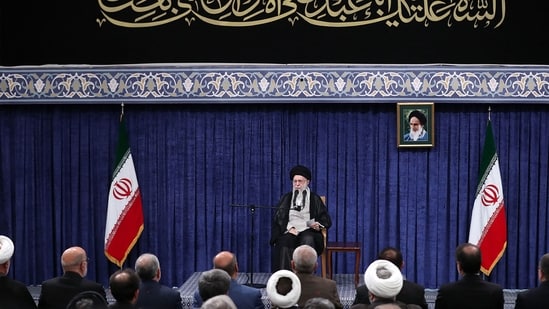
This handout picture released by the office of Iran's Supreme Leader Ayatollah Ali Khamenei shows him hows him waving to the crowd during a meeting with the head of the judiciary and other officials in Tehran on July 16, 2025
The 12-Day War, by contrast, has weakened the heads of those institutions substantially and looks likely to launch a new generation of leaders. That’s bad news for Israel and America.
Today, the regime is defined ideologically by its fight against Israel and the U.S. Supreme Leader Ali Khamenei and his minions have tried to claim victory over the Jewish state in the 12-Day War. But whatever they say in public, the overwhelming sentiment among them is surely not pride but shame. The loss has greatly diminished the supreme leader’s stature. And the consequences of defeat will catapult little-known, hard-core believers—the Revolutionary Guard officers who proved themselves against the Syrian rebellion a decade ago—into the weakened ruling elite. The headline for Israel and America: These men won’t compromise on the regime’s nuclear-weapon ambitions.
And that’s about all we know of them. During the Islamic Revolution in 1978-79, neither Ayatollah Ruhollah Khomeini nor many of his senior adjutants were enigmas to those who had studied Iran. They told us their goals and motivations. As those revolutionaries aged, they compiled their speeches, wrote books or allowed others to chronicle their intellectual evolution.
The new crew on the cusp of power today is comparatively illiterate. These men have a thin paper trail because they see little reason to explain themselves to their countrymen or to the outside world. They are drawn from militant groups such as the Paydari Front and the second tier of the Revolutionary Guards. They look to guidance from the likes of the religiously obsessional Saeed Jalili, a former nuclear negotiator who abjures compromise. They are found in the security organs, occupy seats in parliament and run their own education centers. They have created their own underground shadow government and ideological ecosystem.
The supreme leader’s weakened position has left these men an opening. If Mr. Khamenei had crossed the nuclear threshold and tested a weapon—as voices within the Revolutionary Guards advised him to do months ago—Iran would probably have foreclosed the possibility of foreign attacks. Now the 86-year-old cleric has to worry about dangerous discontent among battle-hardened soldiers.
No matter how much the regime tries to play on Iranian nationalism, it’s unlikely to recapture the citizenry, who no longer see theocrats and their enforcers as estimable expressions of their national identity or faith. To crush the countrywide Women, Life, Freedom movement in 2023—the most recent of many undermining protests—the regime beat, tortured, poisoned and killed young women and girls. Such brutality permanently severs the bonds between society and state. Even Israeli and American bombing runs won’t restore them.
Indeed, the rising generation of the Revolutionary Guards have defined themselves by their willingness to brutalize their countrymen repeatedly. And these guardsmen have had two other core commitments: the A-bomb program and the proxy war strategy devised by their fallen hero, Qassem Soleimani, the Revolutionary Guard dark lord whom an American missile felled in Baghdad in 2020.
Israel’s onslaught against these proxies since Oct. 7, 2023, has badly battered, perhaps permanently crippled, Soleimani’s proxy-based “axis of resistance” against the Jewish state and the U.S. But the nuclear-weapon ambitions remain viable.
Moving forward, the Islamic Republic is unlikely to construct large enrichment plants such as Natanz or rely on mountains to protect its atomic assets. U.S. and Israeli satellite and aerial reconnaissance is too good, and construction times for new underground facilities are too long. Numerous, easily concealed surface facilities are now a better bet—so long as the regime can neutralize foreign spies in Iran. The mullahs have already launched a nationwide dragnet to cleanse their government of spies. These vicious counterintelligence measures will paralyze nuclear construction for a time, but eventually could enable a clandestine nuclear program that neither Jerusalem nor Washington can stop.
The Iranians and Israelis are in a deadly intelligence duel. During the Cold War, Western and Soviet intelligence services continuously went at each other, but destiny seldom hung in the balance. The doctrine of mutually assured destruction provided some comfort and maneuvering room. Israelis are less certain that the threat of mutual annihilation works with the Islamic Republic’s zealots.
Are there enough Iranians in the right places who will risk their lives and the lives of their loved ones to stop the mullahs and the Revolutionary Guards from obtaining the ultimate weapon? Even if Israel has developed a technical capacity to penetrate Iranian official communications, it’s still the most pressing question before the Mossad.
A second question also looms: Can Jerusalem learn enough about the new, fiercely anti-Zionist members of the Iranian elite to frustrate or compromise them? Learning where they live, though obviously important, will be the easy part.
Mr. Gerecht, a former Iranian-targets officer in the Central Intelligence Agency, is a resident scholar at the Foundation for Defense of Democracies. Mr. Takeyh is a senior fellow at the Council on Foreign Relations.
Get the latest headlines from US news and global updates from Pakistan, Nepal, UK, Bangladesh, Russia and US Iran war Live, get all the latest headlines in one place on Hindustan Times.

 E-Paper