
 E-Paper



BRICS reiterates commitment to foster open, fair and non-discriminatory trade environment
The industry ministers of Brazil, Russia, China and South Africa (BRICS) reiterated their commitment to foster an open, fair, and non-discriminatory trade environment to ensure greater participation in global value chains by promoting digital inclusion and encouraging the sustainable use of disruptive technologies for advancing growth


The industry ministers of Brazil, Russia, China and South Africa (BRICS) reiterated their commitment to foster an open, fair, and non-discriminatory trade environment to ensure greater participation in global value chains by promoting digital inclusion and encouraging the sustainable use of disruptive technologies for advancing growth.
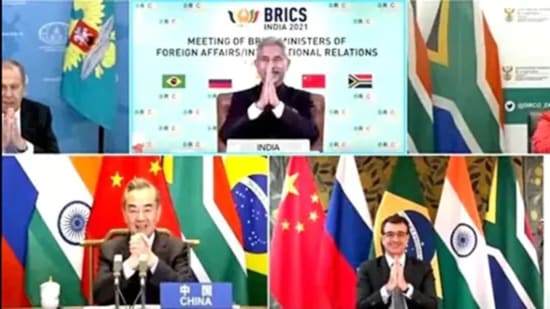
India, chairing the 5th meeting of BRICS industry ministers, expressed its desire to expand the horizon of the New Development Bank (NDB) in strengthening social infrastructure besides promoting the industrial sector. The ministers agreed to collaborate with the NDB. The multilateral financial institution became fully operational in 2016 with an aim to mobilise resources for infrastructure and sustainable development projects in BRICS and other emerging economies.
BRICS ministers recognised the unprecedented impact of the Covid-19 pandemic particularly on the trade and industry, an official statement said. The virtual meeting was chaired by India’s minister of commerce and industry Piyush Goyal on Wednesday. It was attended by Chinese minister of industry Xiao Yaqing, South African trade minister Ebrahim Patel, Brazil’s deputy minister for economy Carlos Da Costa and Russian industry minister Denis Manturov.
India chose the theme “BRICS@15: Intra BRICS Cooperation for Continuity, Consolidation and Consensus “ this year.
In his welcome address, Goyal said India has also been working towards channelising technology towards good and smart governance thus increasing transparency and accountability.
He said India has developed a vibrant and dynamic start-up ecosystem, leveraged existing platforms and digital technologies such as Aadhaar and unified payment interface (UPI) for ensuring delivery of critical services to the last mile. Online systems like COWIN and digital vaccination certificates are being cited as success stories across the world today, the statement quoting the minister said.
Goyal said in this swiftly changing world, the group’s adaptability to new and emerging technologies like Internet of Things, Artificial Intelligence, 3-D Manufacturing and other processes will determine the success of its efforts to embrace Industry 4.0.
Industry 4.0 will play a crucial role in helping BRICS economies in achieving the Sustainable Development Goals (SDG). However, there are challenges of data protection and cybersecurity too. Therefore, it is essential to manage the transition to new technologies in line with national policies and legislation. This understanding is at the heart of the BRICS cooperation agenda, he said.
Goyal said emerging technologies would be an indispensable part of almost all activities, including manufacturing. This requires us to increase our pace towards the adoption of new technologies to develop sustainable industrial cooperation. He said that the adoption of new technologies by micro, small and medium enterprises (MSMEs) would play a crucial role in achieving the target of inclusiveness.
“Our partnership would be successful if we as a group, on the basis of consensus, complement strengths of each other, share our best practices and learn from our weaknesses,” the statement quoting Goyal said.
He said the horizon of NDB should be expanded and resources the be utilized for strengthening social infrastructure especially for funding service delivery in the education and health sector, besides the promotion of infrastructure and industrial sector.


