Hong Kong has imposed bounties on dissidents in exile and threatened to pursue them for life, and recently authorities added 15 more names to its wanted list. Yet in the U.K., where many Hong Kongers have taken refuge, the Labour government wants to weaken restrictions on extradition to the former British colony.
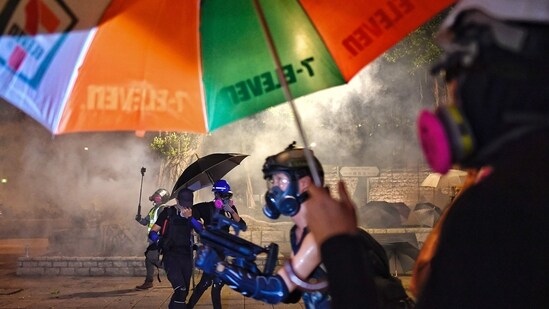
Pro-democracy protesters react from tear gas fired by the police outside Tsim Sha Tsui Police station during a demonstration against the controversial extradition bill in Hong Kong on August 11, 2019 (AFP FILE)
The United Kingdom suspended its extradition treaty with Hong Kong in 2020 after authorities imposed a national-security law that outlaws dissent. The Labour government has now proposed resuming some extraditions on a “case-by-case ad hoc basis,” according to a July 18 letter from the Home Office published on social media last week by conservative MP Alicia Kearns.
Security Minister Dan Jarvis noted in the letter that Hong Kong has also suspended extraditions and asserted “it is in our national interest to have effective extradition relationships to prevent criminals from evading justice and the UK becoming a haven for fugitives.” He has also claimed Hong Kongers won’t be “extradited for politically motivated purposes.”
But Britain’s bountied Hong Kongers aren’t reassured. Publisher Jimmy Lai—a British citizen—has been in a Hong Kong prison since 2020 on bogus charges.
“If Beijing were to accuse me of something like ‘fraud’ tomorrow, they could attempt to use that as grounds to request my extradition, and because such charges may not be seen as political by the U.K., it leaves the door open for abuse,” says Chloe Cheung, a London-based Hong Konger with a HK$1 million (nearly $127,400) bounty on her head. “This is exactly how the Chinese authorities disguise political persecution as ordinary criminal prosecution.”
China violated the Sino-British Joint Declaration when it moved to extinguish freedom in Hong Kong. The national-security law claims broad extraterritorial jurisdiction, and authorities now seek to intimidate and harass even those who escaped abroad. The rule of law is as dead in Hong Kong as it is in the Chinese mainland, and a British extradition policy that suggests otherwise emboldens Beijing and endangers refugees who fled to freedom.
Get the latest headlines from US news and global updates from Pakistan, Nepal, UK, Bangladesh, Russia and US Iran war Live, get all the latest headlines in one place on Hindustan Times.

 E-Paper