
 E-Paper



Canada engineers develop toilet for India that runs without water, sewage system
Engineers in Canada have developed the prototype of a toilet system that can operate without running water, sewage connection or grid power, and is targeted at places such as India where safe sanitation is scarce.


A team of engineers in Canada has devised a prototype that reimagines the humble toilet; with an innovative design that makes it suitable for areas that lack access to sanitation facilities such as adequate running water or sewage systems, making it particularly relevant to India.
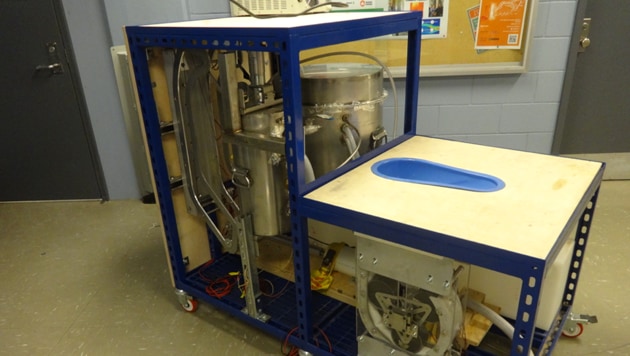
India, of course, is a large part of the team’s objective of creating a sustainable toilet. An earlier version was presented at Reinvent the Toilet Fair held in New Delhi in March 2014.
Almost three years later, an improved model arrived in India. As the team’s leader, professor Yu-Ling Cheng, director of the University of Toronto’s Centre for Global Engineering, said, “We started in April in Coimbatore. It is not yet a commercialisable unit. We did the testing to learn about user behaviour.”
The concept behind the toilet is a household system that can operate without running water or a connection to plumbing, or even without reliable grid power, using a combination of a hand-cranked mechanism, solar power and steam. The excreta is separated into liquid and solid waste.
The solid waste goes into a smoulder chamber that incinerates waste and leaves only ashes, thereby destroying any germs and contaminants. The liquid passes through a sand filter and is pasteurised using the heat from the process for treating solid waste, and what remains can then be either safely discharged or even used for agricultural purposes.
“It is not necessarily just for rural areas; it is also very suitable for urban areas. Many cities do not have the proper fecal sludge management systems in place, and our system would destroy the fecal sludge right at source, so there is no need for downstream management,” Cheng, who was born in Taiwan, explained to the Hindustan Times.

While the final version is still between two and three years away, Cheng said as trials and tests continue for a system that is robust and cost-effective, it promises an ingenious solution to a problem that is rife in countries such as India.
While an earlier prototype was a batch system, one that collected waste through the day and the disposed of it at once, the latest iteration is targeted for household-scale use. Since the process occurs “below the floor”, the user is not exposed to it and can simply push a button before and after using the toilet. This is their version of the “flush and forget” toilet.
The project is supported by the Bill and Melinda Gates Foundation as part of its initiative to meet the challenge of nearly 2.5 billion people globally, including millions in India, not having access to safe sanitation. Not only is it intended to tackle the issue of hygienically disposing of waste water but also that of diseases transmitted when excreta isn’t treated adequately.
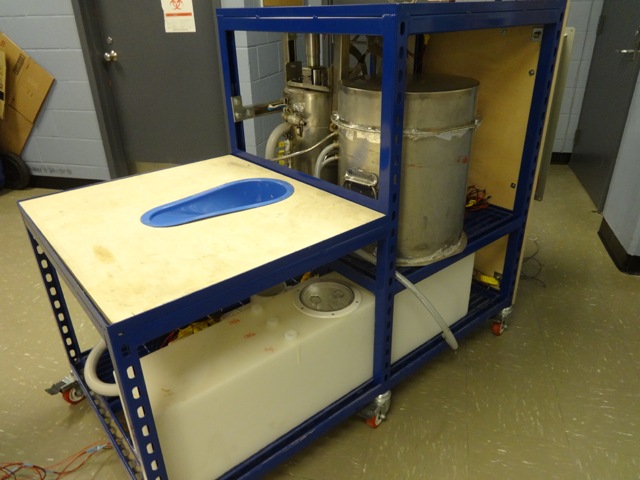
The sand filter, smouldering chamber and ultra-violet rays are deployed to disinfect the waste.
This is particularly timely because of the Indian government’s focus on providing toilets across the country to eradicate open defecation. As Cheng said, “It is suited to India primarily because the need in India is so great. It is also well aligned with the Swacch Bharat campaign.”


