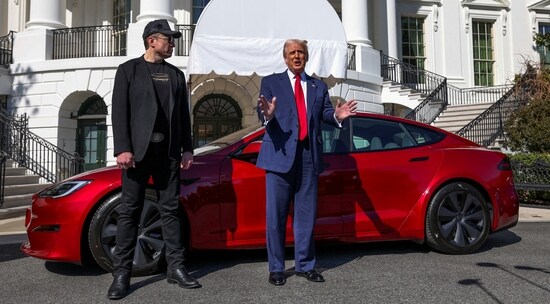
Having once described Joe Biden’s electric-vehicle (EV) policies as “lunacy”, Donald Trump briefly seemed to be softening his opposition when he bought himself a Tesla in March. It was his way of helping Elon Musk, the carmaker’s boss and Mr Trump’s one-time pal. Yet after the pair fell out spectacularly a few months later, Mr Trump put his Tesla up for sale.
Donald Trump bought himself a Tesla in March and put it up for sale after falling out with Elon Musk (REUTERS FILE)
Since then the president has made his true feelings towards EVs clear. The “One Big Beautiful Bill” signed into law last month eliminates fines for carmakers that fail to meet federal fuel-economy standards across their fleets, which had boosted EV sales. Congress has also taken away California’s waiver, which let it diverge from federal standards and set tougher emissions regulations (the state is suing). On September 30th purchase subsidies of up to $7,500 per EV and other tax credits that have aided adoption will disappear, too. Next Mr Trump plans to rescind the Environmental Protection Agency’s “endangerment finding”, an Obama-era ruling that greenhouse gases such as carbon dioxide put public health at risk. This would bring an end to all federal emissions standards (legal challenges are also likely).
By watering down these rules, the president is doing Detroit’s “big three” carmakers—Ford, General Motors and Stellantis—a favour. The shift in policy will allow them to sell more petrol cars, which generate healthier profit margins than EVs, partially offsetting the damage inflicted by Mr Trump’s tariffs on imported cars and parts. Yet while his policies may slow down EV adoption, they will not stop the transition.
Detroit is already seizing the opportunity presented by the rule changes. In June GM announced a $4bn investment plan that will tilt production back towards lucrative pickups and SUVs with petrol engines. Stellantis (whose largest shareholder, Exor, owns a stake in The Economist’s parent company) recently signalled its continued reliance on petrol power with the revival of its powerful (and noisy) Hemi V8 engine for its pickups.
The emissions free-for-all will also cut the need to buy carbon credits from firms such as Tesla, which can be used to help meet targets. Ford, for example, has lowered the value of credits it intends to buy this year by $1.5bn. This will not be pleasant for Tesla, which made $2.8bn selling credits in 2024, nor for ev startups such as Rivian and Lucid. But it will help to defray the costs of Mr Trump’s tariffs.
The big three may take a combined hit of about $8bn this year on imports of cars and parts from Mexico, Canada and elsewhere. For Ford, the reduction in purchases of credits alone will go a long way to mitigating the expected hit from tariffs, estimated at $2bn this year. Jefferies, an investment bank, says that a “credible scenario” for next year would see the benefits from looser emission rules outweighing the burden of tariffs.
Yet despite the internal-combustion renaissance, Detroit’s carmakers are not slamming the brakes on electrification. According to forecasts by Bloombergnef, a research group, ev sales in America will rise from around 1.6m cars this year to 4.1m in 2030, with the share of total car sales increasing from 11% to 27%. That is down from the 48% in 2030 that it had predicted last year, but is still significant progress.
What is more, America’s big carmakers sell not only at home, but also abroad, and must keep pace with foreign competitors who continue to roll out new EV models. Earlier this month Ford unveiled what it described as its “Model T moment” for evs: a platform and production system that will underpin several new affordable models, starting with a pickup launched in 2027 that will cost around $30,000. gm’s commitment to evs is also “ironclad”, according to Bernstein, a broker. In July the carmaker said that production of batteries well suited for entry-level evs would commence in 2027 with its partner, South Korea’s lg Energy Solution. Stellantis may have scaled back ev launches, but still offers electric Jeeps, Ram pickups and Dodge Charger, a revered muscle car.
Indeed, if the profits from selling petrol cars outweigh the costs of tariffs over the next few years, that may even allow Detroit to invest more in developing better evs. Future historians of the car industry may come to regard Mr Trump as a friend of electrification, not the implacable foe he once seemed.
Get the latest headlines from US news and global updates from Pakistan, Nepal, UK, Bangladesh, Russia and US Iran war Live, get all the latest headlines in one place on Hindustan Times.

 E-Paper