
 E-Paper



‘East of Eden’ review: Netflix’s absorbing Steinbeck series
Zoe Kazan—granddaughter of Elia, who directed the 1955 film version—adapts the classic novel into a seven-part drama starring Florence Pugh.


 Prefer HTon Google


Do we still read Steinbeck? “The Pearl” has often been assigned in middle schools, largely because it’s short. Young readers seem to find their own way to “Of Mice and Men,” even if they’re not required to. But “The Grapes of Wrath” and “East of Eden”—the latter of which Zoe Kazan has now adapted into a thoroughly absorbing series with an astonishing Florence Pugh—are forbidding tomes, for students and teachers alike. Never mind that their content still inspires the torch-and-pitchfork set.
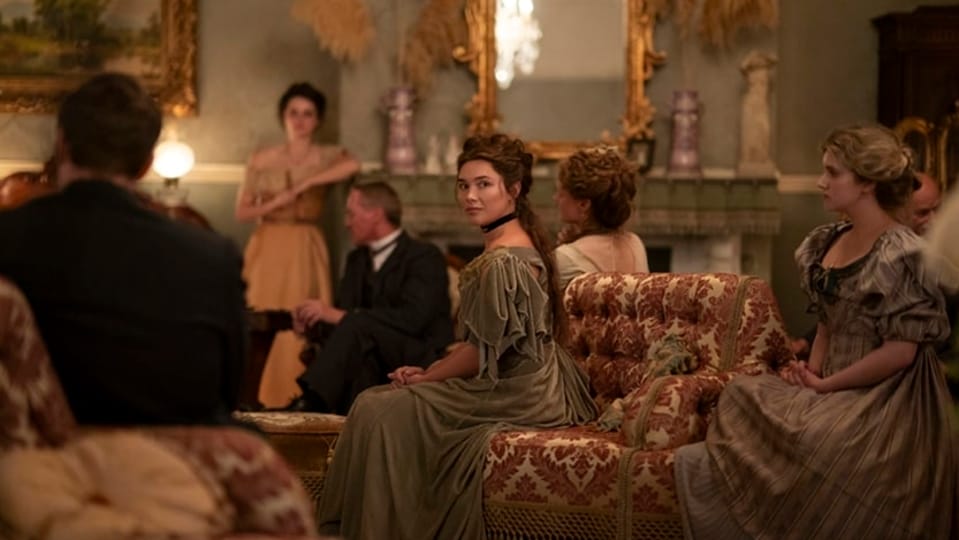
And yet, along the Cannery Row of his Nobel-winning contemporaries—Hemingway, Faulkner, Pearl Buck—John Steinbeck retains a singular and very American claim to fame: his movies. John Ford’s “The Grapes of Wrath” of 1940 is a perennial on “best ever” lists. And the 1955 “East of Eden,” directed by Ms. Kazan’s grandfather Elia, was the only James Dean movie that James Dean got to see; his untimely death and posthumous mythology made it a pop-cultural totem. It also happens to be a marvelously made movie, though the elder Kazan focused solely on the fourth and final section of the novel, leaving it not just abridged but a bit adrift.
The younger Kazan, who developed this project and scripted most of it, has addressed that problem by tackling the entire text, in ways her grandfather couldn’t possibly. And she’s done so in ways that discourage any comparisons with her predecessor. The more dynamic characters of the ’55 movie are rendered decidedly colorless here. The balance of the new story will disorient anyone trying to mentally dovetail the old version into the new. Lee, the Chinese-American scholar who, in the novel, helps the hapless Adam Trask (Christopher Abbott) raise his sons, was deleted from the movie entirely. But thanks to actor Hoon Lee’s sinewy performance, Lee is restored as the most memorable character in the tale.
With one exception. The exception being Cathy Ames (Ms. Pugh).
Often described as monstrous, irredeemable from the crib and the personification of malice, Cathy is both Eve and serpent in Steinbeck’s heavy-handed biblical allegory. The Trasks are already a damaged lot—Cyrus Trask (Tracy Letts), fraudulent Civil War hero and Washington operator, perversely directs his two sons to follow the wrong path: The mild, unsure Adam must join the Army; the cunning, savage Charles (Mike Faist) must run the family farm. Adam will wander for years, Charles never leaving home, until they are reunited after Cyrus’s death and then, one night, find a brutally beaten Cathy on their doorstep. How did she get there? Why? Such is the sordid tale.
Cathy’s life as a prostitute and brothel owner in the very Salinas Valley town they all come to share will shatter her sons, Cal and Aron (Joseph Zada and Joe Anders), who have been told lies about her all their life by their father, Adam. She is made wickedly fascinating by Ms. Pugh and dominates the series. But the Cathy story as fleshed out by Ms. Kazan (all inferences welcome) seems to be a betrayal of Steinbeck, if not Sigmund Freud (who is evoked, however off-handedly).
Whether humans are blessed or doomed from birth is a recurring strain in Steinbeck’s book-length Cain-and-Abel motif (the Cs vs. the As, throughout). It is Lee who introduces the theme of, as Steinbeck has it, “timshel”—Hebrew for “thou mayest”—into the conversation: As he explains it, the King James and American Standard Bibles say that God told Cain that humankind must or shall triumph over sin. The Hebrew suggests that there are choices. And those choices, usually badly made, propel the larger narrative.
That evil exists—in a theological sense—is something Steinbeck seems to have answered for himself in the person of Cathy, who sleeps with her brother-in-law, tries to abort her sons, abandons them at birth, shoots her husband, Adam, when he won’t let her leave, and takes possession of a whorehouse after killing its madam (a marvelously myopic Martha Plimpton). And she exhibits no remorse. But what Ms. Kazan gives us at the very beginning of episode 2 (of seven total) might be described as a psychological escape hatch: In a scene hazy with sunlight and greenery, a 5-year-old Cathy is lured away from home by an adult male proffering candy. She is then, presumably, sexually abused. This is not in the book. And it provides a moral alibi for a character whose creator never gave her one.
Ordinarily, adaptations of classic novels—or movies—not only necessitate updates and alterations: They tell us why we’re here—why remake an oft-told tale, if there’s nothing new to say? But when a formative trauma is provided to a character who was supposed to be born bad, it simply feels like Ms. Kazan ran out of daring. If not cinematic vision.
East of Eden
Thursday, Netflix
Mr. Anderson is the Journal’s TV critic.


