
 E-Paper



EU talks go into overtime with stimulus push facing headwinds
The struggle exposed the fault lines at the heart of the EU as leaders from the fiscally hawkish countries in northern Europe voiced their resentment at paying for the countries worst affected by the virus in the south.


European Union leaders failed to unlock an agreement on a 750 billion-euro ($860 billion) response to the coronavirus pandemic after a second day of sparring in Brussels and will come back to try again on Sunday.
Talks broke up at at 11 p.m. on Saturday after 12 hours of tussling over the composition of the fund and the conditions attached to it, leaving the group under intense pressure to get a deal before financial markets open on Monday.
The struggle exposed the fault lines at the heart of the EU as leaders from the fiscally hawkish countries in northern Europe voiced their resentment at paying for the countries worst affected by the virus in the south.
“We will keep going because we have to resolve it,” Italian Prime Minister Giuseppe Conte told reporters afterward. “Delaying this does no good to anyone.”
Leaders spent the day wrangling over the balance of grants and loans in the plan, with fiscal hardliners trying to water down the handouts that the highly indebted South sees as critical for shoring up its finances. While Saturday proved less bad-tempered and more constructive than Friday’s gathering, it was still difficult to discern much progress. Conte called it a “deadlock” while a German diplomat said the talks had reached a critical phase.
The 27 leaders were meeting in person for the first time since February, when initial talks over the EU’s seven-year, 1 trillion-euro budget also ran into a wall. Now, with more than 100,000 Europeans dead from the virus and an economy to rebuild, investors are looking to the group to muster a display of unity to maintain the rally in stocks.
Saturday started with a fresh compromise proposal drafted by EU Council President Charles Michel but as time wore on, frustration grew. While the hardliners’ ringleader, Mark Rutte of the Netherlands, welcomed a proposal to reduce the amount of grants to 450 billion euros from 500 billion euros, his allies from Austria and Finland pushed for the total to go lower still.
German Chancellor Angela Merkel and French President Emmanuel Macron insisted that they wouldn’t allow the ambition of the plan to be scaled back in a side meeting with Rutte and his allies after dinner, a French diplomat said. The leaders of Europe’s two biggest countries then went back to a hotel for further conversations one-on-one.
In an attempt to bend to another of Rutte’s demands, the new plan had also included a mechanism that would give any country the right to put the brakes on disbursement if it didn’t think the money was being spent correctly. The Dutch saw it as a step in the right direction, but the southerners fretted that it could slow up the cash they need to get their economies going. Leaders must agree unanimously if there’s to be a deal.
Power Brokers
The deliberations are proving to be a baptism of fire for Michel, a former Belgian Prime Minister, and European Commission President Ursula von der Leyen, who drew up the original plan. They only took up their jobs in December and have faced criticism from governments over their handling of the pandemic response.
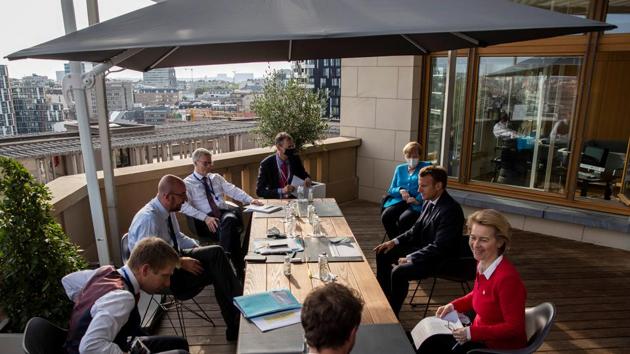
Merkel and Macron have been pressing for an agreement before the summer but haven’t yet been able to bring to their weight to bear to force a result. The bloc’s two largest economies but are seen as crucial power brokers and they were photograph sitting on a sunny terrace as they searched for a breakthrough.
Adding to the complications is the number of side issues that are being tied to the fund.
Many leaders want to see access to financing linked to member states’ compliance with democratic standards and that’s something that Poland and Hungary strongly oppose, since both are subject to EU legal proceedings over rule-of-law backsliding.
Leaders spent the last part of the Saturday discussing the latest proposal, seen by Bloomberg, which stipulates that rule-of-law “conditionality under the regime will be genuine” and that when transgressions are identified, the European Commission will propose “appropriate and proportionate” measures. Those measures will be approved by a qualified majority rather than unanimously, meaning that the Poles and the Hungarians won’t have vetoes to bail each other out as they do in other areas.
Adding another layer of complexity, Hungary’s parliament passed a declaration this month that called on Prime Minister Viktor Orban to reject any stimulus package until the EU investigation into its democratic standards was withdrawn.


