
 E-Paper



Google Doodle honours Polish biologist Rudolf Weigl who invented Typhus vaccine
Typhus spreads through lice in the body and has been responsible for millions of deaths throughout history.

 Prefer HTon Google


The Google doodle on Thursday honoured Polish biologist Rudolf Weigl who is famously known for creating the first effective vaccine against epidemic typhus during World War II. Thursday marks the 138th birthday of the scientist.
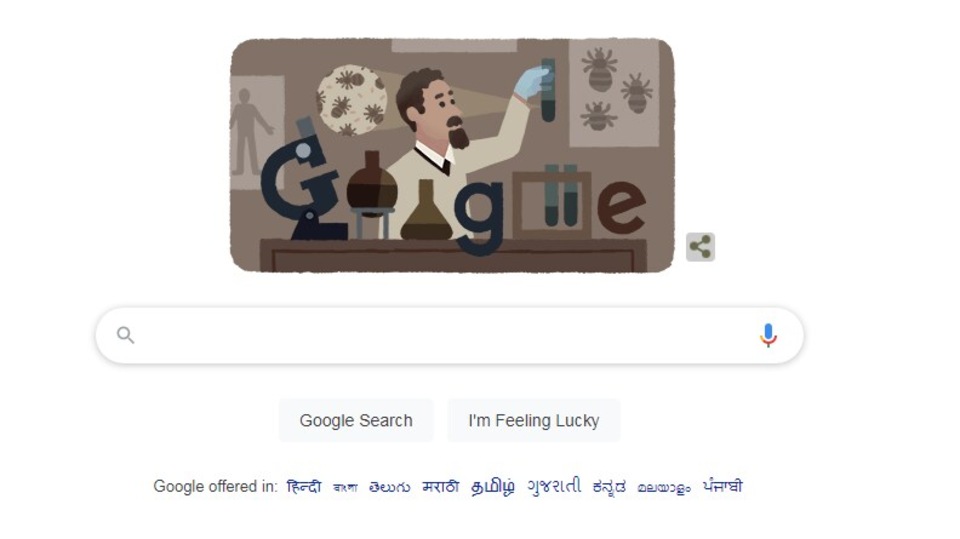
In the doodle, the inventor is illustrated with a test tube in his gloved hands. The illustration also had lice on the wall, and a human body at the extreme left corner, while the tech giant's name is illustrated with a microscope, beakers on bunsen burners, and test tubes in holders all placed on a lab table.
Typhus spreads through lice in the body and has been responsible for millions of deaths throughout history.
Weigl was born in 1883 in Moravia's Prerau, modern-day Czech Republic, then part of the Austro-Hungarian Empire. He was a native German speaker but was raised in Poland where he adopted the Polish language and culture.
In 1907, Weigl graduated with a degree in biological sciences from Poland's Lwow University. He then went on to earn doctoral degrees in zoology, comparative anatomy and histology -- the study of the microscopic anatomy of biological tissues.
During the spread of Typhus across Europe, Weigl carried out innovative research in which he grew infected lice in his lab and harvested their stomachs to be mashed into a vaccine. At the time of research, Weigl himself got infected with the disease but recovered.
In 1936, Weigl's vaccine was successfully administered to its first beneficiary.
For his landmark work, Weigl was nominated twice for the Nobel Prize. He died in 1957 at the age of 74.


