
 E-Paper



How Yale Escaped the Crackdown on Higher Education
The Ivy League is at the center of a national campus shake-up but Yale has avoided the crosshairs.


 Prefer HTon Google


President Trump has made an example of Ivy League universities, attacking, cajoling and fining them in brisk succession. There’s a notable exception: Yale University.
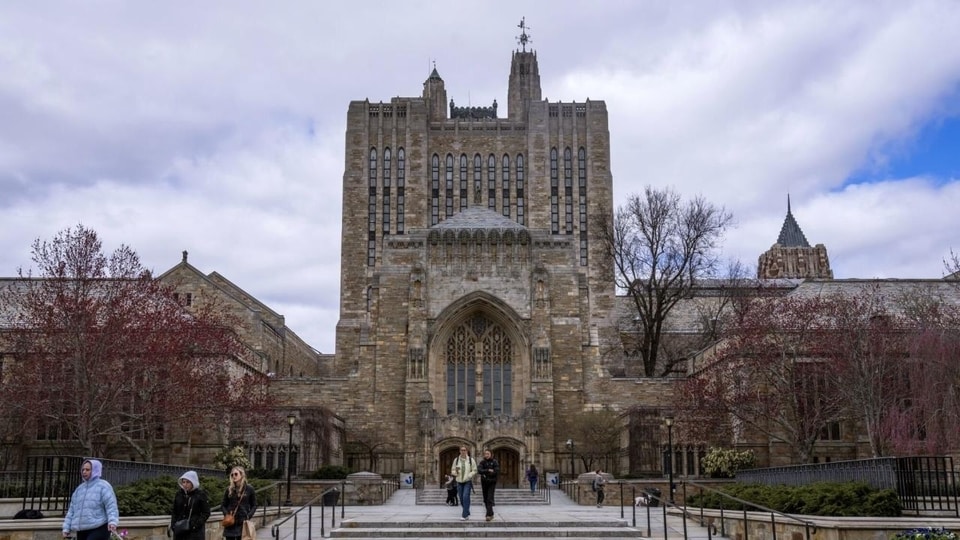
In New Haven, Conn., the school’s conspicuous absence from the crosshairs has become a subject of intense campus speculation—among professors, students and even parents.
“This is the $64,000 question,” said Evan Morris, a Yale professor of radiology and biomedical imaging. “My colleagues and I are all looking at each other and waiting for the other shoe to drop.”
The question hung over October’s Yale Family Weekend, as parents partook of cherished traditions like performances by the Yale Glee Club, lectures by distinguished faculty and tours of the neo-Gothic-style campus.
During a talk with moms and dads, university President Maurie McInnis was asked why Yale had been spared. She said there was no obvious answer, according to the Yale Daily News.
“Whether it is that long tradition, the long tradition we have of encouraging open debate… or whether it’s we’re at the end of the alphabet, I don’t have that answer,” McInnis told the gathering, according to the student paper.
The perception on campus is that McInnis has tried to lay low. Some students have rallied around that tactic. In an exchange on Fizz, a student social-media site open to those with Yale email addresses, classmates reacted to Trump freezing funds at other schools and warned peers to keep their mouths shut and stop protesting the conflict in Gaza, according to screenshots reviewed by The Wall Street Journal.
“The only thing continuing to protest will do is to take education and opportunities away from the rest of us,” said one post. “Ppl need to stop being stupid and selfish and realize they will gain no ground under this administration on the Israel issue.”
‘Thoughtful discourse’
When Trump began accusing universities of being Marxist indoctrination factories, Yalies girded themselves. The school has long been known as a progressive bastion.
Though Yale’s pro-Palestinian protests over the Gaza war weren’t as disruptive or aggressive as those at Columbia or Harvard, the university did earn a D on an annual report card this year from the Anti-Defamation League, which monitors campus antisemitism. The Education Department’s Office for Civil Rights is investigating the university for alleged antisemitic discrimination and harassment.
And the school has a reputation for the sort of identity politics the Trump administration criticizes elsewhere. Conservatives still decry a 2015 Yale incident, when student anger over a professor’s defense of potentially offensive Halloween costumes helped lead to his exit as a residence-hall supervisor.
Now, nearly a year into Trump’s term, many on campus are loath to discuss Yale’s relative outlier status for fear of jinxing it. Those who do chalk it up to well-connected alumni, fortuitous timing and a leader focused on steering the campus back toward the political center.
McInnis took Yale’s helm in the summer of 2024, after the handling of campus protests had already helped derail three Ivy League presidents. In her first year in office, McInnis established a policy that restrained the university from commenting on most political issues of the day—a position championed by the Trump administration. She created a campus civics center to “promote thoughtful discourse” and championed the Buckley Institute, the conservative political club named after William F. Buckley Jr.
McInnis more than doubled government-lobbying expenditures from years past to north of $300,000 per quarter, according to federal documents. She opened a Yale office inside the Beltway to direct efforts and traveled frequently to Washington to meet with lawmakers and plead the university’s case.
Through a spokesperson, McInnis declined an interview for this article.
The government’s stated rationale for targeting schools was to stop harassment of Jewish students, and Yale took stronger action against pro-Palestinian campus activists compared with some peers. In April, about 200 demonstrators gathered to protest a visit from Itamar Ben-Gvir, Israel’s national security minister. The university then withdrew Yalies4Palestine’s status as a registered student organization, because the group “flagrantly violated the rules” regarding protests, Yale said in a statement at the time.
The university’s response earned public kudos from the Trump administration, which said the protests included “outrageous examples of harassment and bigotry” and that the administration was “cautiously encouraged by Yale’s actions.”
Meanwhile, Yale’s free-speech ranking rose with the Foundation for Individual Rights and Expression, metrics closely watched within the Trump administration. It looks like they are making an effort to protect free speech, said Sean Stevens, who runs the rankings for FIRE. “At least they are doing better than most of their peers.”
Divide on campus
Yale hasn’t emerged unscathed.
McInnis lobbied against a 21% endowment tax, cautioning it would diminish Yale’s “impact on humanity.” Though the tax passed at 8%, it will still cost Yale tens of millions. When Trump froze some federal research funding, Yale endured cuts to grants.
But unlike Harvard, Columbia, Penn, Princeton, Cornell and Brown, Yale has escaped targeted sanctions. Dartmouth, broadly considered the most conservative school in the Ivy League, has escaped Trump’s ire, although it was asked to sign a compact, which requested that schools conform to standards around admissions, hiring and student life in exchange for funding advantages.
McInnis has made public statements. She joined scores of university presidents in signing an American Association of Colleges and Universities’ statement condemning “undue government intrusion.” Yale also joined two dozen universities that signed onto an amicus brief in Harvard’s federal lawsuit challenging the funding freeze.
But McInnis hasn’t assumed as aggressive a posture against Trump as some of her peers. Princeton President Christopher Eisgruber called the administration’s actions against Columbia a “radical threat” in a piece for The Atlantic. In response to demands from the Trump administration, Harvard President Alan Garber wrote that the “University will not surrender its independence or relinquish its constitutional rights.”
McInnis’s approach has divided the campus. Some see it as conciliatory, others as pragmatic. Last month, a professor and a prominent alum were sharing a ride to Boston for a weekend seminar about Machiavelli. Along the way, they discussed Yale’s responsibility to the institution versus higher education writ large.
Andrew Lipka, Yale class of ’78, cited a quote, attributed to Winston Churchill: An appeaser is someone who feeds a crocodile hoping it will eat him last.
“It’s our obligation to say something,” said Lipka, an ophthalmologist. “United we stand.”
Absolutely not, Yale political science professor Steven Smith responded from the passenger seat as the two traveled on the Massachusetts Turnpike.
“We’re under no obligation to get involved,” he said. “Self-preservation is a noble goal.”
This semester, a student senator told the campus paper she was glad Yale has so far surfed under the radar; she didn’t want to end up “like our peer institutions.”
Netanel Crispe, a 2025 graduate who believes Yale hasn’t sufficiently addressed antisemitism, likens Yale’s strategy to outrunning a bear. Survival requires not outpacing the bear, merely outpacing your friends who are also running away.
“The strategy,” Crispe said, “boils down to ‘We just have to be a bit better than Harvard and Columbia and then nobody will bother us.’”
Write to Douglas Belkin at Doug.Belkin@wsj.com


