
 E-Paper



Imran Khan takes oath as Pakistan PM, Sidhu explains why he hugged army chief
Pakistan Army chief, Gen Qamar Bajwa, and former Indian cricketer, Navjot Singh Sidhu, were seen embracing in television footage, were part of the audience at Imran Khan’s oath ceremony in Islamabad.

 Prefer HTon Google


Imran Khan took oath as Pakistan’s Prime Minister at a simple ceremony at the President’s House in Islamabad on Saturday, assuming the reins at a time when the country is grappling with a currency crisis and uneasy ties with its neighbours.
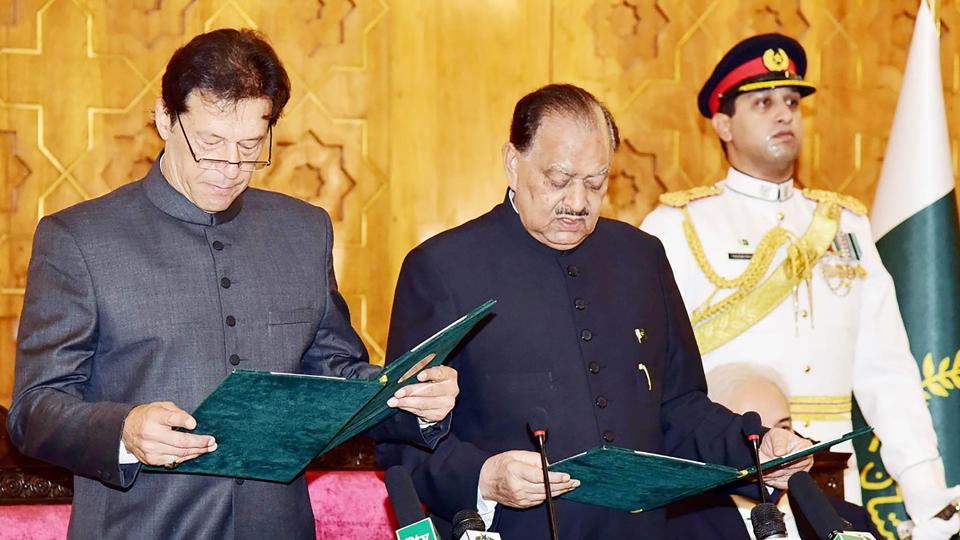
Khan, 65, wearing a traditional dark sherwani in the style of his hero, Pakistan’s founder Mohammad Ali Jinnah, was administered the oath by President Mamnoon Hussain.
Hundreds of guests, including politicians, members of Khan’s Pakistan Tehreek-e-Insaf (PTI) party, civil servants, diplomats and the military top brass, witnessed the ceremony. Khan’s third wife, Bushra Bibi, wearing a white burqa in which only her eyes were visible, was seated in the front row.
Army chief, Gen Qamar Bajwa, and former Indian cricketer, Navjot Singh Sidhu, who were seen embracing in television footage, were part of the audience. Wasim Akram and other members of the 1992 cricket World Cup winning team captained by Khan also attended the ceremony.
Amid mounting criticism of his behaviour, Sidhu said he had embraced Bajwa after the army chief told him of plans to open the route to Gurdwara Darbar Sahib at Kartarpur in Pakistan for Guru Nanak’s 550th birth in 2019.
As the Oxford-educated Khan read out his oath, the president corrected Khan at two points as he faltered and misread words. Khan, who earlier lifted his sherwani and exposed his white trousers, much to the amusement of the audience, while taking out his glasses, had problems pronouncing words and reading them.
After taking oath, Khan and his wife greeted several guests. The ceremony, scheduled to begin at 9.30 am, started a little after 10 am. Within about 20 minutes, Khan had been sworn in.
Members of Khan’s family were in attendance, though some of his sisters stayed away. There was no major opposition politician in the gathering. President Hussain, who was part of ousted premier Nawaz Sharif’s PML-N party, frowned through the ceremony. Khan appeared to snub him as he shook hands with caretaker premier Nasir-ul-Mulk and ignored the president.
Khan’s assumption of office marked the end of decades of rotating leadership between the PML-N and Pakistan People’s Party (PPP) — the two main political forces that have dominated the political scene when the military was not ruling Pakistan. However, no Pakistani premier has completed a full five-year term.
The July 25 election that brought the PTI to power was branded “Pakistan’s dirtiest”, with accusations during the campaign that the military was trying to tilt the field in Khan’s favour. The army and Khan have denied claims of “blatant” vote rigging.
The PTI emerged the single largest party with 116 seats, and its number reached 158 in the 342-member National Assembly after nine independent members joined it, the party was allotted 28 of 60 seats reserved for women and five of 10 seats for minorities.
Khan has promised to transform corruption-affected Pakistan into an Islamic welfare state. He has said his initial focus will be on reviving the battered economy. The Pakistani rupee has declined significantly in the past year, the trade deficit is widening and foreign exchange reserves have dwindled.
Analysts say the new government may need to turn to the International Monetary Fund for Pakistan’s second bailout since 2013.
Pakistan’s relations with India remain strained after terror attacks by Pakistan-based groups in 2016. The sentencing of Indian national Kulbhushan Jadhav to death by a military court in April last year has hit ties. The US has warned Pakistan and suspended security aid worth almost $2 billion due to Pakistan’s support to the Afghan Taliban and other terror groups.


