
 E-Paper



India raises Balochistan, Sindh at UNHRC
India has raised the human rights situation in Pakistani provinces such as Balochistan and Khyber-Pakhtunkhwa at the UNHRC session in Geneva.


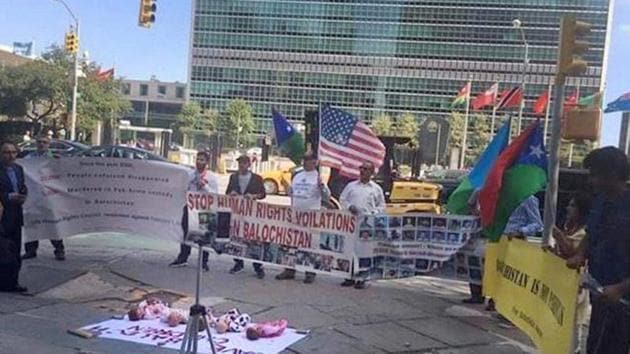
India has responded to Pakistan’s allegations of rights violations in Jammu and Kashmir at the ongoing session of the UN Human Rights Council in Geneva by highlighting alleged atrocities in the Pakistani provinces of Balochistan, Sindh and Khyber-Pakhtunkhwa.
The two countries clashed at the UNHRC session on Wednesday evening, with India’s permanent representative, Ajit Kumar, saying the “monster” of terrorist groups created by Pakistan is now “devouring its own creator”.
Under India’s “right to reply” after a statement by Pakistan law minister Zahid Hamid, Alok Jha, counsellor in the Indian mission, said Islamabad’s “trust in the methods of terror” was so deep it did not hesitate from using it against its own people.
Jha specifically mentioned Balochistan, Sindh and Khyber-Pakhtunwa provinces and the semi-autonomous tribal areas in northwest Pakistan in this regard.
“While advocating restraint to others, it has no hesitation in using air power against its own people...Pakistan will be well advised to focus its energies on setting its own house in order and acting against the perpetrators of terrorist attacks on its neighbours instead of ritually taking up alleged human rights violations elsewhere,” he said.
India also regretted that the Organisation of Islamic Cooperation delegates had used the UNHRC session to comment on Kashmir. The OIC statement, Jha said, reflected a “complete inability” to understand India’s position on the issue.
“OIC has no locus standi in matters concerning India’s internal affairs,” Jha said.
During the discussion on death penalty, India noted there was no international consensus for or against it. Characterising death penalty as a rights issue in the context of the right to life of a convicted prisoner was “deeply flawed” and best remained as the inalienable right and exclusive decision of a sovereign state, it said.
Virander Paul, deputy permanent representative, said: “In india, death penalty is exercised in the ‘rarest of rare’ cases, where the crime committed is so heinous as to shock the conscience of society.
“Indian law provides for all procedural safeguards, including the right to a fair hearing by an independent court, the presumption of innocence, the minimum guarantee for the defence, and the right to review by a higher court.”
Indian laws, Paul said, had specific provisions for suspending the death penalty in exceptional cases, and juvenile offenders cannot be sentenced to death under any circumstances. “Accordingly, the question of whether to retain or abolish the death penalty and the types of crimes for which the death penalty is applied should remain the inalienable right and exclusive decision of the sovereign state,” he added.
The session of the UNHRC runs from February 27 to March 24.


