
 E-Paper



Ketanji Brown Jackson confirmed: First Black woman to be US Supreme Court judge
US President Joe Biden, who committed to nominating a Black woman to the Supreme Court during his presidential election campaign, said Judge Ketanji Brown Jackson’s confirmation was a “historic moment”.

 Prefer HTon Google


WASHINGTON: With a historic Senate confirmation on Thursday, Ketanji Brown Jackson has become the first Black woman to rise up to become justice of the United States (US) Supreme Court.
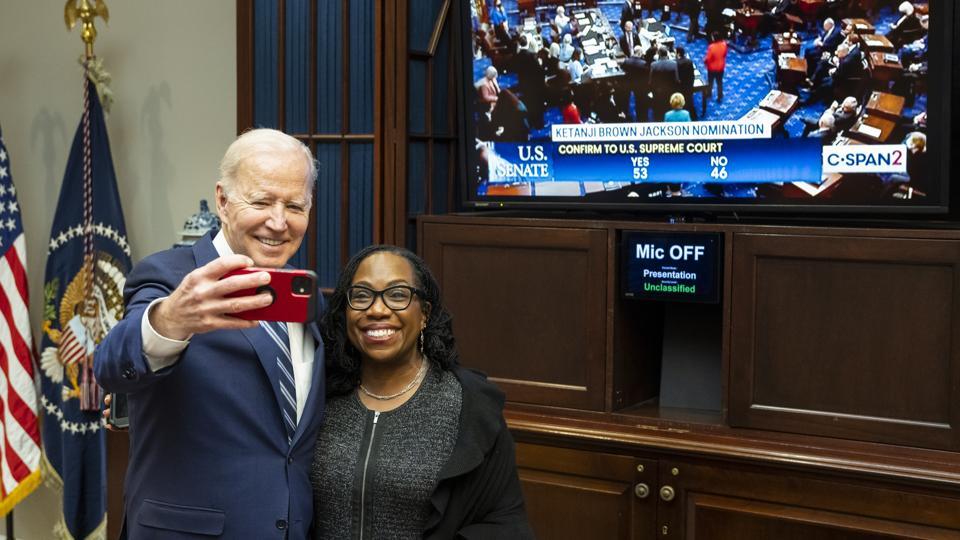
Jackson, nominated by President Joe Biden, served as a judge in the US Court of Appeals for the District of Columbia (DC) circuit, and had earlier served as a district court judge in DC between 2013 and 2021.
After a confirmation process, which saw Democrats hail her qualifications and acknowledge the need to make the court more inclusive and Republicans interrogate her on her jurisprudence in a manner that many saw as carrying racial overtones, the Senate voted to confirm 53:47, with three Republicans backing Jackson’s nomination.
During his presidential election campaign in February 2020, Biden committed to nominating a Black woman to the court. This was in the backdrop of debates around the embedded racial bias in thecriminal justice system, the lack of diversity and representation in the court, and a conservative turn in jurisprudence.
The Supreme Court has nine judges, with six who lean conservative or right (and were nominated by Republican administrations) and three who lean liberal (and were nominated by Democratic administrations). Justice Stephen G Breyer, who was nominated to the court by President Bill Clinton in 1994, announced his decision to retire in January — thus creating a vacancy for Biden to fill.
Jackson served as a former clerk to Breyer. A graduate of Harvard Law School, Jackson has also served as public defender — a White House statement had pointed out that she would be the first former public defender to serve as a Supreme Court judge — as well as the vice chair of the US sentencing commission, a bipartisan agency to reduce sentencing disparities.
The decision to nominate a Black woman to the court had drawn political criticism from the Republicans, who claimed that it was not race or gender but merit and judicial ability that should determine the nomination. Responding to that criticism, Biden said in February, that the person he nominates would be of “extraordinary qualifications, character and integrity”. “And that person will be the first Black woman ever nominated to the Supreme Court. It is long-overdue”.
There have only been two Black judges in the Supreme Court so far — Thurgood Marshall, who retired in 1991, and Clarence Thomas, who is still on the bench. Jackson also becomes only the sixth woman to become a Supreme Court judge; three are currently on the bench, and she becomes the fourth, making it the most gender-inclusive bench in the top court’s history.
Political observers believe that during the confirmation process, Democrats sent a message to their constituency about their commitment to the cause of justice and diversity, while the Republicans sought to tap into White anxieties and fears, often resorting to conspiracy theories.
Jackson’s nomination does not change the balance of the court. But it comes at a critical time when the Supreme Court is hearing cases on some of America’s most contentious issues such as gun rights, affirmative action, and perhaps most significantly, abortion — where the jurisprudence that followed the historic Roe vs Wade judgment of 1973, which upheld abortion rights and prohibited excessive restrictions till the stage of fetal viability, is at stake.


