
 E-Paper



‘Made in America’: Biden defends economic record, unveils plan to tame inflation
The US President said that the federal government spent $600 billion to keep the country secure, and would make sure this was oriented towards supporting American businesses


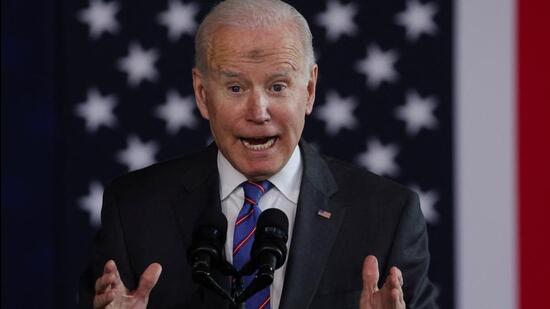
WASHINGTON: Dealing with what is the most pressing domestic challenge, United States (US) President Joe Biden, in his first State of the Union address, defended his economic record by citing growth and job figures, pledged to promote ‘Made in America’ products, recognising the key role of private sector in both innovation and jobs.
He also acknowledged the challenge posed by inflation, attributed it to the peculiarities of the pandemic-induced disruptions, and claimed that he had a plan to fight inflation by lowering costs — not lowering wages.
Defending the record
Biden spoke extensively about two legislations — America Rescue Plan and the bipartisan infrastructure law, focusing on the immediate positive consequences of the first and the long-term importance of the second.
The $1.9 trillion America Rescue Plan, the President said, provided “immediate economic relief for tens of millions of Americans”, fuelled vaccination efforts, and created jobs. “In fact, our economy created 6.5 million new jobs just last year — more jobs created in one year than ever before in the history of America. Our economy grew at a rate of 5.7% last year, the strongest growth in nearly 40 years.”
Claiming that the plan helped working class families, and ensured no one was left behind, Biden used the moment to attack the “trickle down” theory.
“For the past 40 years, we were told that if we gave tax breaks to those at the very top, the benefits would trickle down to everyone else. But that trickle-down theory led to weaker economic growth, lower wages, bigger deficits, and the widest gap between those at the top and everyone else in nearly a century.”
His vision, Biden said, was to invest in America, educate Americans, grow the economy from the bottom-up and middle-out. “Because, we know that when the middle class grows, the poor have a ladder up and the wealthy do very well.” He also slammed an unfair tax system and said it was time for corporations to pay their “fair share”.
Explaining the rationale of the infrastructure law, the President said that at one point, the US used to have the best roads, bridges and airports; now its infrastructure was ranked 13th in the world. “We won’t be able to compete for the jobs of 21st Century if we don’t fix that. That’s why it was so important to pass the Bipartisan Infrastructure Law— the most sweeping investment to rebuild America in history.”
Declaring that this was going to be an “infrastructure decade”, Biden said this would transform US and put it on a path to “win the economic competition of the 21st Century that we face with the rest of the world — particularly with China”. “As I have told Xi Jinping, it is never a good bet to bet against the American people.” These were among the few references to China in Biden’s speech, and notably, he framed it in terms of economic — rather than outright strategic — competition.
Biden also claimed that this would create jobs for millions, modernising roads, airports, ports, waterways, while withstanding the “devastating effects the climate crisis”. “Tonight, I am announcing that this year we will start fixing over 65,000 miles of highway and 1,500 bridges in disrepair.”
Made in America
In an echo of the economic nationalism that has deepened across all countries, and to ensure that the Republican flank did not capitalise on local grievances as they had during Donald Trump’s rise, Biden also declared a sharp focus on local jobs and local products, saying that while using taxpayer dollars to rebuild the US, “we are going to buy American products to support American jobs.”
He said that the federal government spent $600 billion to keep the country secure, and he would make sure that this was oriented towards supporting American businesses. “We will buy American to make sure everything from the deck of an aircraft carrier to the steel on highway guardrails are made in America.”
He claimed that companies were now choosing to build new factories here, when just a few years ago, they would have built them overseas — and cited Ford’s $11 billion and GM’s $7 billion investments in building electric vehicles as examples.
Biden called the Congress to pass the Bipartisan Innovation Act — which would see unprecedented investment in manufacturing, research and technology — in order to “level the playing field” with China. The US President recognised the role of private sector companies in boosting America’s competitive edge, singling out Intel for its $20 billion investment in a semiconductor plant.
Inflation
In a recognition of what is arguably his biggest political economy challenge, Biden acknowledged that “too many families” were struggling to keep up with the bills. “Inflation is robbing them of the gains they might otherwise feel. I get it. That’s why my top priority is getting prices under control.”
Explaining what he saw as the roots of the current bout of inflation, Biden said that the US economy bounced back faster than most had predicted, but businesses had a hard time hiring enough workers to keep up production, and separately, global supply chains were disrupted. “When factories close, it takes longer to make goods and get them from the warehouse to the store, and prices go up.”
Stating that one way to fight inflation was to “drive down wages and make Americans poorer”, Biden said he had a better plan — of lowering costs, not wages. And for this, he returned to his theme of ‘Made in America’.
“Make more cars and semiconductors in America. More infrastructure and innovation in America. More goods moving faster and cheaper in America. More jobs where you can earn a good living in America. And instead of relying on foreign supply chains, let’s make it in America.” He claimed this is what economists termed as “increasing the productive capacity of our economy.”
With a key Biden economic signature plan — Build Back Better — stuck in the Senate, due to opposition from people from his own party, the administration has more or less given up on being able to preserve the plan in its entirety. But Biden made an attempt to rescue parts of it in the speech, by pointing to key ingredients of the plan that would lower costs — and not increase the deficit. These included cutting the costs of prescription drugs, cutting energy costs for families on average of $500 a year, and cutting the cost of child care.
Biden said that lowering costs also entailed more competition and announced a crackdown on companies overcharging American businesses and consumers. “I am a capitalist, but capitalism without competition isn’t capitalism. It’s exploitation — and it drives up prices. When corporations don’t have to compete, their profits go up, your prices go up, and small businesses and family farmers and ranchers go under.”


