E-Paper



NASA’s new Roman telescope could find thousands of hidden worlds, probe forces of cosmos: ‘Weird, rare, unusual’
The telescope is designed to survey the universe at unprecedented speed. Its field of view is more than 100 times wider than that of the Hubble Space Telescope.

 Prefer HTon Google


A new NASA space telescope is on its way to scan vast stretches of the universe, hunt for thousands of planets and probe the mysterious forces shaping the cosmos.
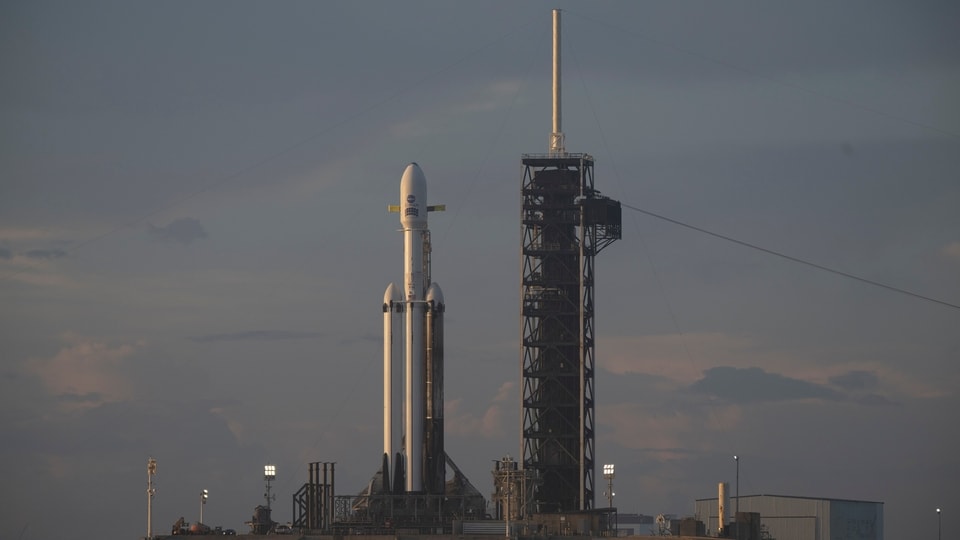
NASA launched the $4.3 billion Roman Space Telescope on Sunday aboard a SpaceX Falcon Heavy rocket from Kennedy Space Center, sending the bus-sized observatory towards an observation point about 1 million miles (1.6 million kilometres) away. The telescope will take more than three months to reach its destination, the Associated Press reported.
It will survey vast areas of space at unprecedented speed, helping scientists study parts of the universe that remain largely unexplored.
Named after Nancy Grace Roman, NASA’s first chief astronomer, the telescope is designed to survey the universe at unprecedented speed. Its field of view is more than 100 times wider than that of the Hubble Space Telescope.
“It’s going to find thousands of supernovae, tens of thousands of planets, billions of galaxies and tens of billions of stars,” NASA science mission director Nicky Fox said. “It’s going to be able to do things that we’ve never been able to do before with its massive field of view.”
Also Read: NASA once sent chicken eggs to space with funding from KFC
A century in a month
Roman’s biggest advantage is speed. A month of observations of the Milky Way by Roman would take Hubble a century to complete, according to senior project scientist Julie McEnery.
The telescope will scan the galactic bulge at the centre of the Milky Way, providing what McEnery said would be the deepest look yet into the heart of the galaxy.
Roman will work alongside Hubble and the James Webb Space Telescope, as well as the European Space Agency’s Euclid spacecraft and the National Science Foundation’s Vera C. Rubin Observatory in Chile.
Once Roman spots new worlds, Webb’s greater power and sensitivity will allow scientists to study them in greater detail.
“Roman’s vast reach will allow us to find the weird, the rare and the unusual,” McEnery said on the eve of launch. “We’ll redefine what it means to find a needle in a haystack.”
Hunting the invisible
Roman is also expected to help scientists understand dark matter and dark energy, which together are believed to make up about 95 percent of the universe, AFP reported.
Dark matter is thought to act as a kind of gravitational glue, while dark energy is believed to be a repulsive force driving the universe’s expansion.
With its infrared vision, Roman will detect light from celestial objects billions of years ago, allowing scientists to look back into the universe’s distant past.
The telescope’s wide view could also help determine how quickly the universe is expanding and shed light on the origins of dark matter and dark energy.
AFP reported that Roman’s observations could challenge existing ideas about the structure of the universe. McEnery said recent observations suggest that the standard model of the universe may be incorrect.
“Recent observations hint that our standard model of the universe is incorrect,” she said at a press conference on Saturday.
Roman will have a wide-field infrared camera that matches Hubble’s sensitivity but is 1,000 times faster. It also carries an experimental coronagraph designed to block out starlight and allow scientists to directly image planets orbiting a masked star.
The telescope is expected to discover thousands of exoplanets and tens of thousands of supernovae.
Roman launched nearly a year ahead of schedule and within budget. It is NASA’s first space telescope to be named after a woman.
The telescope is named after Nancy Grace Roman, who became known as the “Mother of Hubble”. She joined NASA in 1959 and argued that observatories above Earth’s obscuring atmosphere could see farther and better. She died in 2018 at the age of 93.
(With inputs from AP, AFP)