NASA’s Voyager 1 has become the first spacecraft to travel beyond a light-day from Earth, marking another milestone in its nearly 50-year journey through space. The space agency confirmed the achievement on Thursday, even as the ageing probe faces technical problems and runs low on power.
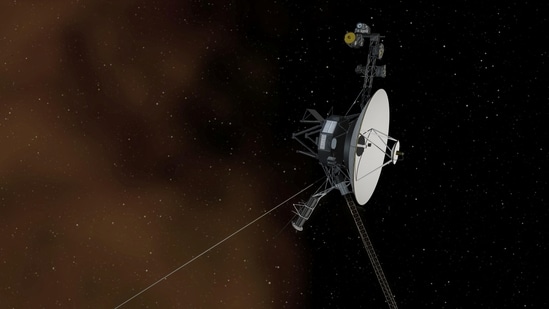
Voyager 1 crossed the distance that light travels in 24 hours, around 26 billion kilometers or 16 billion miles, on Wednesday at 5:16 am EST (10:16 GMT), NASA said. A radio signal sent by the spacecraft was received at the Deep Space Network facility in Madrid, Spain, according to news agency Reuters. The signals took almost a day to reach earth.
The milestone came 49 years, two months and 11 days after the spacecraft began its journey. Voyager 1 is currently the most distant human-made object in space.
NASA engineer Nshan Kazaryan announced the confirmation at the agency’s Jet Propulsion Laboratory (JPL) in California.
"After 16 billion miles of exploration, Voyager 1 continues its journey into the unknown," Kazaryan said according to Reuters.
{{/usCountry}}"After 16 billion miles of exploration, Voyager 1 continues its journey into the unknown," Kazaryan said according to Reuters.
{{/usCountry}}Also read: Voyager 1 becomes first human-made object to reach one light-day from Earth
NASA celebrates milestone as probe continues its journey
NASA officials and mission leaders welcomed the achievement, while acknowledging the challenges of keeping the ageing spacecraft.
"This is such an amazing day," Nicola Fox, NASA's head of science, said according to Reuters at a JPL event, praising the team "that just continues to let Voyager keep on trekking out there."
A light-day is the distance light travels in 24 hours, while a light-year measures the distance it covers in a year. One light-year is approximately 5.9 trillion miles (9.5 trillion km).
Fox said the mission would continue to hold scientific value even after communication with the spacecraft becomes impossible.
"When's the mission going to end? It's never going to end, even when we can no longer talk to Voyager," she said as cited by Reuters.
Voyager 1 is currently travelling towards the star Gliese 445, which is around 17 light-years from Earth. If it continues along its present path, it is expected to pass within about 1.7 light-years of the star in approximately 40,000 years.
Voyager 1 continues to send data from interstellar space
The spacecraft is travelling at nearly 38,000 miles per hour (61,000 km per hour). It entered interstellar space in 2012 after crossing the outer boundary of the heliosphere, a protective region formed by particles and magnetic fields from the Sun.
Before reaching interstellar space, Voyager 1 travelled past Jupiter and Saturn.
Its twin spacecraft, Voyager 2, was launched in 1977, a few weeks after Voyager 1. It entered interstellar space in 2018.
Voyager 1 continues to collect information about conditions beyond the heliosphere. Its observations include the effects of solar activity, such as storms and pressure fronts, as well as fast-moving particles known as galactic cosmic rays.
Also read: SpaceX pulls off first-ever spaceship ‘catch’ as Starship spacecraft returns from orbit | Video
Ageing spacecraft faces technical problems and power shortage
Despite reaching the milestone, Voyager 1 is showing signs of its age. The spacecraft stopped transmitting science and engineering data last week, although it has remained in contact with Earth. Voyager project manager Suzanne Dodd expressed confidence that the data transmission would resume.
The spacecraft is also facing a shortage of electrical power.
"And, meanwhile, we're running out of power," Voyager mission manager Kareem Badaruddin said as quoted by Reuters.
Recent power-saving measures could allow both Voyager spacecraft to remain in communication with Earth for another three to four years, a JPL representative said.
"The anomalies have become normal for us," Badaruddin said.
He added that the team was having to use modern technology to communicate with and manage the ageing systems aboard the spacecraft.
NASA has switched off several instruments on both probes to conserve the limited electricity generated by their plutonium power sources. Voyager 1 is now operating with two instruments, while Voyager 2 has three instruments still running.
"They're in an area of space that we've never been to, so every single bit of data that comes back is precious," Fox said.
Also read: SpaceX’s historic Starship catch could impact the future of space travel
Voyager 2 expected to reach milestone in 2035
While Voyager 1 has crossed the one-light-day mark, its twin is expected to reach the same distance in November 2035.
Dodd described Voyager 2 as being in very good health compared with its twin.
The mission's continued journey has also raised the possibility of sending more nuclear-powered spacecraft to study interstellar space. Fox said future missions would require substantial power to explore such distant regions.
Voyager deputy project scientist Jamie Rankin said the spacecraft's journey offered a reminder of the importance of continuing to explore despite challenges.
"I think that this should be a reminder to all of us," Rankin said, "that no matter how long it takes or how dark things get, or what we think our limitations are, we should never stop shining and never stop reaching for the stars — for we never know how far we will go," as quoted by Reuters.
(With inputs from Reuters)