
 E-Paper





Follow the latest breaking news, major developments and agenda-setting stories from India and around the world with the newsdesk at Hindustan Times. Operating round the clock, the desk brings together experienced editors, reporters and correspondents to deliver fast, accurate and contextual reporting across subjects that influence public policy, governance, business, society and international affairs. The HT News Desk covers politics, elections, government policies, the economy, business and markets, science and technology, the environment, law and order, infrastructure, education, climate issues and geopolitics, while closely tracking developments across states, institutions and global capitals. The team also leads coverage of major breaking news events, policy announcements, court proceedings, natural disasters, public emergencies and significant international developments. Reports published by the newsdesk are based on information gathered from reporters on the ground, official statements, government agencies, court records, regulatory filings, recognised institutions and other authoritative sources. Stories undergo editorial scrutiny and verification processes to ensure accuracy, fairness and relevance, and are updated as events evolve and additional information becomes available. Whether covering a key political decision in New Delhi, an economic policy shift affecting millions, a landmark court ruling or a major global event, the HT News Desk aims to provide readers with reliable, fact-based journalism that delivers not only the latest developments but also the context and analysis needed to understand their wider implications.
 Trending News
Pakistan minister claims terror policy turnaround in talks with US
Foreign minister Khawaja Asif urged the US to take note of “gross human rights violations” being perpetrated by Indian security forces in Kashmir.


On notice from the Trump administration, Pakistan has tried to convince the US it is pursuing a “zero-tolerance and indiscriminate” approach to combating terror while complaining that its contribution to counter-terrorism had been ignored by America’s new South Asia strategy.
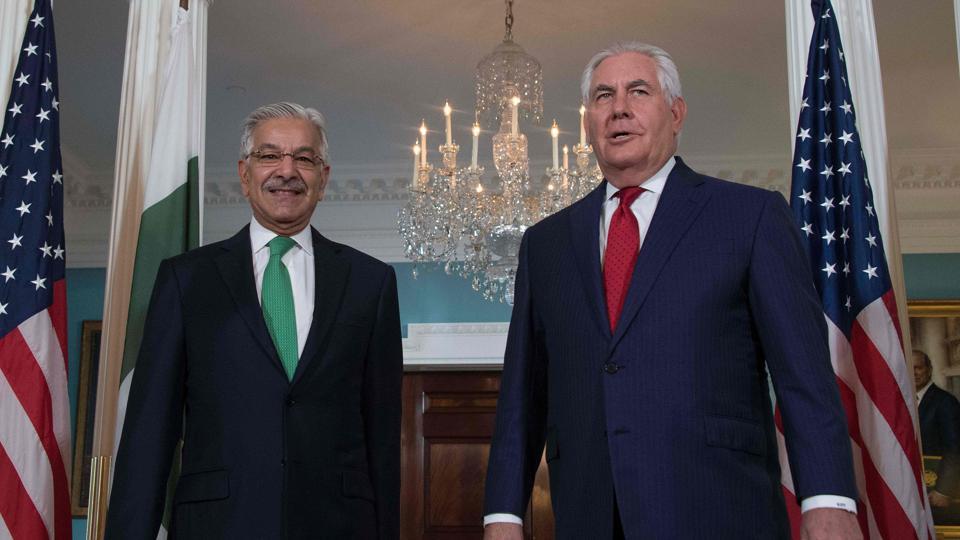
Foreign minister Khawaja Asif told secretary of state Rex Tillerson that Pakistan has “pursued a zero-tolerance and indiscriminate approach in its campaign against all terrorist and militant groups”, according to a statement from Pakistan’s foreign ministry.
Pakistan has been accused by the US, and most other nations including neighbours India and Afghanistan, of giving terrorists safe havens and acting against them only selectively, distinguishing good terrorists who serve Pakistani interests from the bad, those who don’t.
The US has cut aid and other payments to Pakistan as punishment for those same cynical choices Islamabad has turned into policy, and even cancelled a proposal to sell it eight new F-16 fighter jets.
President Donald Trump’s new South Asia strategy calls for a tougher US posture with Pakistan for the same reasons. “We can no longer be silent about Pakistan’s safe havens for terrorist organisations,” he said unveiling it in August, effectively putting Pakistan, a major non-Nato ally with military benefits, on notice.
Trump also proposed a larger role for India in Afghanistan, economically and developmentally, expanding its current footprint.
Islamabad had felt terribly disappointed — jilted, proverbially — and cancelled pre-arranged high-level official exchanges in retaliation, and Asif had put off a planned visit to the US and travelled to China instead, in a ploy to play off Pakistan’s two major benefactors against each other.
On Wednesday, Asif was down in a room with Tillerson, complaining about the “strong public reaction in Pakistan to the pronouncement of the US administration's South Asia policy - based on inadequate recognition of Pakistan's sterling contribution in the fight against terrorism”.
And, pushing the victimhood card, Asif griped about Afghanistan, the civil war-torn impoverished neighbour — “in addition to huge human and material cost incurred by Pakistan, our cultural ethos as a moderate state had suffered due to protracted instability in Afghanistan”.
The US state department readout of the meeting did not reflect or register the complaint lodged by Asif. “The foreign minister and the secretary talked about the President’s South Asia strategy...that was announced back in August,” state department spokesperson Heather Nauert told reporters.
Tillerson went much further on the US position on Pakistan, in the context of the South Asia policy, while speaking ahead of the meeting: “We have concerns about the future of Pakistan’s government too, in terms of them – we want their government to be stable. We want it to be peaceful.”
The state department has not explained Tillerson’s concerns about the Pakistan government. But Tillerson’s thinking on the issue came through a bit in a follow-up remark: “And many of the same issues they’re struggling with inside of Pakistan are our issues. So we think there is opportunity for us to strengthen that relationship.”
The Pakistanis felt strangely buoyed by what they thought they had heard from Tillerson. In the words of the foreign ministry: “He (Tillerson) remarked that Pakistan's interests and concerns will be accommodated since its role was critical to President Trump's South Asia strategy. He added that future stability of Pakistan was an important element of the strategy.”
Most importantly for some in Pakistan, Asif did not forget India. “The foreign minister urged the United States to take note of the gross human rights violations being perpetrated by Indian security forces in occupied Kashmir,” said the statement, adding, “He said peace in South Asia would remain out of reach until the resolution of all longstanding disputes, including the core dispute of Jammu and Kashmir.”


