
 E-Paper



Queen Camilla unveils British Indian spy Noor Inayat Khan's portrait: Who is she
Noor Inayat Khan was a member of RAF’s Women’s Auxiliary Air Force (WAAF) when she was recruited to the SOE in 1942.

 Prefer HTon Google


Britain's King Charles' wife Queen Camilla unveiled a new portrait of the Indian-origin spy and descendent of Tipu Sultan, Noor Inayat Khan at the Royal Air Force (RAF) Club to honour her sacrifice as an undercover agent for Britain's Special Operations Executive (SOE) during the World War II. The royal formally named a room at the RAF Club as “Noor Inayat Khan Room” which houses the portrait.
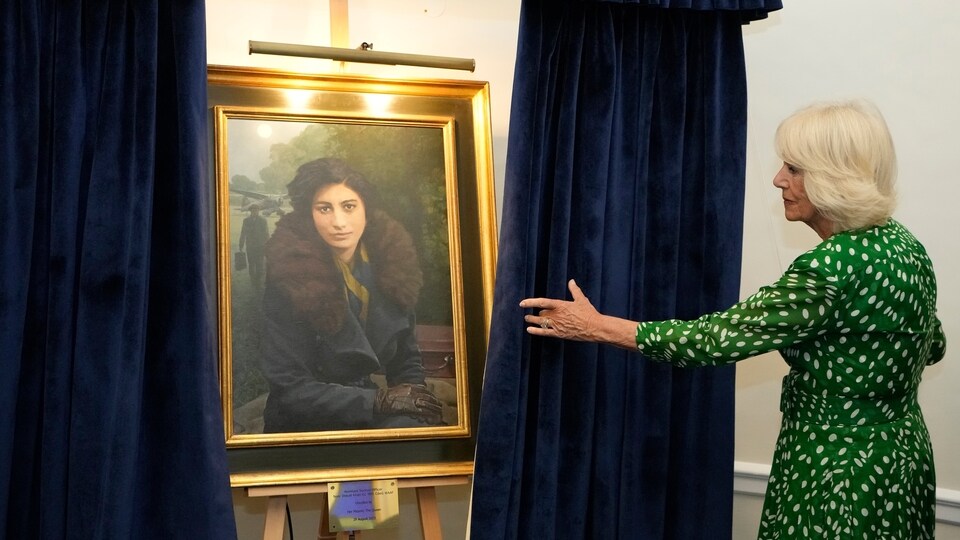
Noor Inayat Khan was a member of RAF’s Women’s Auxiliary Air Force (WAAF) when she was recruited to the SOE in 1942. She then became one of only two members of the WAAF to be awarded the George Cross (GC) which is the highest award bestowed for heroism.
"It was a proud moment to have the Queen unveil the portrait of Noor Inayat Khan at the RAF Club,” British Indian author Shrabani Basu, who presented a copy of her biography of Noor – 'Spy Princess: The Life of Noor Inayat Khan' – to the Queen, said at the unveiling ceremony.
"For me, it has been a privilege to tell her story. This wonderful portrait will now be seen by many young men and women for generations. Noor's story will never be forgotten," she added.
Watch: Tomato, food fights but goggles must at Spain's La Tomatina festival
Who is Noor Inayat Khan?
Noor Inayat Khan was born Noor-un-Nisa Inayat Khan in Moscow in 1914 to an Indian sufi saint father and American mother. She then moved to London at a young age before settling in Paris for school. Following the fall of France during the Second World War, she escaped to England and joined the WAAF. In 1942, she was recruited into the SOE.
"Noor was the first woman SOE operator to be infiltrated into France, and was landed by Lysander aircraft on 16 June 1943. During the following weeks, the Gestapo arrested most of the Paris Resistance Group in which she worked. Despite the danger, Noor refused to return to England because she did not wish to leave her French comrades without communications and she hoped also to rebuild the Group,” the RAF Club said in a statement.
"The Gestapo had a full description of Noor, who they knew only by her code name ‘Madeleine’, and in October 1943 she was captured by them. Despite brutal interrogation she refused to give any information, either as to her work or her colleagues. She was imprisoned in Gestapo HQ, during which time she made two unsuccessful attempts at escape, and was then sent to Germany for so called ‘safe custody’. She was considered to be a particularly dangerous and uncooperative prisoner,” it noted.


