
 E-Paper



Shouldn’t become sanctuary for terror groups to attack others: Brics on Afghanistan
The Delhi Declaration issued after a virtual summit of Brazil-Russia-India-China-South Africa (Brics) expressed concern at developments in Afghanistan and made a call for “refraining from violence and settling the situation by peaceful means”.


The Brics grouping on Thursday asserted Afghanistan’s territory shouldn’t become a sanctuary for terror groups to mount attacks on other nations and called for an inclusive intra-Afghan dialogue to ensure stability and peace in the war-torn country following the Taliban takeover.
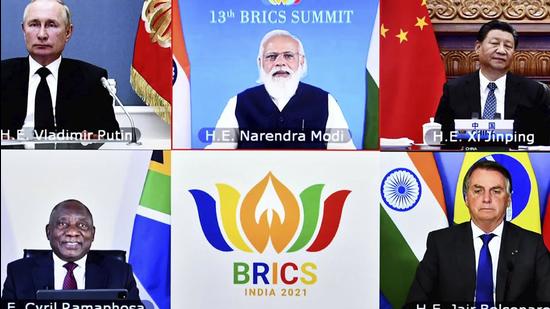
The Delhi Declaration issued after a virtual summit of Brazil-Russia-India-China-South Africa (Brics) expressed concern at developments in Afghanistan and made a call for “refraining from violence and settling the situation by peaceful means”. The grouping highlighted the importance of fighting terror and upholding human rights, including those of women and minorities.
The strongly worded joint statement came two days after the Taliban unveiled an interim setup in Kabul led by Mohammad Hasan Akhund and dominated by 17 leaders sanctioned by the UN Security Council. Despite recent remarks by Taliban leaders that they would form an inclusive government, the new regime comprised mainly members of the group’s old guard and top military commanders such as Sirajuddin Haqqani.
The Delhi Declaration, issued at the conclusion of the summit, said: “We underscore the priority of fighting terrorism, including preventing attempts by terrorist organisations to use Afghan territory as terrorist sanctuary and to carry out attacks against other countries, as well as drug trade within Afghanistan.”
While calling on all parties to refrain from violence and to settle the situation through peaceful means, the declaration added, “We stress the need to contribute to fostering an inclusive intra-Afghan dialogue so as to ensure stability, civil peace, law and order in the country.”
The Brics members condemned the terrorist attacks near Kabul airport on August 26 that resulted in the death of more than 180 people, mostly Afghans and 13 US military personnel. They also emphasised the need to address the humanitarian situation and to “uphold human rights, including those of women, children and minorities”, the declaration said.
Russian President Vladimir Putin was the only one of the five leaders to raise the situation in Afghanistan in the televised opening remarks, saying all members of Brics do not want Afghanistan to remain a threat to its neighbours, or Afghan soil to be a source of drug trafficking and terrorism.
Prime Minister Narendra Modi noted in his opening remarks that the grouping had adopted the Brics Counter-Terrorism Action Plan. The plan is aimed at implementing the Brics counter-terrorism strategy adopted by the national security advisors and defines the approach for cooperation in this field, including joint efforts to identify and respond to “persistent and emerging terror threats”.
People familiar with developments said on condition of anonymity that the situation in Afghanistan and the threat of terrorism emanating from Afghan soil figured extensively in the closed deliberations between the five leaders. Putin highlighted the dangers posed by terrorism while Brazil President Jair Bolsonaro pointed to the problem of narcotics originating from Afghanistan, the people said.
“The Russian position, as outlined by President Putin and Nikolai Patrushev, the secretary of Russia’s security council, during his visit this week, is very similar to India’s position and we have similar concerns regarding Afghanistan,” one of the people cited above said.
Briefing the media after the summit, secretary Sanjay Bhattacharyya, who is the Sherpa to Brics, said a key outcome of the meeting was a “very strong sense of consensus” on Afghanistan, which supports India’s perspective on developments in the war-torn country and the region.
“There was a very strong condemnation of terrorism and that Afghan territory should not be used either for terrorism or for drug trafficking, and that it should not become a reason for problems in the neighbourhood,” he said. The role of the UN Security Council in addressing the humanitarian aspects of the situation was highlighted, he said.
Putin, in his opening remarks, said close partnership between the Brics states is required because the situation across the world remains turbulent and long-standing regional conflicts were flaring up with renewed vigour.
“The withdrawal of the US and its allies from Afghanistan has led to a new crisis and it’s still unclear how this will affect regional and global security,” he said.
Russia and its Brics partners have “consistently advocated the establishment of long-awaited peace and stability on Afghan soil”, and the people of the country have “fought for many decades and earned the right to independently determine what their state will be like”, Putin added.
“We are all interested in Afghanistan ceasing to be a threat to the neighbours, so that terrorism and illegal drug trafficking threaten us from Afghan territory. We are interested in stopping migration flows. We stand for Afghans to be able to live peacefully and with dignity in their homeland,” he said.
Putin also said that the current crisis in Afghanistan stems directly from “irresponsible attempts to impose alien values from the outside and the desire to build so-called democratic structures using methods of socio-political engineering without taking into account either the historical or national characteristics of other peoples and ignoring their traditions”.
“All this results in destabilisation and chaos, after which the authors of these experiments back down, abandoning their charges to their fate. The entire international community will have to clear up the mess as a result,” Putin said, without naming the US.
Bhattacharyya said all the leaders focused on post-Covid-19 recovery and vaccines during their deliberations in light of the widespread disruption caused by the pandemic. Modi noted that the post-pandemic agenda of Brics should focus on building back, resilience, innovation, credibility and sustainability.
The leaders discussed the need for extensive vaccination and the development of vaccines. A vaccine R&D centre is now being proposed as a virtual network to facilitate the development and distribution of vaccines.
The Delhi Declaration regretted the “glaring inequity in access to vaccines, diagnostics and therapeutics, especially for the world’s poorest and most vulnerable populations” and highlighted the “importance of safe, efficacious, accessible and affordable vaccines”.
The leaders also discussed the reforms of multilateral bodies such as the UN Security Council in view of a long-standing feeling that the existing systems need to respond to the needs of global governance and be more responsive.
There were also discussions on the New Development Bank (NDB), which has emerged as a flagship project in economic and financial cooperation between Brics members. The bank has provided funding worth $29 billion to 73 infrastructure projects, including $7 billion for 18 projects in India.
The Delhi Declaration further said the world community has a “collective responsibility to work together against the Covid-19 pandemic” within existing international frameworks such as the WHO, and noted that cooperation on the “origins of the SARS-COV-2 is an important aspect of the fight”.
It added, “We support science-based, inclusive of broad expertise, transparent, and timely processes, free from politicisation or interference, to strengthen international capabilities to better understand the emergence of novel pathogens and to help prevent future pandemics.”


