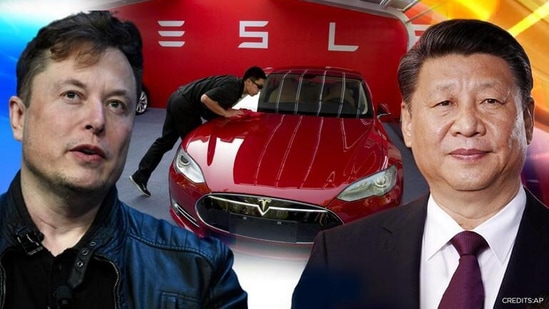
Tesla is security concern for China before crucial 20th Party Congress
'Eternal leader' Xi Jinping, who has already revamped the powerful Central Military Commission with generals loyal to him, is expected to get another five-year term later this October.
Tesla cars will not be allowed to enter the Chinese coastal district of Beidaihe - where the Communist Party holds a secretive annual summer conference that traditionally discusses major policy decisions and personnel moves - for at least two months starting from July 1. This year, in the run-up to 20th Communist Party Congress in Beijing, the coastal town in Heibei province will host a 15-day retreat of top present and past leaders of the Communist Party of China, with President Xi Jinping discussing the future of the People's Republic with past leaders like Jiang Zemin and Hu Jintao. This meeting of elders in August is a usual secretive affair with no media or outsiders allowed.
Tesla, Inc. founder Elon Musk and Chinese president Xi Jinping
{{^htLoading}} {{/htLoading}}
Tesla owners have been told to submit an undertaking - which has been seen by Hindustan Times and which says "I ___ promise to undertake that from 1.7.2022 to 31.8.2022 I would not drive the car with plate number ___ and enter Beidhaihe district or drive the car inside Beidaihe district..."
Restrictions on Tesla cars in Beidaihe - also reported by Reuters - come weeks after they were barred from some roads in Chengdu early this month, just as president Xi Jinping was in the city.
More crucially, the Beidhaihe restrictions mean a different light can be cast on the forthcoming 20th meeting of the Communist Party Congress in October this year, at which 'eternal leader' Xi Jinping will be 'elected' to another five-year term and cement his all-powerful position within the government.
{{^htLoading}} {{/htLoading}}
Undertaking to be signed by Tesla car owners ahead of Beidaihe meeting
{{^usCountry}}
Xi has already restructured the Central Military Commission, of which he is chairman, and has brought in generals who are loyal to him and have served with him in the past.
{{/usCountry}}
{{#usCountry}}
Xi has already restructured the Central Military Commission, of which he is chairman, and has brought in generals who are loyal to him and have served with him in the past.
{{/usCountry}}
Why is China wary of Tesla cars?
The restrictions come amid China's suspicion of cameras on Tesla cars - the Model 3 has eight, as well as millimetre-wave radar and 12 ultrasonic sensors.
{{^htLoading}} {{/htLoading}}
The Chinese government claims these cameras pose potential security threats; last year Tesla cars were banned from military complexes.
Tesla cars have external cameras to assist drivers with parking, changing lanes and other features.
Automakers are increasingly using cameras to aid in navigation and parking but control of these images - storage and use - is becoming a challenge for the industry and global regulators.
Tesla founder Elon Musk has said his cars do not spy in China, or anywhere else, and that the company would be shut down if this was the case.
Tesla has since also said data generated by cars it sells in China - including images and sensor data - will be stored in that country.
Shishir Gupta is Executive Editor at Hindustan Times and one of India's top journalists covering national security, strategic affairs, foreign policy and geopolitics. Over the past three decades, he has extensively reported on India's military, diplomatic and security landscape, covering every major conflict and national security challenge, from the 1999 Kargil War and the 2020 East Ladakh standoff to Operation Sindoor in 2025. He has also covered major terror attacks, including the IC-814 hijacking, the 26/11 Mumbai attacks and the 2025 Pahalgam terror strike, along with numerous Pakistan-backed terrorist incidents in the Kashmir Valley and across India. He has reported on national and state elections for more than three decades. A recognised authority on strategic affairs, Gupta has covered India's nuclear programme since the Pokhran-II (Shakti series) tests in May 1998 and has written extensively on global nuclear issues, Indian diplomacy and the country's expanding global outreach. He has also reported widely on international conflicts and terrorism, with a special focus on the Indian subcontinent. Gupta has interviewed Prime Minister Narendra Modi more than four times, including Modi's first interview with the print media after becoming Prime Minister in May 2014. His other interviews include three with the Dalai Lama, as well as conversations with Benjamin Netanyahu, Amit Shah, Yogi Adityanath, S. Jaishankar, Nirmala Sitharaman and Piyush Goyal. He is the author of Indian Mujahideen: The Enemy Within (Hachette, 2011) and Himalayan Face-off: Chinese Assertion and Indian Riposte (Hachette, 2014). He was awarded the Chevening-Wolfson Joint Scholarship at Wolfson College, University of Cambridge, UK, in 1998 and participated in the International Visitor Leadership Program (IVLP) of the US State Department in 2006. He received the Ben Gurion Prize from Israel in 2011 and the K. Subrahmanyam Prize for Strategic Studies in 2015 from the Manohar Parrikar Institute for Defence Studies and Analyses (MP-IDSA). Since 2024, he has hosted Point Blank, Hindustan Times' weekly YouTube show on global geopolitics.
Get the latest World News, breaking headlines and global updates from the US, UK, Pakistan, Bangladesh, Russia and other countries. Follow major international events on Hindustan Times.
Get the latest World News, breaking headlines and global updates from the US, UK, Pakistan, Bangladesh, Russia and other countries. Follow major international events on Hindustan Times.
Home/World News/Tesla is security concern for China before crucial 20th Party Congress
{{^htLoading}}
Advertisement
{{/htLoading}}
SHARE THIS ARTICLE ON
{{#usCountry}}{{/usCountry}}
Notifications
Get breaking alerts directly from the newsroom
Notifications are on!You'll be notified when news breaks