
 E-Paper


The ‘Smart’ Restrooms That Can Solve America’s Public Bathroom Crisis
Throne Labs is betting that Uber-like ratings and privacy-protecting sensors can lead to a better, more enduring system of public toilets.


 Prefer HTon Google


When it comes to the prevalence of public toilets, one analysis suggests the U.S. ranks 30th in the world, tied with Botswana.
The obvious solution—just build more of them—doesn’t work.
New public bathrooms quickly become the kind of park facilities we’ve all had the unfortunate experience of entering in a moment of dire necessity, and then slowly backing away from.
The fix? Smart systems that leverage technology not only to monitor and secure bathrooms, but also to nudge users to behave themselves while inside. The new approach—which can be deployed quickly and at scale—even borrows a nerdy refrain from the tech industry: “bathroom as a service.”
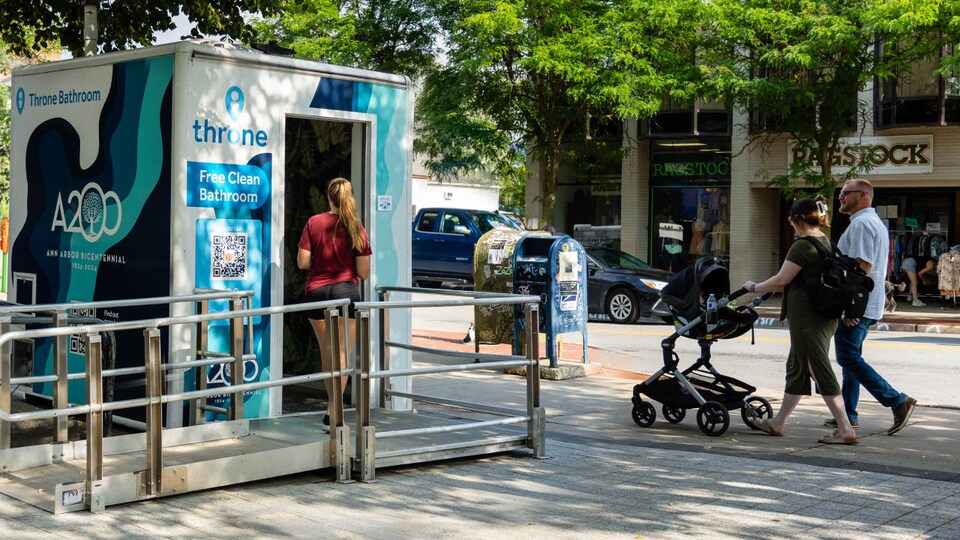
In the U.S., these kinds of loos are currently only offered by Washington, D.C.-based Throne Labs.
The brains behind Throne start by getting real about why Americans usually can’t have nice things. (Case in point: New York City’s latest public toilets.) They assume a cultural inability to protect and maintain shared assets, and design their system with software and just enough internet-connected sensors to monitor the facilities without violating our expectation of privacy. Accessing one of these free bathrooms means verifying yourself digitally, in a way that isn’t linked to your real identity but can be used to restrict your access if you misbehave.
If Throne and other up-and-comers can persuade enough cities to pay for them—an important question, since cities are always strapped for cash—more Americans could soon have a place to answer nature’s call without first buying a drink at Starbucks.
Locked but open
Throne’s solution relies on gating access to their facilities, but in a way the company’s founders insist means they remain accessible to all. Users are associated with a unique identifier via an app or text message, so dumbphones work too. (In rare cases, those who don’t have a phone can get a keycard.) If you mess up the bathroom, you’re given a warning, and if you’re a repeat offender, you could lose your potty privileges. It’s similar to an Uber rider score, says Throne Labs Chief Executive Fletcher Wilson.
Throne bathrooms also have smoke sensors to detect if someone smokes in them, and occupancy sensors. They limit any given session to 10 minutes. After a warning, the doors will pop open. Everyone is asked upon entry to rate the cleanliness of the bathroom. If a bathroom needs cleaning, a Throne employee is dispatched for a cleanup.
A look inside a Throne bathroom. If you mess it up, the company can ban you for life—or at least until you get a new mobile number.
The best sign of the potential of Throne’s system comes from America’s long-suffering civil servants.
“The experience for people has been almost nothing but positive,” says Derek Delacourt, who oversees several city operations and services for Ann Arbor, Mich. “You rarely get that in public service anymore.” The city tested 10 Thrones in a year-long program that included 100,000 uses, and ended up signing a five-year contract to keep eight of them.
“The ratings of these bathrooms have been through the roof,” he adds.
In Los Angeles, the region’s Metro system has deployed 20 Throne bathrooms and has plans to add 44 more, in anticipation of events such as the 2026 World Cup and 2028 Olympics. One of the city’s first deployments was at the Metro station in MacArthur Park, in a densely populated area ravaged by the opioid epidemic.
A sort of community-policing mechanism took hold around the bathroom, as the unhoused people who relied on it for a clean and dignified place to deal with life’s necessities took pains to make sure no one messed it up, says Stephen Tu, head of station experience for LA Metro.
“We knew that if it could withstand some of the greatest societal challenges at that location, we were confident that we could expand this to other stations,” he adds.
Off-grid advantages
Another differentiator for Throne is that the bathrooms are entirely off grid. You might even call them high-end Porta Potties, although the company’s founders wince when you do.
Each prefabricated bathroom has running water from a built-in supply, solar power on the roof, and flush toilets that empty into a built-in storage tank. The bathrooms must be refilled and emptied regularly, but the company can monitor use and adjust the service frequency, says Jessica Heinzelman, chief operating officer of Throne. They can be serviced less often than conventional bathrooms, which are tended on a set schedule, or more often if a big event is happening.
Alternatives to Throne also leverage smart tech, but they go the route of traditional infrastructure. Quebec-based Urben Blu, for example, makes prefabricated, self-cleaning bathrooms.
After every use, the toilet is cleaned and dried; at preset intervals, cascading sheets of soapy water flush across the floor. There are more than 100 of the company’s bathrooms installed in North America, including in Toronto and Albany, N.Y.
The stalls echo the self-cleaning “sanisettes” of Paris, a staple since the 1980s now numbering 400.
In the U.S., building conventional public bathrooms can be hideously expensive. A single toilet in San Francisco had an initial projected cost of $1.7 million. And that’s just the capital expenditure—the real killer is the operating costs, which can run to the tens of thousands a year.
City planners who have contracts with Throne told me that using them is less costly than building and maintaining new bathrooms, but that it’s hard to make an apples-to-apples comparison with conventional ones. For example, the LA Metro system has contracted with Throne for 30 locations at a cost of $2.71 million for all of 2025, for a cost of about $90,000 per location a year.
That might sound high, but it includes everything—the facility and all its servicing—and compares favorably with typical costs to build a new bathroom, connect it to services and maintain it. Importantly, Throne’s bathrooms can be rolled out overnight, as opposed to the years it can take to plan, commission and build a conventional new bathroom.
By gating access, detecting when bathrooms need servicing, being solely responsible for cleaning and maintenance and eliminating connections to municipal sewer, water and power, a company like Throne makes deployment much easier, says Ann Arbor’s Delacourt. One of the city’s Thrones is outside a homeless shelter, where its regular users guard it zealously, he says.
Throne has deployed more than 100 of its self-contained comfort stations across the U.S. to date, and plans to continue enhancing them: A smell sensor, for instance, could dial up the ventilation system in the event of excessively foul odors. However they innovate in the future, the company’s founders have promised that their sensors—and your data—won’t be used in a way that impinges on anyone’s privacy.
“It won’t be tied to individual users,” says Heinzelman, “so it won’t be like, ‘This person blew up the toilet.’”
Write to Christopher Mims at christopher.mims@wsj.com


