U.S. Says Government Employee Blocked from Leaving China
The exit ban on an employee of the U.S. Patent and Trademark Office comes after Beijing confirmed imposing similar restrictions on a Wells Fargo banker.
China has blocked a U.S. government employee from leaving the country after the person traveled there in a personal capacity, the U.S. Embassy in Beijing said.
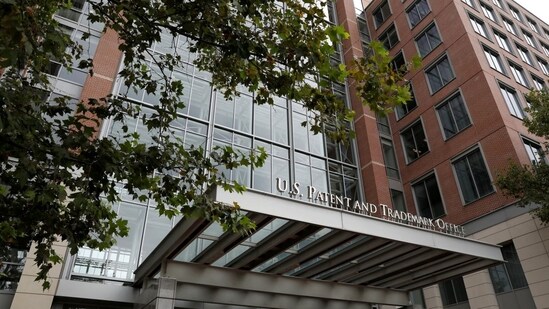
The U.S. Patent and Trademark Office in Alexandria, Virginia.
The employee of the U.S. Patent and Trademark Office was “made subject to an exit ban in China,” a spokesperson for the U.S. Embassy said Tuesday. “We are tracking this case very closely and are engaged with Chinese officials to resolve the situation as quickly as possible.”
The embassy spokesperson didn’t disclose the employee’s identity or any specifics around the person’s visit to China. The USPTO is an agency under the Commerce Department.
A spokesman for China’s Foreign Ministry said he didn’t have details to offer when asked about the exit ban during a regular briefing on Tuesday. “China is a country with rule of law and all matters concerning entry and exit are handled in accordance with the law,” said the spokesman, Guo Jiakun, who neither confirmed nor denied the exit ban.
The Washington Post earlier reported the exit ban on the USPTO employee. According to the Post, which cited people familiar with the matter, a U.S. citizen who works for the office had traveled to China several months ago to visit family and was prevented from leaving after he failed to disclose on his visa application that he worked for the U.S. government.
In a separate report that cited a U.S. State Department cable, the New York Times said the USPTO employee was subjected to an exit ban in mid-April and has been interrogated by Chinese intelligence officers about his past service in the U.S. military.
The exit ban was imposed amid fractious ties between the U.S. and China, as President Trump levied tariffs on Chinese goods and imposed export controls on advanced U.S. technology. Trade tensions have continued to simmer, even as both governments agreed to a tentative truce in June.
The disclosure comes after China’s Foreign Ministry confirmed that similar restrictions had been imposed on Wells Fargo banker Chenyue Mao.
Mao has been blocked from leaving the country because she is required to assist in a criminal probe, the ministry said Monday.
Wells Fargo has suspended all travel to China after the exit ban on Mao, a Shanghai-born managing director based at its Atlanta office, the Wall Street Journal reported last week, citing people familiar with the matter.
Western officials and human-rights groups say the use of exit bans has become increasingly common in China, where authorities have imposed such measures on people being investigated or asked to assist government probes. Often, people targeted don’t know that they are subject to such bans until they try to leave mainland China.
Beijing has imposed travel restrictions on both Chinese and foreign nationals. Most exit bans aren’t imposed on people accused of crimes but have targeted those involved in civil litigations such as business disputes.
In other cases, the bans are implemented to facilitate criminal probes, intimidate dissidents or even create leverage in disputes with foreign companies and governments. Exit bans can last for months or years as the investigations that prompted the restrictions drag on.
According to the Times report, officers working for China’s Ministry of State Security—the country’s main civilian intelligence agency—seized the man’s passport, credit card, cellphone and iPad on April 14 while he was in the southwestern city of Chengdu. The officers later returned the man’s passport and the man traveled to Beijing in early May accompanied by U.S. Embassy officials, the report said.
The USPTO employee told U.S. diplomats that the questioning by Chinese officers focused heavily on his background in the U.S. military, the Times report said. The man told the Chinese officers about an entry-level job he had held at a nuclear institute in China, his graduate studies in engineering at a university in Puerto Rico and his work maintaining Black Hawk helicopters while he was in the U.S. Army, the report said.
Get the latest headlines from US news and global updates from Pakistan, Nepal, UK, Bangladesh, Russia and US Iran war Live, get all the latest headlines in one place on Hindustan Times.
Home/World News/U.S. Says Government Employee Blocked From Leaving China

 E-Paper