
 E-Paper



Venezuela Mobilizes Troops and Militias as U.S. Military Looms Offshore
Nicolás Maduro says his country is ready for combat, though the strongman’s military is underfunded, ill-trained and no match for American firepower


 Prefer HTon Google


Venezuela is moving troops into position on the Caribbean coast and mobilizing what President Nicolás Maduro asserts is a millions-strong militia in a display of defiance against the biggest American military buildup in the Caribbean since the 1980s.
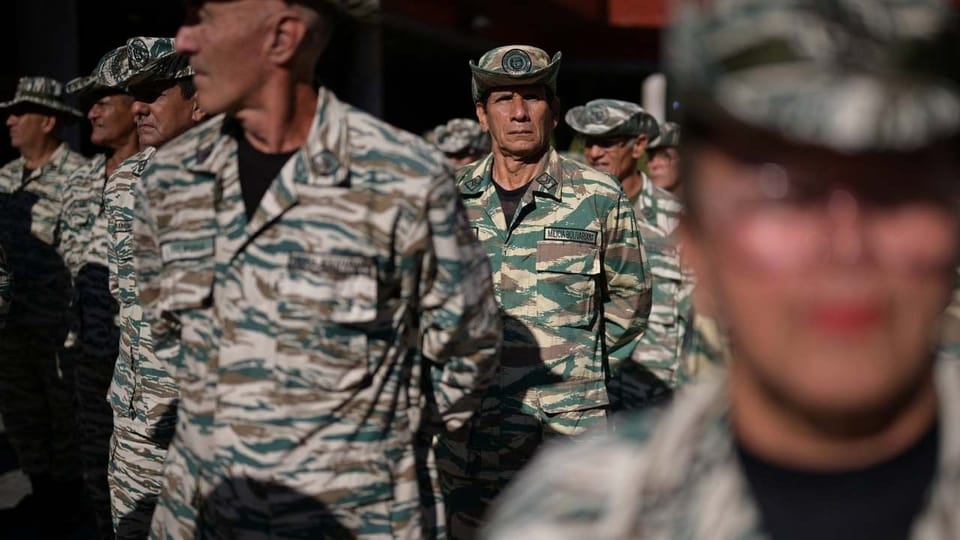
The strongman’s regime has cranked up its propaganda machine. On state television, radio and social media, announcers are telling Venezuelans that the U.S. is a rapacious Nazi-like state that wants to dig its claws into the country’s oil wealth but that the Venezuelan military, the National Bolivarian Armed Forces, are positioning to repel any invasion.
Footage has shown militia members—men and women; often elderly, slightly plump Venezuelans—running obstacle courses, crawling under barbed wire and firing rifles. The Venezuelan armed forces, which military experts say on paper number 125,000 soldiers, are shown marching in formation, with troops mounting armored vehicles and moving boxes of munitions around. The country’s Russian-made jet fighters are featured in footage shooting across the skies.
“The people are ready for combat, ready for battle,” Maduro told a crowd of supporters earlier this week. “Venezuela will not be humiliated. Venezuela will bow to no one. Venezuela will continue on its path of peace, harmony, and stability.”
The regime’s aggressive posturing obscures the vulnerability of its armed forces against the world’s most powerful military. Experts say the U.S. buildup isn’t enough to support an invasion of Venezuela, but would be sufficient to support sustained strikes on boats allegedly carrying drugs to the U.S. or to even bomb targets on Venezuela’s soil, as President Trump has warned.
The U.S. has moved advanced weaponry into the Caribbean and in the skies north of Venezuela, including eight Navy warships, an attack submarine, F-35B jet fighters, P-8 Poseidon spy planes and MQ-9 Reaper drones.
The Pentagon has deployed elite special operations forces, including the Army’s secretive 160th Special Operations Aviation Regiment, the “Night Stalkers,” a U.S. official said. The unit flies missions for commandos such as the Green Berets, The Navy SEALs and Delta Force and is famous for its involvement in the raid that killed Osama bin Laden. Large troop-carrying and attack helicopters are part of the mix, with some aircraft conducting training flights fewer than 90 miles from Venezuela, the official said.
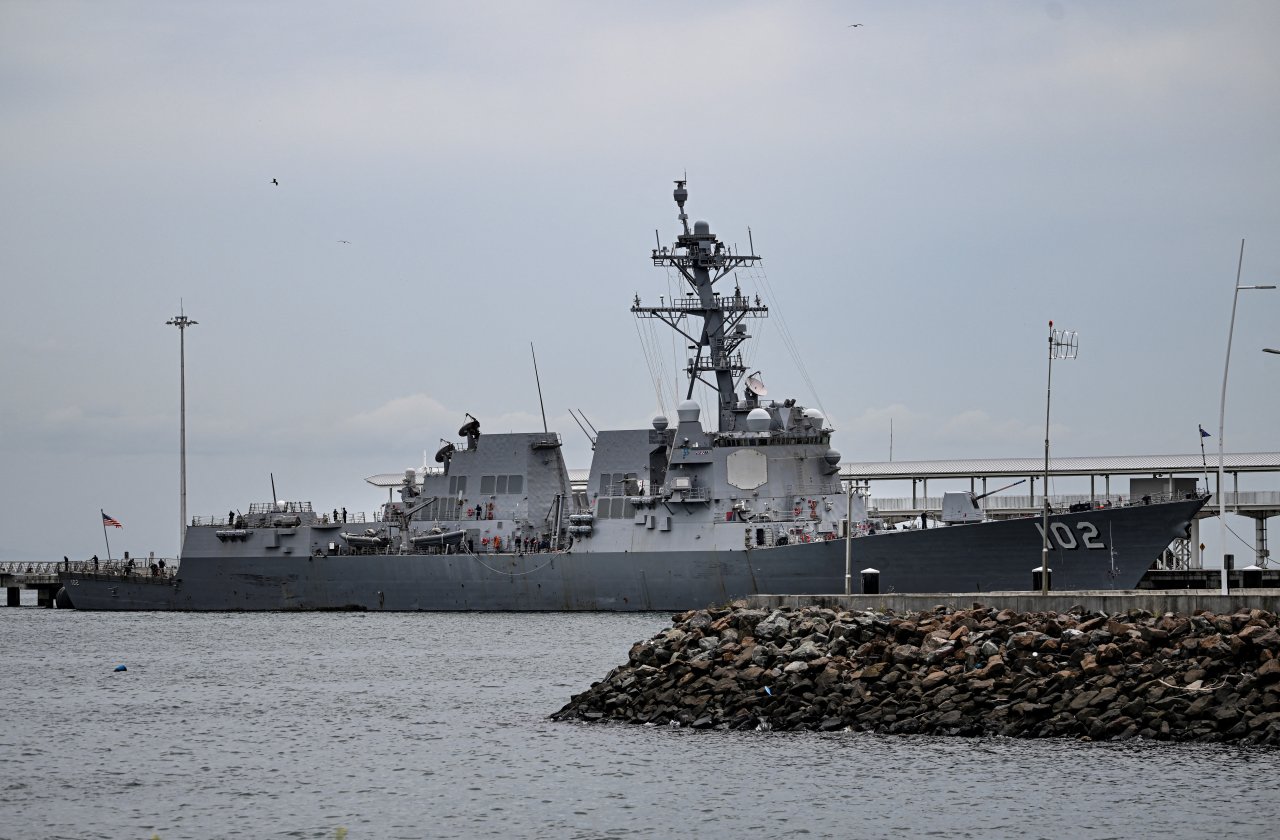
The Pentagon also dispatched B-52 bombers on Wednesday near La Orchila, according to flight tracking data, a Venezuelan island where Maduro’s forces carried out drills last month featuring jets, warships and amphibious vehicles. The aircraft carry heavy payloads but also do surveillance.
So far, the U.S. has carried out at least five strikes on alleged drug boats, killing 27 in an unusual display of American force against narcotics trafficking. The bombings are controversial. Some American lawmakers say the killings are tantamount to extrajudicial executions. The Trump administration says the alleged drug traffickers are terrorists who pose an imminent threat.
The four-star U.S. Navy admiral overseeing the buildup of military assets in the Caribbean is stepping down early.
In response to the American military action, Maduro has surrounded himself with military men and sounded a call to arms.
Flanked at one recent event by the uniformed high brass of Venezuela’s armed forces, Maduro ordered them to expand efforts to recruit members of the country’s indigenous communities to buttress the civilian militias he says would try to stop an American landing.
“Raise your hands if you want to be a slave to the gringos,” Maduro said. “If you want peace, get ready to earn peace.”
The government also counts on Colombian armed groups that have long been permitted to operate in Venezuela, including the battle-hardened ELN, which can be used to head off potential street protests in opposition to the regime and hold down key areas in the interior, said Alberto Romero, a former high-ranking Colombian intelligence officer.
Footage of Maduro’s top lieutenants—among them Diosdado Cabello, considered the country’s No. 2, and Defense Minister Vladimir Padrino López—shows them preparing defenses, sometimes in regions distant from Caracas.

In one, Cabello is in camouflaged fatigues as he drives himself along a highway en route to a militia deployment in the country’s west.
“It’s important the world knows that Venezuela is a country of peace,” he says, “but we are fierce beasts when we have to defend it.”
Venezuela is hardly ready for any American action. An economy that had been showing tiny signs of life not long ago is in a free fall, predicted to contract 3% in 2026 with inflation to hit 682%, said the International Monetary Fund.
Its military is in shambles, former high-ranking army officers and other experts say. Experienced officers were forced into exile or fired to ensure that only Maduro loyalists remained. Ordinary soldiers are poorly fed, and there is little in the way of logistics to provide the provisions for deployed units, said Edward Rodriguez, a former colonel now exiled in the U.S.
“They have been systematically worn down,” Rodriguez said. “There is no way to maintain the army or the national guard, the ones who are out in the streets, who are on the beaches. There’s no way to get water for them, or food for them.”
Rodriguez said he thinks the government is simply trying to put up “a smoke screen to wait out or at least frighten American troops a little bit so they don’t come in. They know it’s a lost cause but they’re trying to buy time.”
Another former top officer now in the U.S. said the regime hasn’t been able to carry out any significant troop deployment since August. That was when soldiers were sent to the Colombian border as Maduro—in an effort to blunt Trump’s criticism—asserted his government was actively battling cocaine trafficking from the neighboring country.
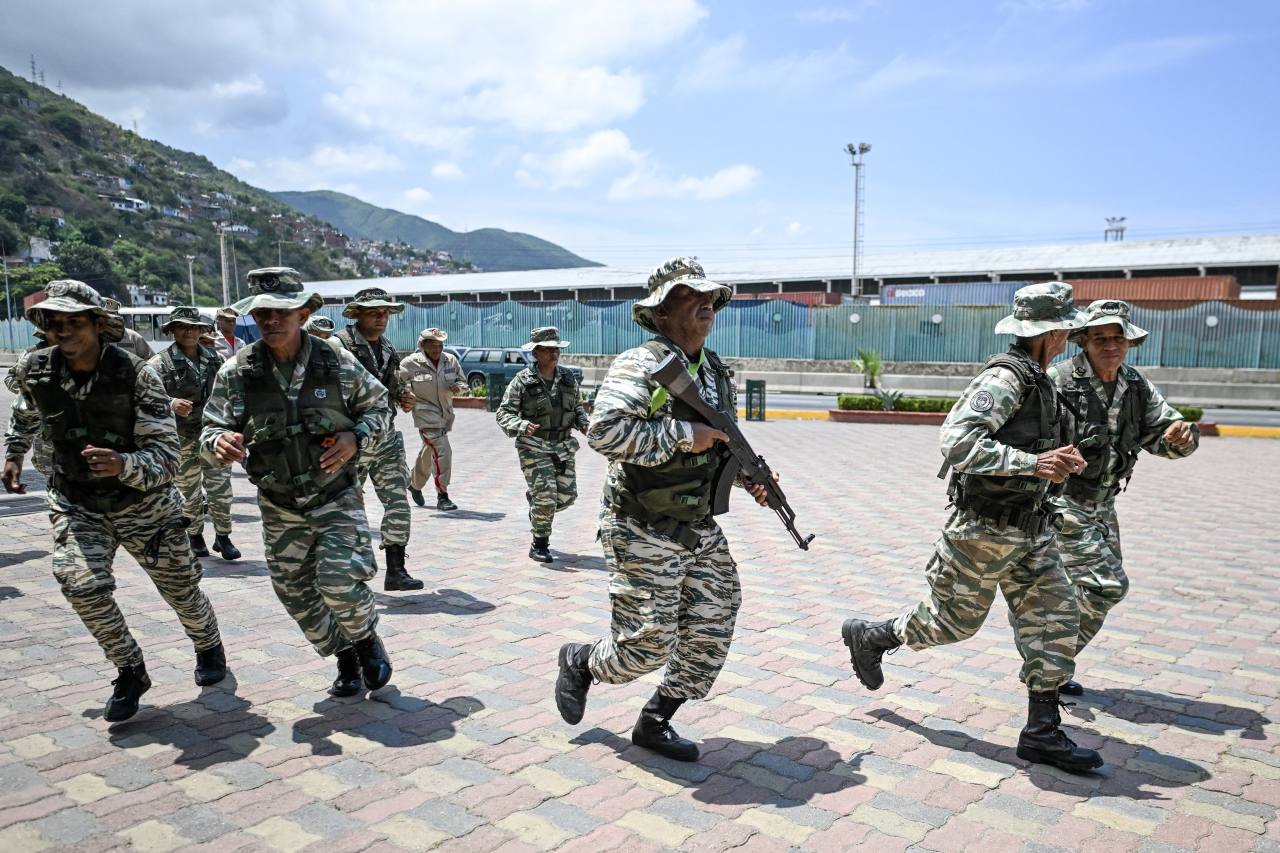
Those shown deploying in coastal areas, he said, were already stationed in garrisons nearby. Morale is poor and training is deficient, the officer said. “Since Maduro came to power, the military have been trained to repress protests inside the country, rather than defend Venezuela in a conventional conflict,” he said.
Some Venezuelans say they are determined to slow the U.S. military should it dare attack.
“We are clear about the threat and that we could give our lives for the fatherland, to defend all of the country because thanks to Nicolás we have social benefits we can’t lose,” said Blanca Soto, 55 years old, a community leader in a working-class district of Caracas. “We can’t go backward, even if we have to endure hardships.”
At the same time, Maduro is trying to portray business as usual in the country while, in some moments, trying to appeal directly to Trump. “No war, just peace, please, please, please,” he said this week in English.
The Venezuelan leader has been boasting of upgrades at oncology and pediatric health clinics his government helped pay for. The Foreign Ministry has turned its attention to Africa, to open up embassies in Burkina Faso and Zimbabwe. And through it all, the regime is still taking flights of deportees from the U.S., reaching 14,947 received from February through Wednesday, Maduro said in a speech.
Cabello took time out from detailing the country’s defenses to poke fun at Trump’s statements this week confirming he had approved Central Intelligence Agency operations in Venezuela.
“We have to say thanks to the U.S. for formally telling us that the CIA is going to start operations,” he said on his TV show. “Wow, first time.”
On the streets of Venezuela, meanwhile, some hope that the American threats and show of military force just might lead Maduro to abdicate or for others in his inner circle to unseat him from power.
“I have been watching this situation with the USA for two months and nothing has happened,” said Milagros Campos, 46. “I would like the economy to get better and think it’s important for a change in government for that to happen.”
Write to Juan Forero at juan.forero@wsj.com, Kejal Vyas at kejal.vyas@wsj.com, José de Córdoba at jose.decordoba@wsj.com and Lara Seligman at lara.seligman@wsj.com


