For years, America’s job market has rewarded the footloose. The surest route to a higher salary, the usual advice goes, is to string together a series of one- or two-year stints, each paying a bit better than the last. Career gurus on TikTok set videos of their own salary progression to jaunty pop beats, cloaking online bragging as guidance for the uninitiated. On Reddit, posters debate just how little time in a role a job-hopper can get away with before future employers might start to fret about disloyalty. (A year or so is the consensus, though a brave few argue for six months.)
For the first time in 15 years, barring blips in 2012 and 2018, wage growth for “job-stayers”, those who have stuck with their employer, is running faster than for “job-switchers”, those who jumped ship
Now things are changing. For the first time in 15 years, barring blips in 2012 and 2018, wage growth for “job-stayers”, those who have stuck with their employer, is running faster than for “job-switchers”, those who jumped ship, according to data from the Federal Reserve Bank of Atlanta (see chart 1). Thus, for America’s office drones, hunkering down and impressing the boss may well be a better bet than polishing their CV or at last responding to those LinkedIn messages from head-hunters.
The woes of job-hoppers are a particularly visible sign of a wider trend: the softening of America’s once rock-solid labour market. Another sign is the rising unemployment rate for fresh university graduates, who are struggling to persuade anyone to take a punt on them.
There have been plenty of weak patches in the jobs market over the past few years. Some firms, like the big consultancies, vastly over-hired during the post-pandemic boom, and have since spent years painfully paring back. Coders have complained about poor prospects for a while; first, high interest rates hurt tech-firm valuations, then new artificial-intelligence models turned out to be particularly adept at programming.
But a broad jobs slowdown is a fresh development. Even as the stimulus-fuelled excesses of the post-pandemic years cooled, America’s labour market remained impressively robust. For month after month, new payrolls data would show that hundreds of thousands of jobs were being added to the economy. Now that motor may be slowing. June’s payroll numbers looked strong on the surface—some 147,000 jobs were added across the economy, beating expectations—but half of those were in government, mostly teaching. Private-sector employment, a better measure of the underlying state of the economy, was disappointingly weak.
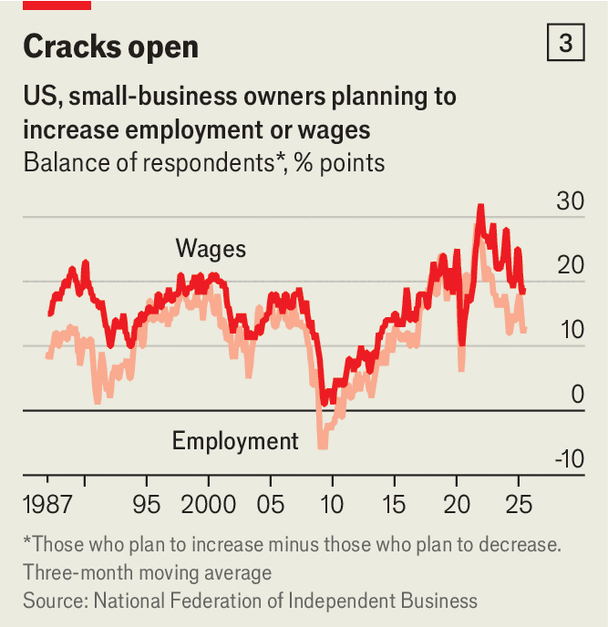
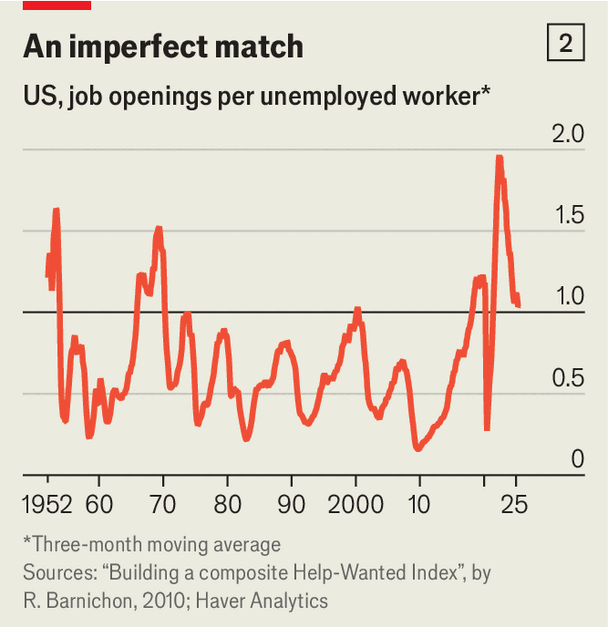
Unusually, over the past few years there have been more job openings than people on the unemployment rolls, an indication of red-hot demand for workers. However, this ratio of vacancies to unemployment, which economists watch closely as a measure of labour-market health, has recently fallen and is back to one, meaning there are about as many job openings as job-seekers (see chart 2). Surveys of bosses tell a similar story of cooling labour demand: the share of small-business owners who are planning to raise hiring or lift salaries is at its lowest since the pandemic (see chart 3).
What does all this mean for America’s would-be job-hoppers? Once labour markets start cracking, they have a habit of deteriorating further. The Federal Reserve may, in due course, come to the rescue by lowering interest rates—but only after it can be persuaded that tariffs will not set off another round of inflation. If ever there was a time to redecorate your office and invest in a comfier chair, now might be it. You could be there for a while.
For more expert analysis of the biggest stories in economics, finance and markets, sign up to Money Talks, our weekly subscriber-only newsletter.
Get the latest headlines from US news and global updates from Pakistan, Nepal, UK, Bangladesh, Russia and US Iran war Live, get all the latest headlines in one place on Hindustan Times.

 E-Paper