
 E-Paper



What Chinese, US media said on PM Modi-Xi Jinping meeting at SCO summit amid Trump tariff tensions
PM Modi and Xi Jinping's meeting, in backdrop of the US tariff tussle, was prominently featured in top media outlets in China and United States.

 Prefer HTon Google


Prime Minister Narendra Modi and Chinese President Xi Jinping struck a conciliatory note, calling India and China “partners, not rivals” at the Shanghai Cooperation Organisation (SCO) Summit in Tianjin, their first bilateral meeting since the Galwan Valley clashes in 2020.
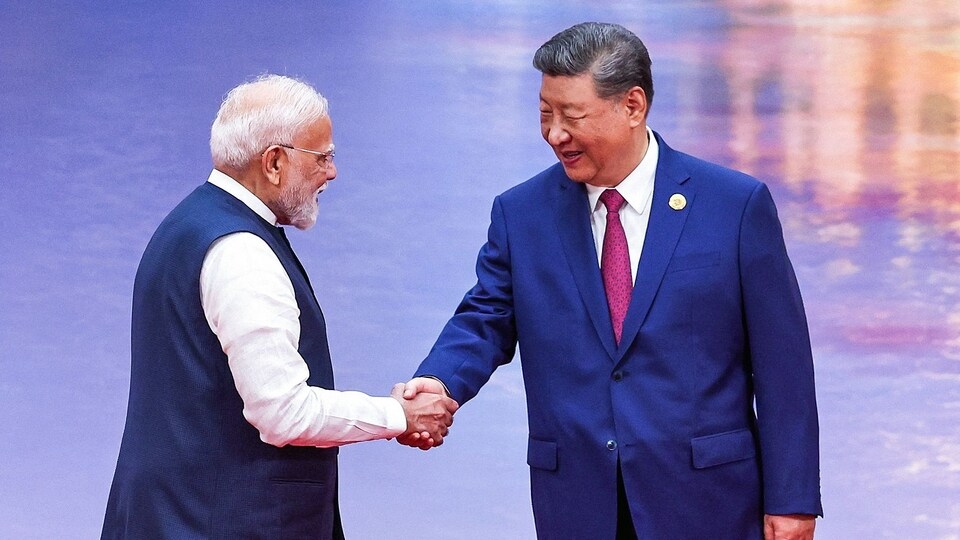
The meeting between the leaders of two Asian economic giants, held against the backdrop of the US tariff tussle that has impacted almost all leading economies across the world, including India, was prominently featured by top media organisations in China and the United States.
While Chinese state media carried the New Delhi-Beijing thaw on front pages, hailing it as “fruitful” and a sign of ties being back “on the right track”, US media outlets, however, focussed on Xi Jinping's push for a new global order, the symbolism of Modi standing alongside Xi and Russian President Vladimir Putin, and the broader message of strategic unity directed at Washington amid trade frictions with US President Donald Trump.
What Chinese media
State-run China Daily carried a front-page headline, ‘Partnership seen as key to Sino-Indian relations’. It played up the two leaders’ call to treat each other as “partners, not rivals".
Another prominent headline from China Daily carried Xi’s broader SCO message: “Staying True to SCO Founding Mission And Ushering in a Better Future”, underlining multilateral cooperation and opposition to “Cold War mentality.”
The Global Times spoke with Qian Feng, director of the research department at the National Strategy Institute at Tsinghua University. “For the long-term development of the China-India relations, three key challenges including rebuilding strategic mutual trust, properly handling the boundary question and restoring cooperation need to be addressed,” Qian Feng told the Global Times on Monday.
"On the boundary question, while the situation has been generally stable, it is necessary to push for substantive progress to reduce opportunities for external forces to sow discord," he added.
The meeting between Modi and Xi was “fruitful”, which reached new important consensus on the development of bilateral relations, Cai Qi, a member of the Standing Committee of the Political Bureau of the CPC Central Committee and a member of the Secretariat of the CPC Central Committee, said on Sunday, Xinhua reported.
What US media said
Some US media outlets also closely tracked the Xi-Modi meeting, though the tone was less celebratory. CNN, with the headline - “Xi and Modi talk friendship in a ‘chaotic’ world as Trump’s tariffs bite”, reported that “the positive signals are sure to be closely watched in Washington, where tensions with New Delhi threaten to derail what had been years of efforts from US diplomats to deepen ties with the country as a key counterweight to a rising and increasingly assertive China - a set of circumstances that makes the latest meeting all the more important and timely”.
CNN also stressed Xi’s portrayal of China as a “stabiliser” in global politics, contrasting with what it described as America’s “bullying” approach.
The Time also carried a report headlining “China’s Xi Hosts Modi and Putin for Summit Amid Anger Over Trump’s Tariffs”. It said, “Modi's move toward China might be seen as a strategic blow to the US, but the summit is likely aimed at boosting China's position as a global leader and countering Western influence in global affairs.”
The Washington Post focused on US domestic turbulence, with the headline “China tries to use Trump turmoil to unite leaders against U.S.-led order”. The report highlighted that Xi was capitalising on Washington’s unpredictability, positioning the SCO as a stabilising bloc and inviting India to align more closely with Beijing and Moscow.
The Wall Street Journal was more direct, calling the trilateral optics a signal to Washington: “Chinese, Russian, Indian Leaders Pledge Cooperation, in a Message to Trump”.
News agency Associated Press headlined “SCO summit could challenge US dominance and lend weight to China's vision of a multipolar world”. It said since the Russia-Ukraine war began, India has become a major buyer of Russian oil, increasing tensions with Washington. Modi also remarked on “steady progress” in improving relations with China after meeting its top diplomat in August and noted “respect for each other’s interests and sensitiveness".
India's SCO entry potentially challenges Russian and Chinese domination over the association. Despite their trade ties, India is unlikely to offer meaningful support for Russia's war in Ukraine or China's claims to Taiwan and the South China Sea, the AP report said.
Other US outlets connected the Modi-Xi engagement with President Trump’s tariff war. The New York Times pointed to Modi’s rare China visit as evidence of “fraying patience” with Washington, while The Economist labelled Trump’s trade stance “a pointless rupture that will change India — and the world”.
PM Modi, Xi Jinping meeting at SCO summit
On Sunday, Xi met with Modi and the two leaders vowed to resolve differences surrounding a border dispute, which led to a freeze in relations in 2020.
On Monday, Xi announced that China plans to accelerate the creation of a development bank and set up an international platform for energy cooperation. The Chinese President announced this at a summit that represents an emerging challenge to US global leadership, with Russia and India participating.
The security forum was originally seen as a foil to US influence in Central Asia and has grown in size and influence over the years.


