E-Paper



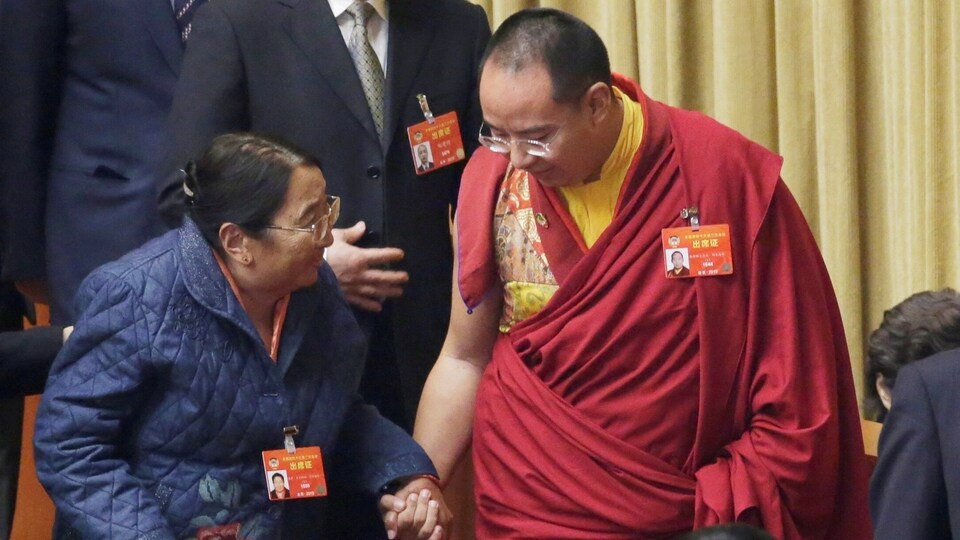
Who is Gyaltsen Norbu, China-picked Panchen Lama?
Gyaltsen Norbu, appointed by China, seeks to promote Communist control over Tibetan Buddhism, which raises alarm among Tibetan activists

 Prefer HTon Google


China said on Monday it protested to India over Prime Minister Narendra Modi's greetings to the Dalai Lama on his 90th birthday and the attendance of Indian officials at the celebrations, stressing New Delhi should fully appreciate Beijing's sensitivities on Tibet-related issues.
The position of the Chinese government on Tibet-related issues is consistent and clear, Chinese Foreign Ministry spokesperson Mao Ning told a media briefing here.
Mao was replying to a question on Prime Minister Modi's greeting the Dalai Lama on his 90th birthday and the attendance of Indian officials, including Parliamentary Affairs Minister Kiren Rijiju, at his birthday celebrations.
Last Wednesday, Tibetan spiritual leader Dalai Lama said the institution of the Dalai Lama will continue, and only the Gaden Phodrang Trust will have the authority to recognise his future reincarnation.
Mao had reiterated China's stand that the reincarnation of the Dalai Lama and the Panchen Lama — considered by many schools as the second-highest priest of Tibetan Buddhism — has to comply with rigorous religious rituals and historical conventions in line with domestic search, lots drawn from a 'golden urn', and the central government's approval.
The present 14th Dalai Lama went through this procedure and was approved by the then central government, she had said. The reincarnation of the Dalai Lama must uphold those principles and follow religious rituals and historical conventions, and Chinese law and regulations, she had said.
Appearing to be a move to replace the 14th Dalai Lama, China had appointed a young Tibetan, Gyaltsen Norbu, as the second-highest spiritual leader in Tibetan Buddhism, who pledged to make the religion more Chinese.
Who is Gyaltsen Norbu?
According to a Reuters report, Gyaltsen Norbu is a senior member of the Chinese People’s Consultative Conference, a rubberstamp political advisory body, and vice president of the state-controlled Buddhist Association of China.
Gyaltsen Norbu was chosen by China as the 11th Panchen Lama in 1995, replacing the Dalai Lama's choice, Gedhun Choekyi Nyima, a six-year-old boy who hasn't been seen in the last 30 years.
Where does Gyaltsen Norbu live?
He does not live at Tashi Lunpo monastery in Tibet’s Shigatse city, which is Panchen Lama’s traditional seat, but in Beijing.
He visits Tibet for a few months each year to meet government officials and take part in religious ceremonies, according to Chinese state media.
Gyaltsen Norbu's association with the Party
Gyaltsen Norbu's movements are heavily controlled by the Chinese government, said the Reuters report.
In a recent meeting in Zhongnanhai, the Communist Party’s leadership compound in Beijing, President Xi Jinping asked Norbu to "advance the systematic promotion of the Sinicisation of religion.”
The term refers to a years-long push to bring all organised religions in China under greater Communist Party ideological control.
At the meeting with the Chinese President, Gyaltsen Norbu vowed to “firmly support the leadership of the Chinese Communist Party.”
Tibetan officials living in exile in India, like the Dalai Lama, said it was exactly the kind of political interference that they wanted to avoid in the eventual succession of the Dalai Lama.
Gyaltsen Norbu went to Buddhist-majority Thailand in 2019, his first visit outside greater China. Local media in Nepal said last year that the government there shot down a proposal by Norbu to visit Lumbini, the birthplace of Buddha.
What do Tibetans think of Gyaltsen Norbu?
For ordinary Tibetans living abroad, Gyaltsen Norbu is just another monk from their community.
Tibetan activists living abroad and in India say, based on their conversations with friends and family in Tibet, that Norbu is not held in high esteem among ethnic Tibetans in China.