E-Paper



The big Red fall in Nepal
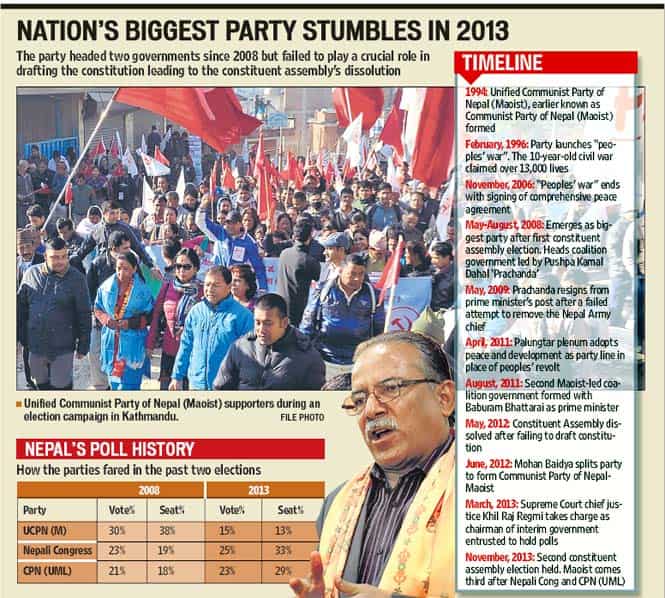
Outcome of the recently held constituent assembly poll in Nepal has dealt a big blow to Maoists, the country’s biggest party. The final seat tally isn’t out yet, but with just 15% of votes, Unified Communist Party of Nepal (Maoist) party has been reduced to around 80 seats in the 601-member constituent assembly.


Outcome of the recently held constituent assembly poll in Nepal has dealt a big blow to Maoists, the country’s biggest party.
The final seat tally isn’t out yet, but with just 15% of votes, Unified Communist Party of Nepal (Maoist) party has been reduced to around 80 seats in the 601-member constituent assembly.

Even party chairman Pushpa Kamal Dahal Prachanda suffered a humiliating loss in Kathmandu, but managed to save face by winning from Siraha.
Five years ago it surprised many by emerging as the biggest party in the constituent assembly election that was to draft a new constitution.
The victory, less than two years after they gave up arms (ending a 10 year long civil war that claimed over 13,000 lives) and joining political mainstream, was seen as an event that could usher in a New Nepal.
The party headed two governments since 2008 but failed to play a crucial role in drafting the constitution leading to the constituent assembly’s dissolution last year.
Though all major parties were responsible for failure to draft the statute, Maoists faced most of the voters’ ire.
The party came a distant third this time after Nepali Congress and Communist Party of Nepal (Unified Marxist Leninist) —both considered centrist.
With less than 30 seats separating them, Nepali Congress and CPN (UML) are close to securing two-third majority in the constituent assembly.
Both parties are close to forming a coalition government and could deliver the new constitution based on the two-third majority vote needed. But they are talking of consensus to finish the task.
Unable to digest the verdict Maoists complained of massive rigging—this after they themselves had praised the polling process — as reason for the debacle.
The party is seeking review of the entire poll process and also amendment of the interim constitution so that the new statute is drafted through consensus and not by two-third majority vote.
The demand for review has been rejected by the election commission and NC and CPN (UML) have refused to amend the interim constitution.
In order to stay relevant in changed circumstances Prachanda is also talking about consensus on government formation.
His frustration is understandable. In a speech to party cadres before polling he had urged them to use all means possible to ensure victory as defeat would spell “disaster”.
Reasons for the loss
The biggest factor for Maoist loss was the party’s vertical split last year. Unhappy with the leadership for abandoning ‘peoples’ revolution’ for ‘peace and development’, senior leader Mohan Baidya and other hardliners opted out.
The poll boycott call given by this faction, campaign against UCPN (M) candidates and support to candidates from other parties hurt Maoists most.
Disgruntled former Peoples’ Liberation Army combatants who left the party after taking government compensation also contributed to reverses.
“Much of the manipulations that take place in Nepali elections didn’t happen this time. Unlike last time Maoists didn’t have guns and there was no intimidation of voters,” said Sridhar Khatri, executive director of South Asia Centre for Policy Studies.
Voters also seem to have rejected the Maoist idea of dividing the country into federal states based on ethnicity.
The party’s “over-confidence” and message to voters that constitution won’t be drafted if UCPN (M) failed to get two-third majority, didn’t work.
“Voters wanted Maoists inside parliament in 2008 for the sake of peace. But they (voters) became disillusioned,” said Lok Raj Baral, executive chairman of Nepal Centre for Contemporary Studies.
Prachanda factor
Nepali politics is replete with instances of leaders who reach peak of popularity and power riding on public support but fail to deliver on promises once they are in government.
Prachanda, who was seen in 2008 as the one person who could usher peace and development, seems the latest to join that list.
He is still Nepal’s most powerful and influential politician, but in the past five years his image has transformed from someone who had a magic wand to one who is opportunist, power hungry and untrustworthy.
“There was lot of expectation from him. But he kept shifting his position and himself admitted that he made series of mistakes,” stated Khatri.
Prachanda’s resignation from the Prime Minister’s post over removal of Nepal Army chief, his lavish lifestyle, mishandling of the integration process of former combatants also played a part in swinging opinion.
“Voters had enough of Prachanda’s emotional and contradictory outbursts,” said Baral.
The way ahead
Despite their electoral loss Prachanda and his party still plays a major role in Nepali politics and could influence formation of the next government and also drafting of the constitution.
Since the Baidya faction that stayed away from election also wants to have its say in framing of the next constitution, there could be some hiccups in coming weeks and months.
“Prachanda will have to swallow his pride and re-evaluate his position. Both Maoist factions will also have to make compromises and come together to stay relevant,” said Khatri.
Rumours are rife that Prachanda and Baidya are looking at ways to bury differences to reunite the party.
“Instead of bickering about election outcome they should play a responsible role and ensure that the constitution gets drafted soon. If that happens they might even make a comeback in the next election,” said Baral.